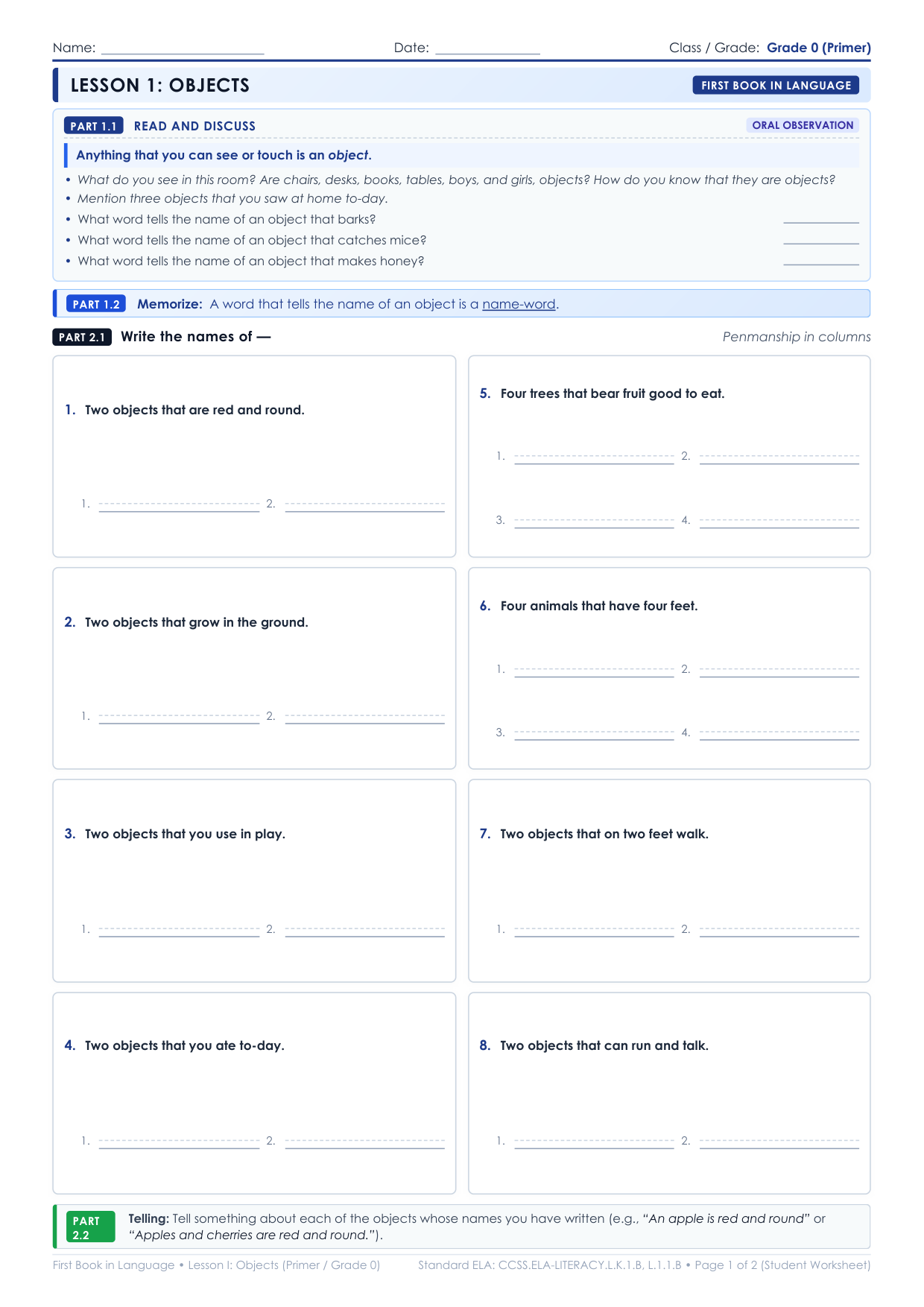
Grade 0 • Lesson 1: Objects & Name-Words
Explore the foundation of language through sensory observation: discover what an object is (anything you can see or touch), identify name-words (nouns) across 8 categories, and practice initial spoken sentences.
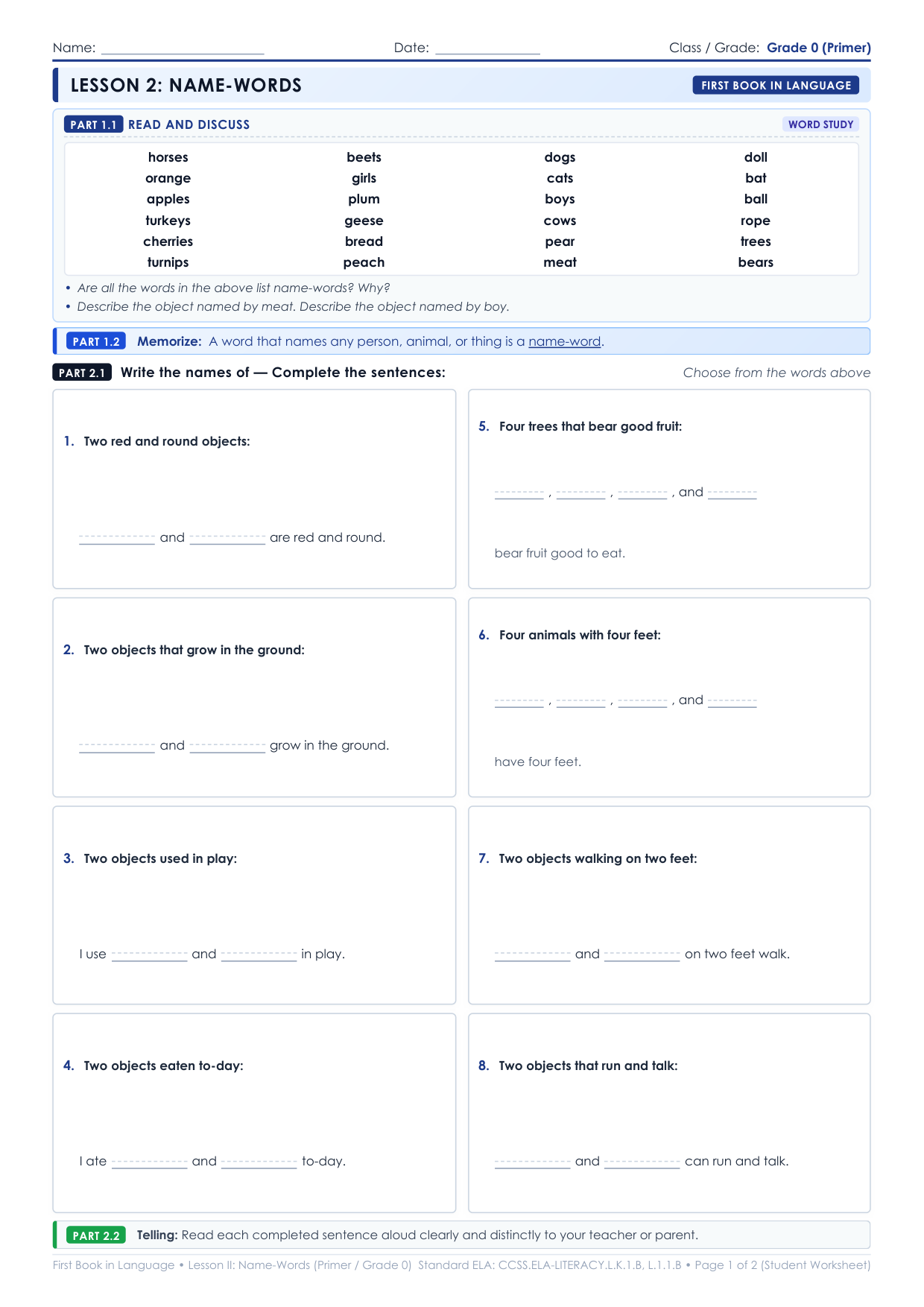
Grade 0 • Lesson 2: Name-Words
Study 24 core name-words across animals, produce, and play objects. Complete 8 living sentence frames by matching fitting words from the list, followed by clear oral reading practice.
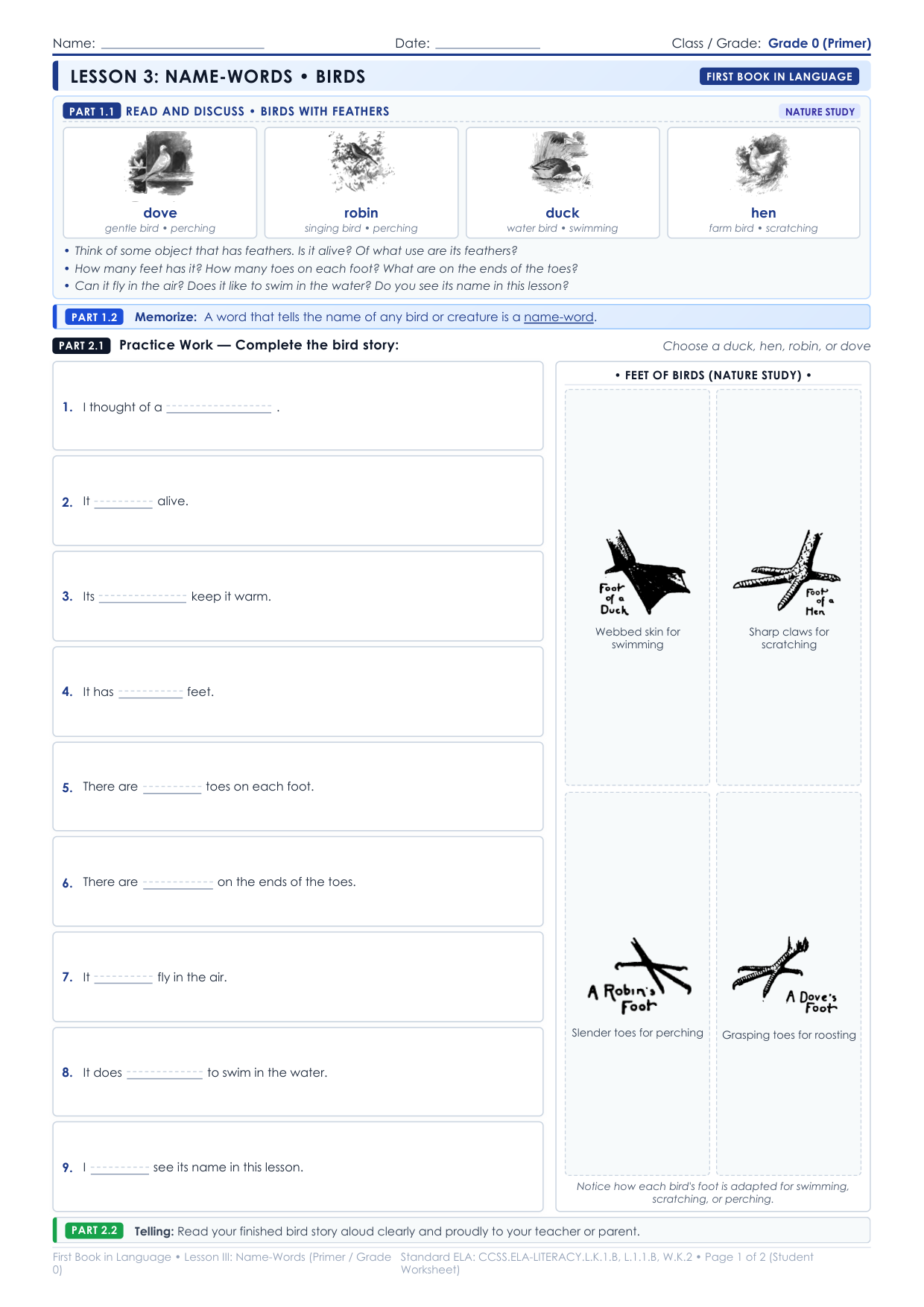
Grade 0 • Lesson 3: Name-Words • Birds
Investigate four feathered birds (dove, robin, duck, hen) and examine their feet adaptations. Complete a 9-line living nature story about your chosen bird and practice oral paragraph narration.
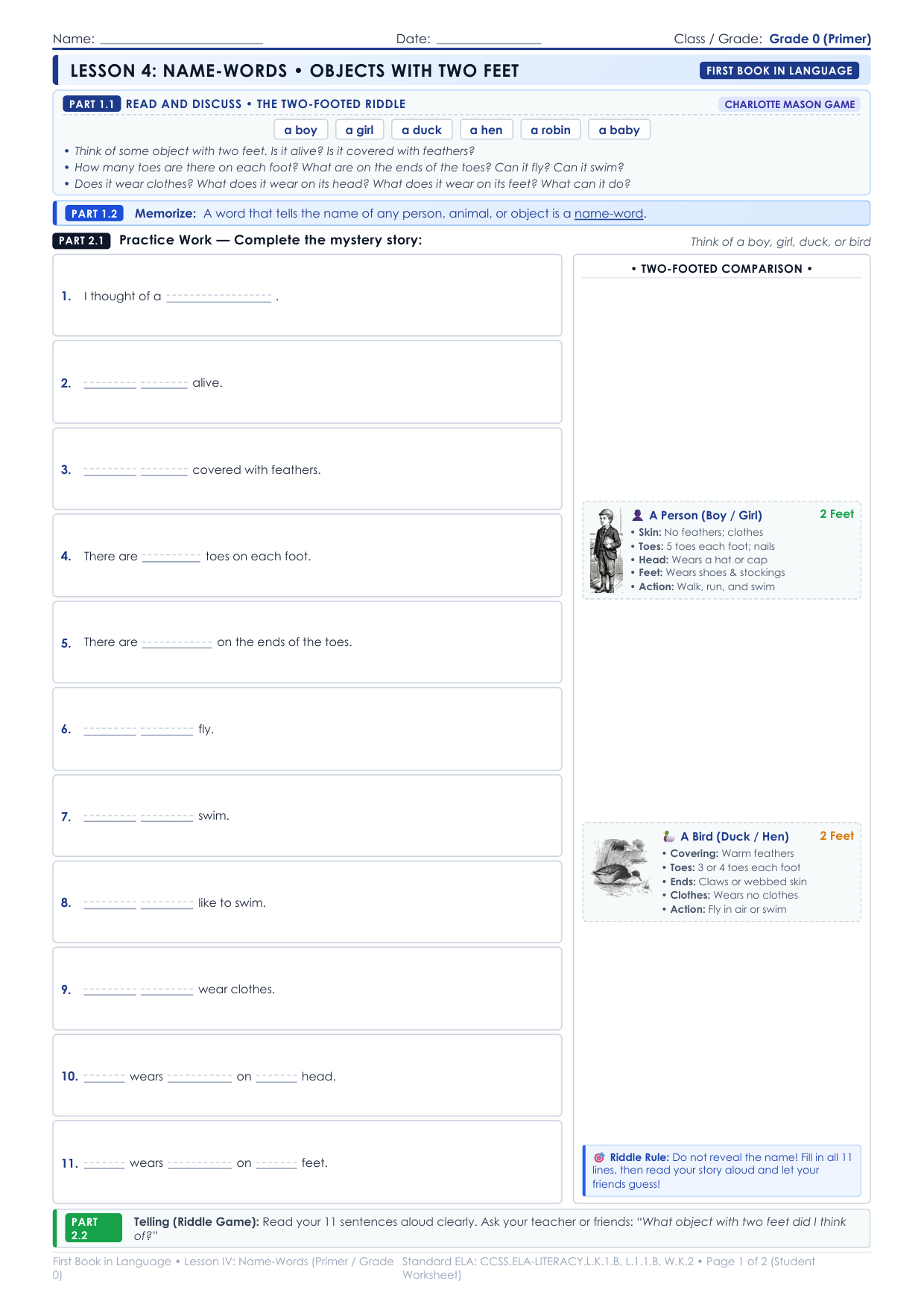
Grade 0 • Lesson 4: Objects with Two Feet
Play the classic Charlotte Mason guessing riddle: compare creatures with two feet (humans vs. birds). Complete 11 clue sentences and recite them aloud for friends to guess the mystery object.
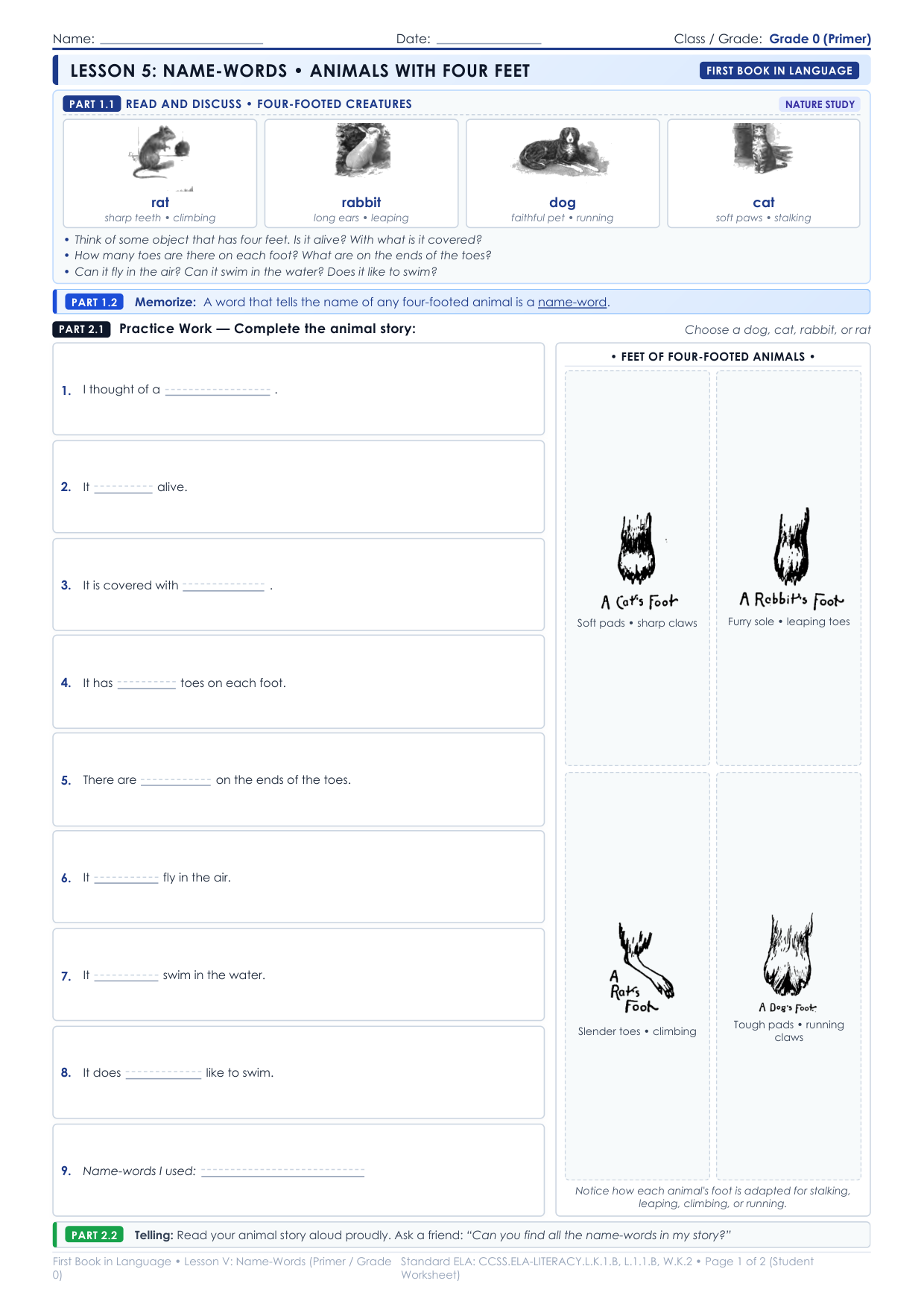
Grade 0 • Lesson 5: Animals with Four Feet
Observe four familiar four-footed animals (dog, cat, rabbit, rat), examine how their paws and claws differ, read an 8-sentence animal story, and practice writing the animal names.
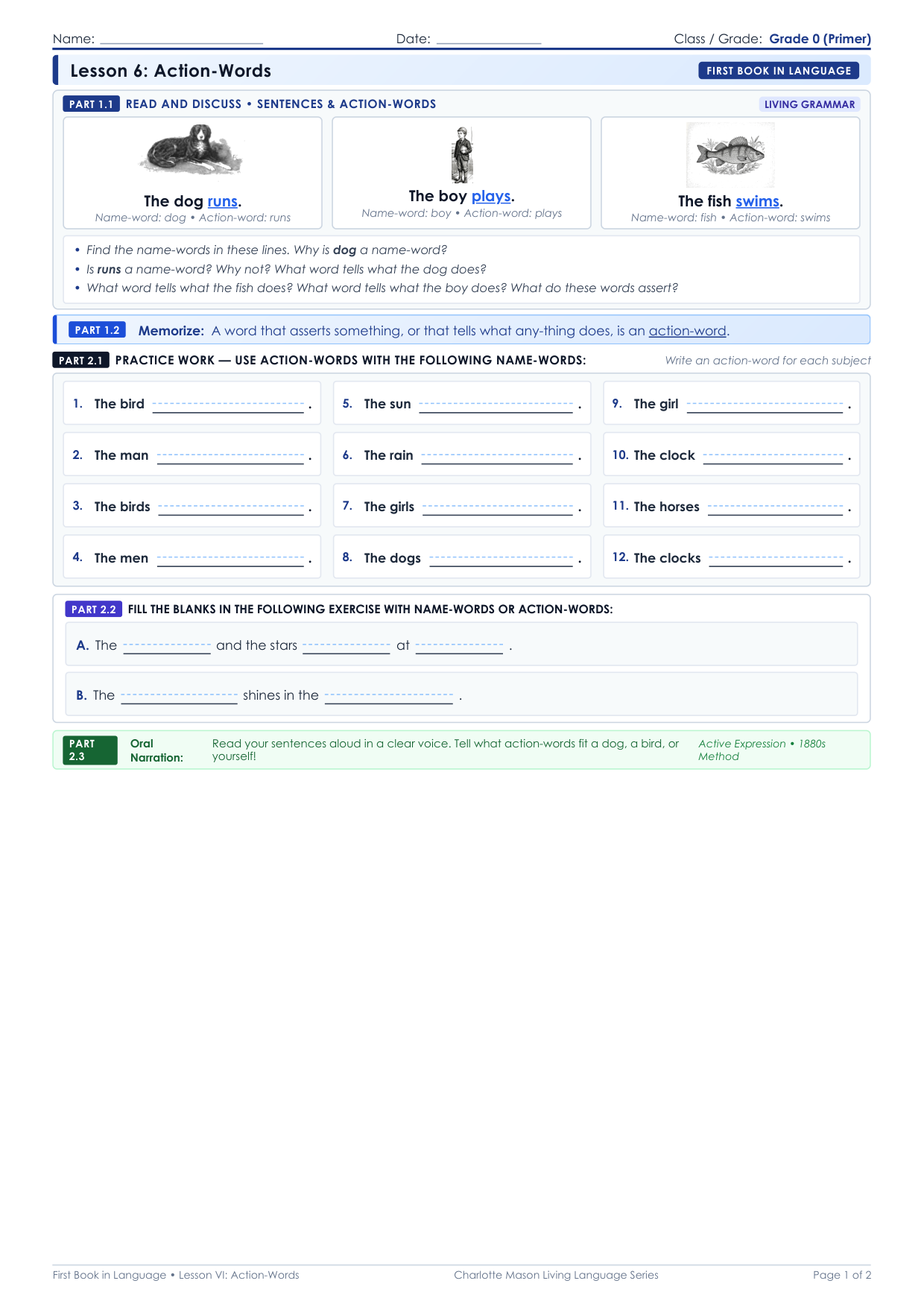
Grade 0 • Lesson 6: Action-Words
Discover what an action-word is through living models (The dog runs, The boy plays, The fish swims). Practice matching action-words with 12 singular and plural subjects, complete living sentences, and recite aloud.
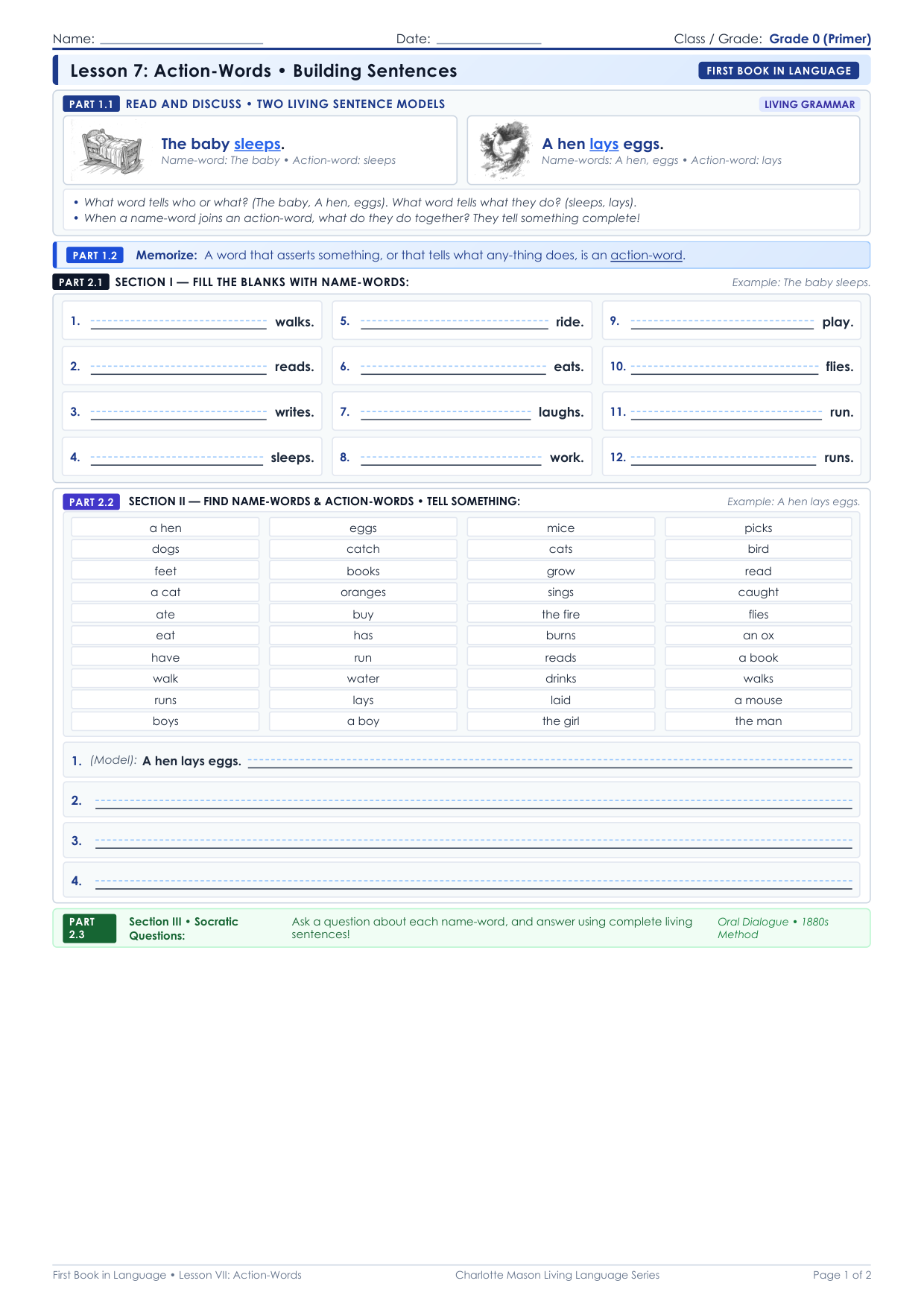
Grade 0 • Lesson 7: Action-Words • Building Sentences
Combine name-words and action-words to form complete living thoughts. Complete 12 subject-verb frames, categorize a classic 40-word matrix, and construct living sentences.
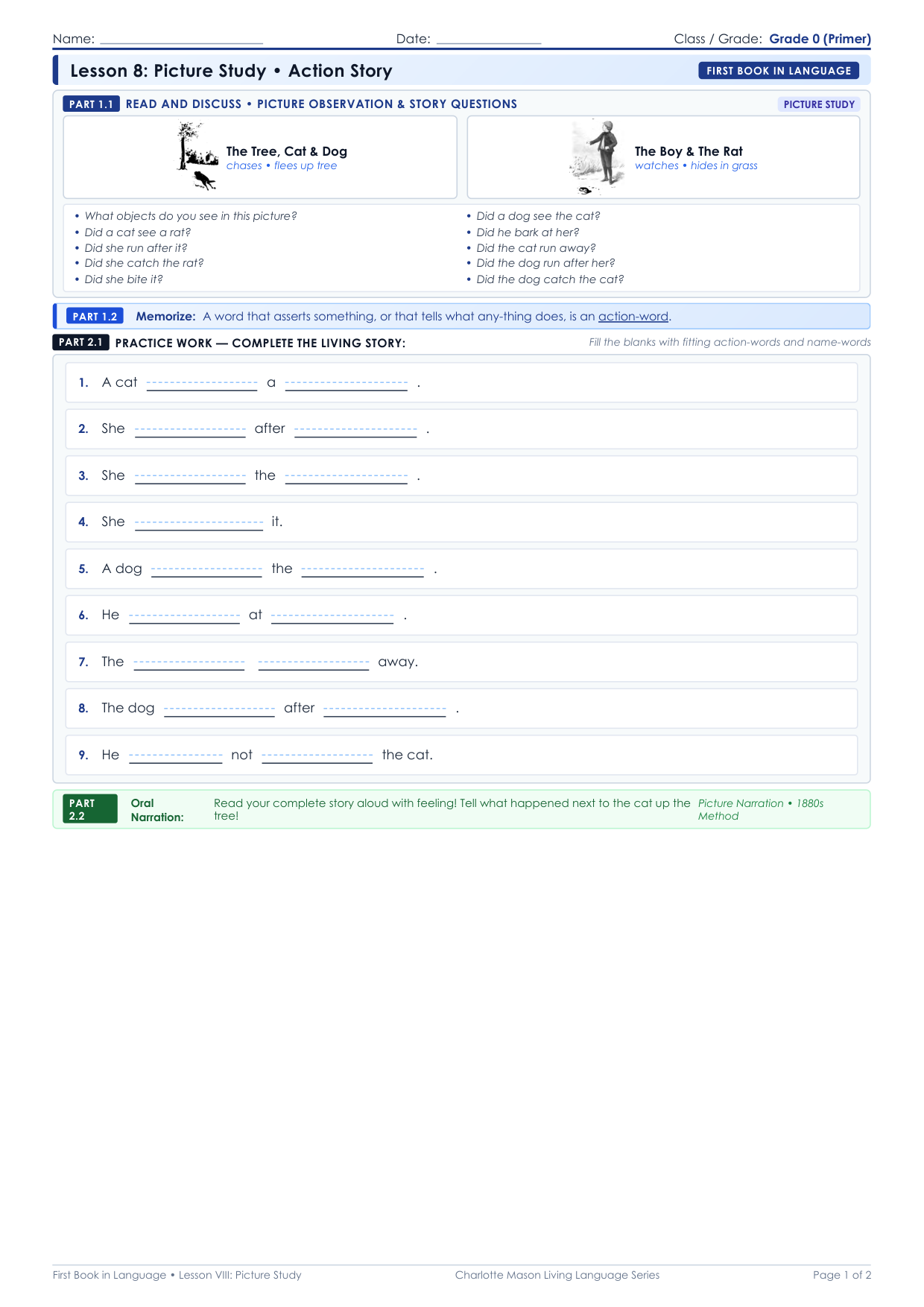
Grade 0 • Lesson 8: Picture Study • Action Story
Observe the dramatic chase in the meadow with the cat, dog, and rat. Answer 10 Socratic story questions, complete 9 narrative past-tense sentences, and recite aloud.
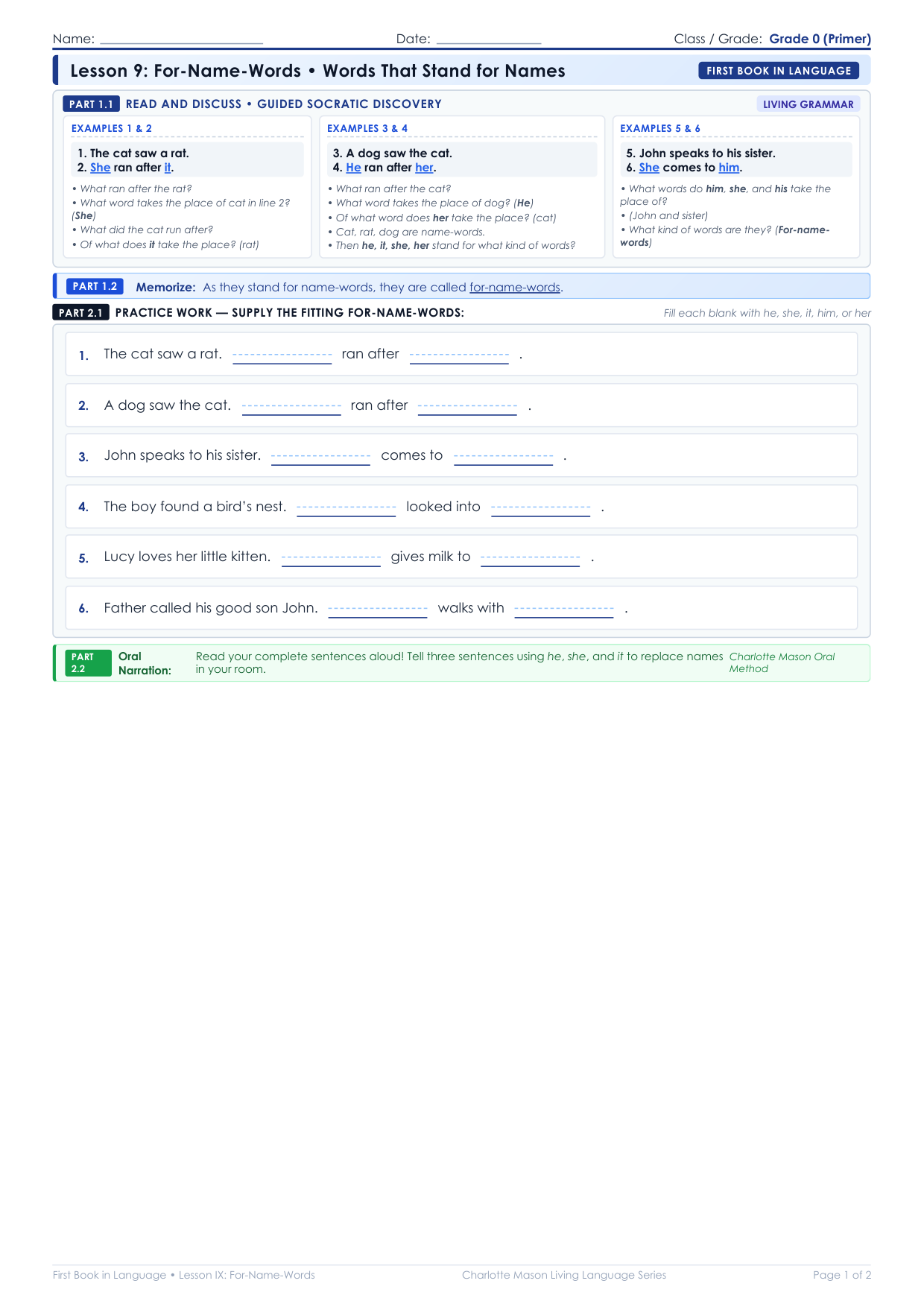
Grade 0 • Lesson 9: For-Name-Words
Discover how English avoids clumsy repetition by using words that stand for names (she, it, he, her, him). Socratic discovery dialogue, 6 practice sentences, and penmanship lines.
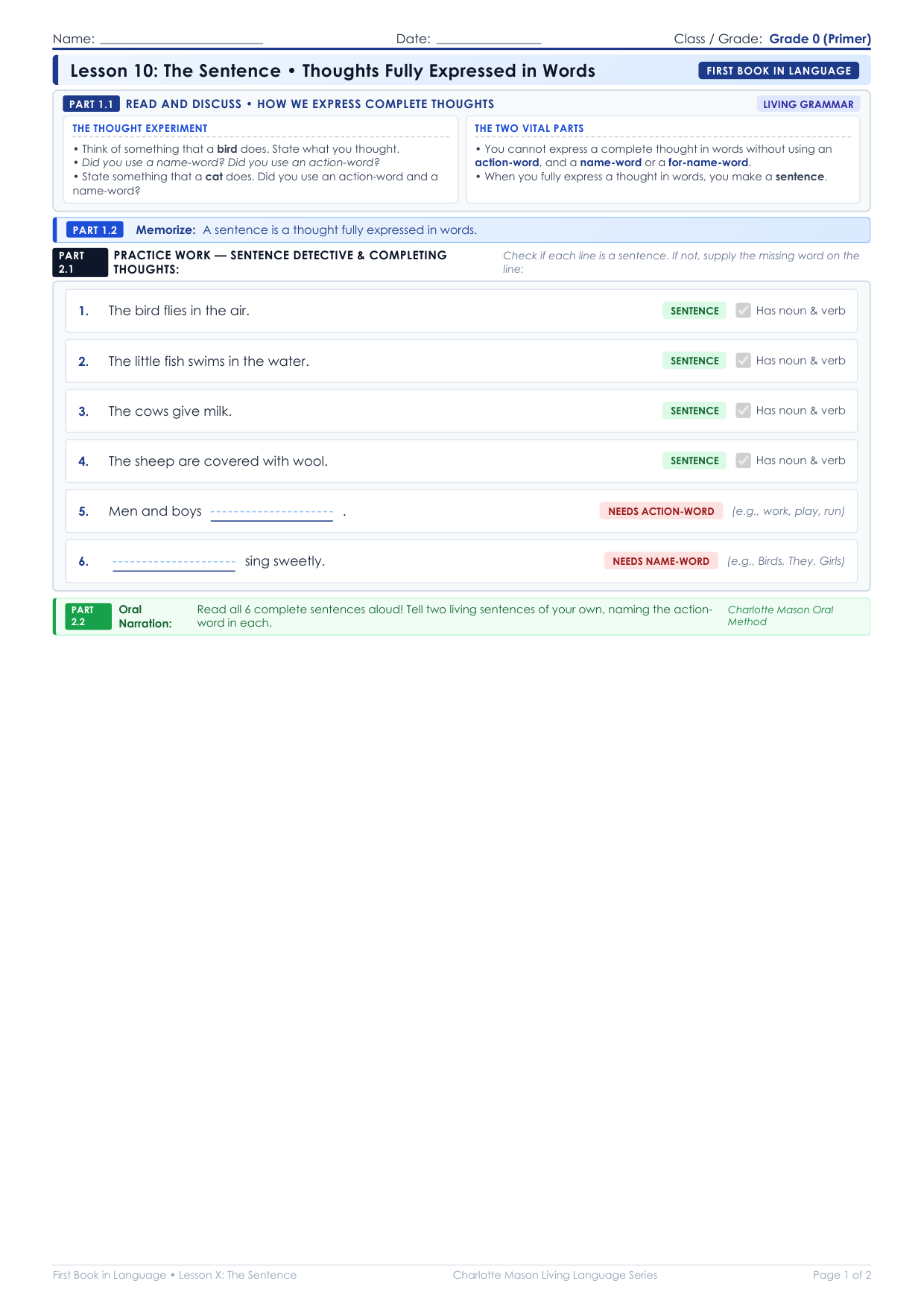
Grade 0 • Lesson 10: The Sentence
Discover the foundational law of language: a sentence is a thought fully expressed in words. Solve the Sentence Detective puzzle to distinguish complete sentences from broken fragments.
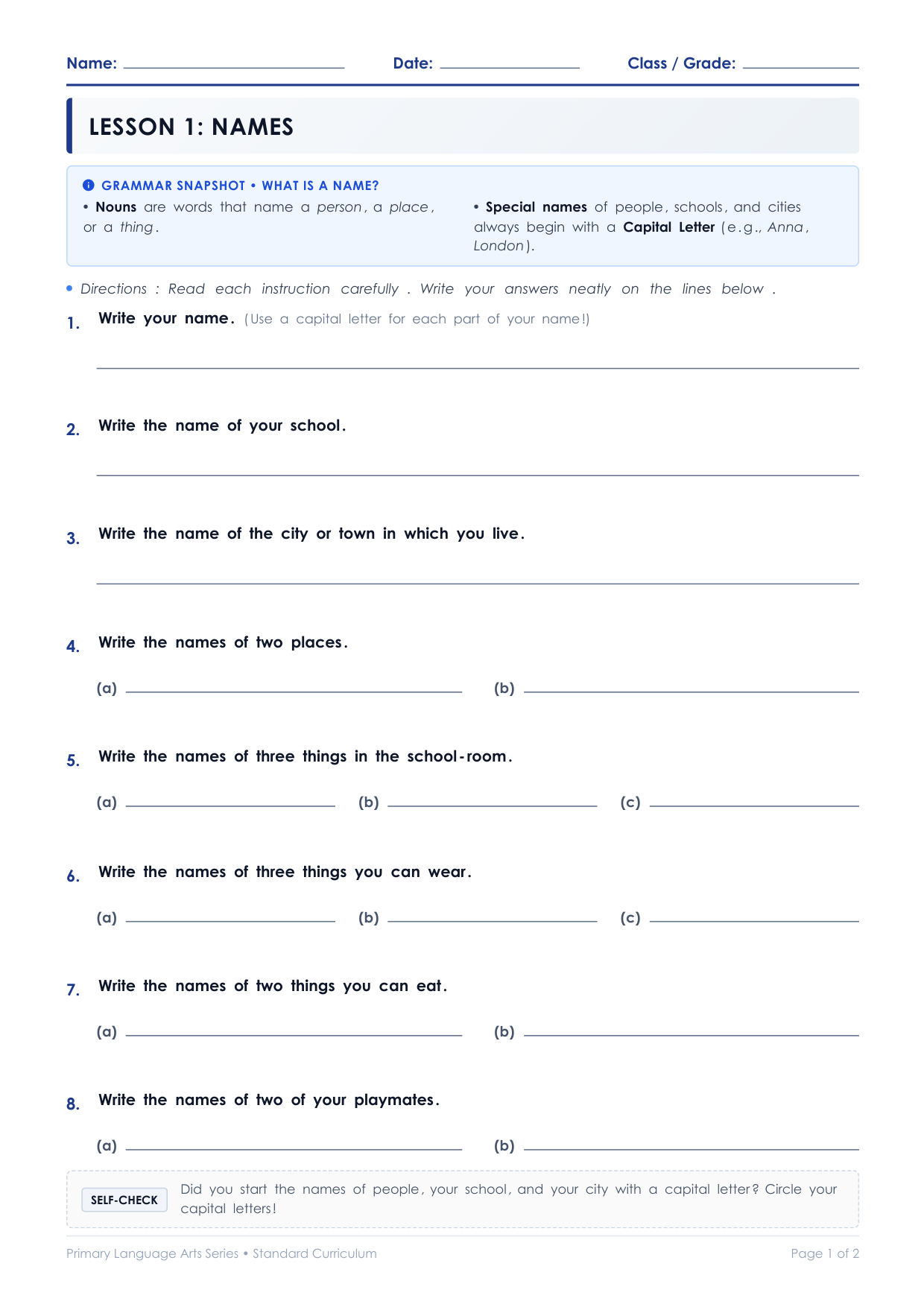
Lesson 1: Names
Introduction to naming words (nouns) for people, places, and everyday objects. Practice initial capitalization of proper names.
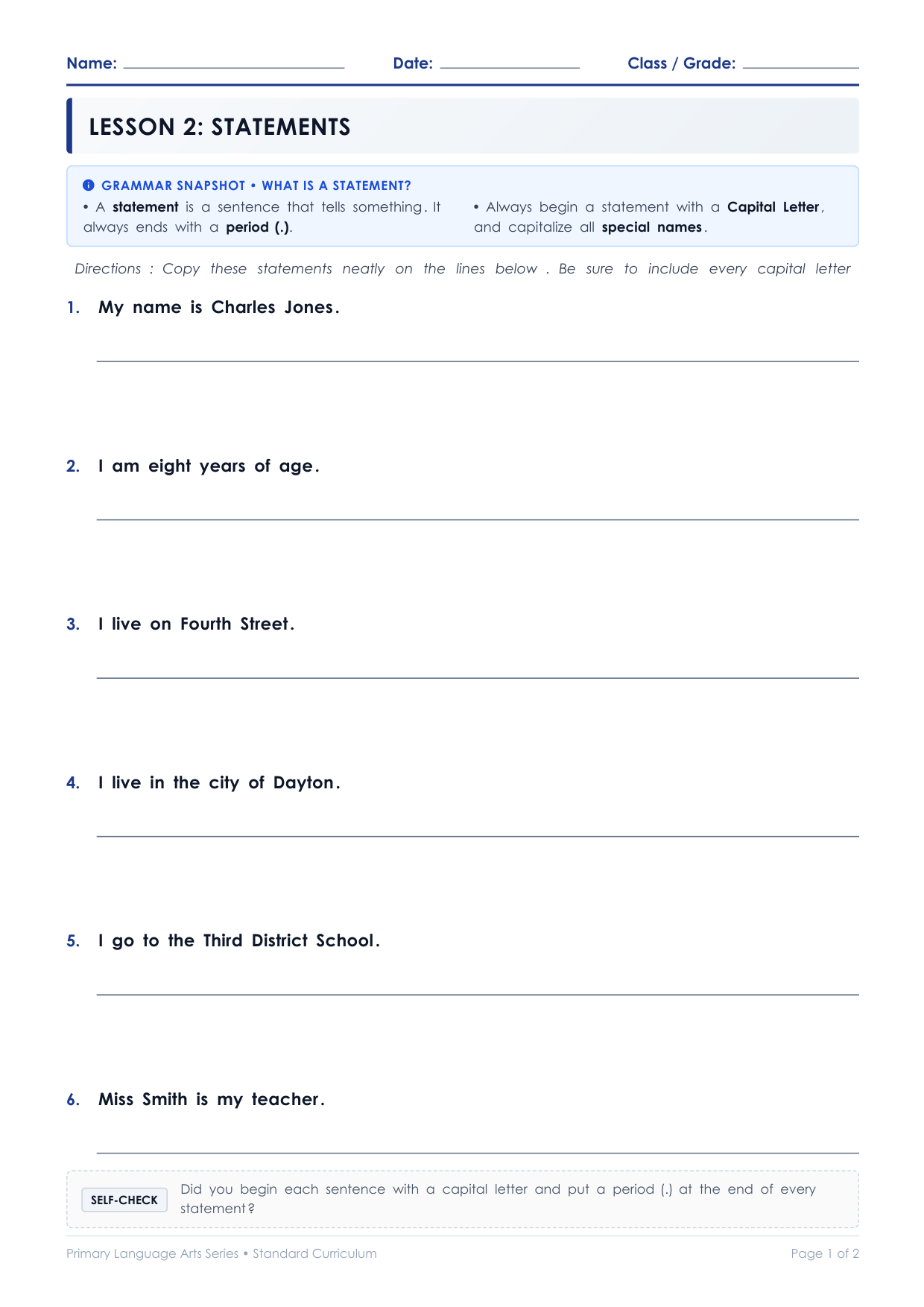
Lesson 2: Statements
Study and copy complete declarative sentences. Practice capitalizing the pronoun "I", street and school names, and terminal periods.
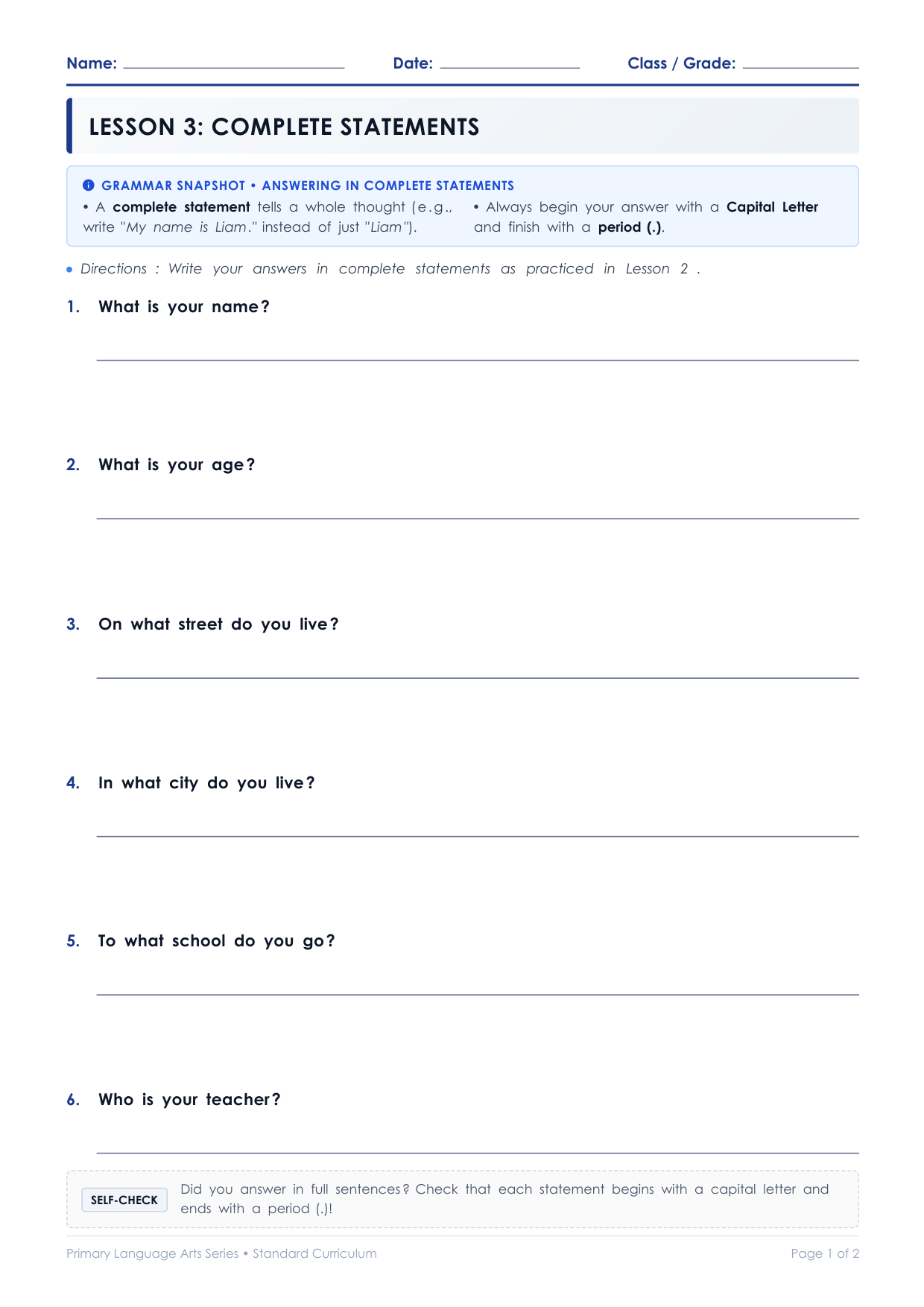
Lesson 3: Complete Statements
Transform inquiry questions into full declarative statements. Answer 6 personal identity prompts in complete, punctuated sentences.
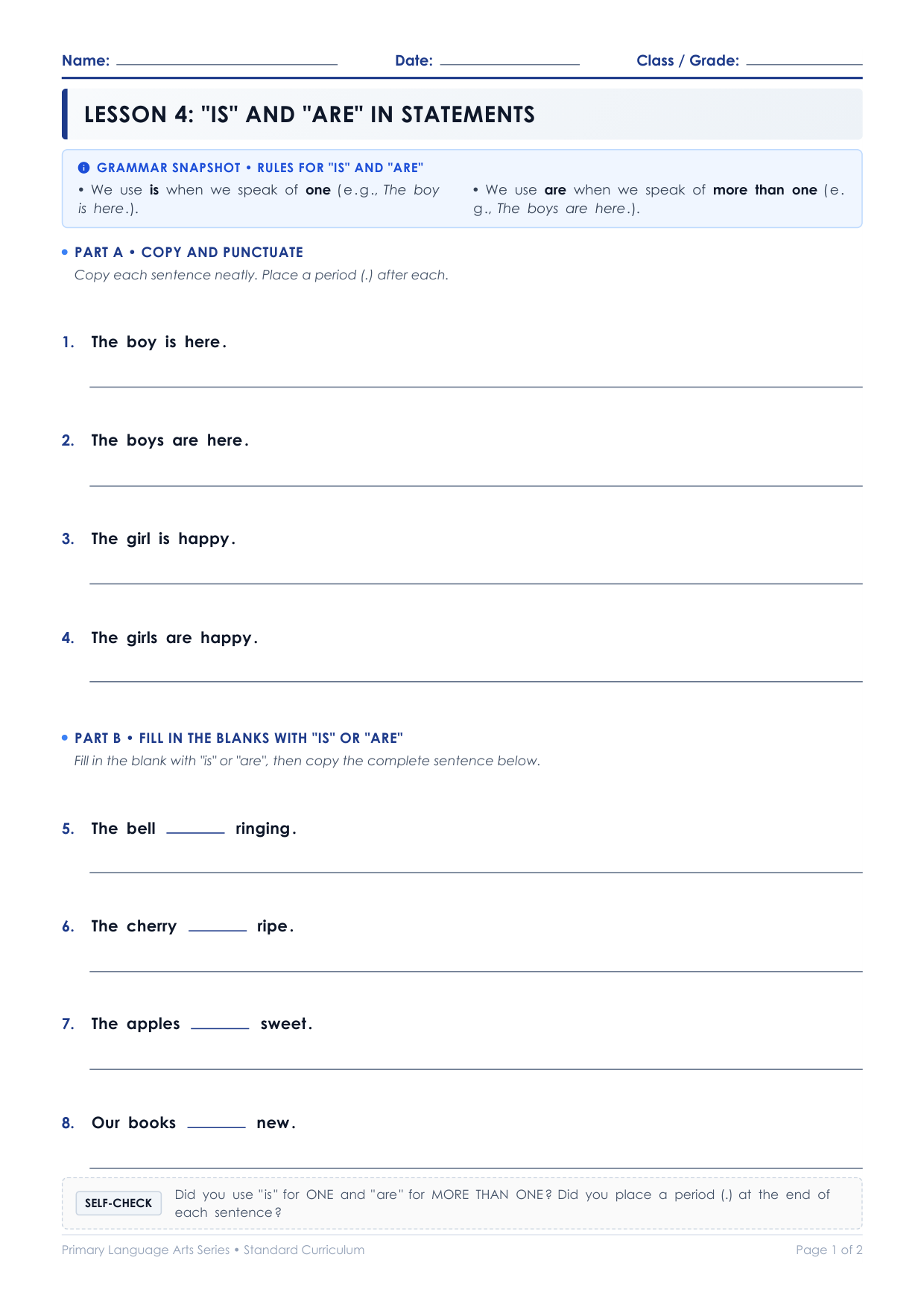
Lesson 4: "Is" & "Are"
Master subject-verb agreement with "is" (for one) and "are" (for more than one). Includes guided copying and sentence completion.
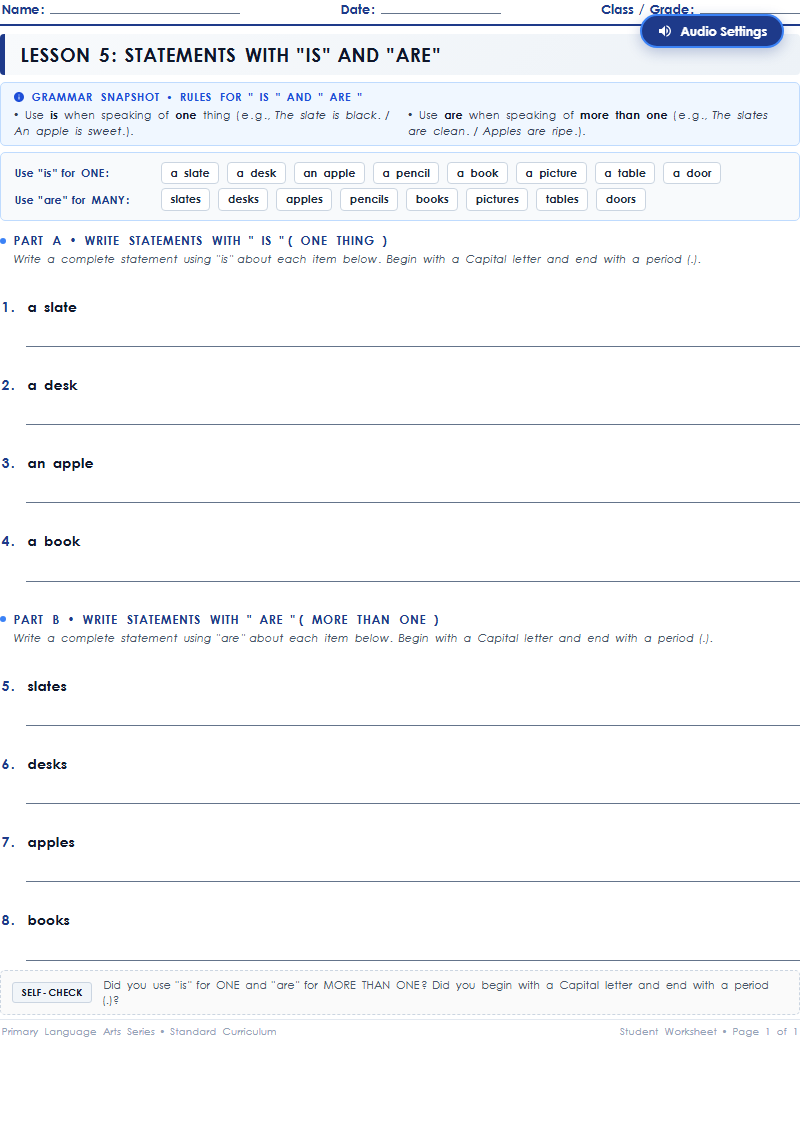
Lesson 5: "Is" & "Are"
Construct complete statements about singular and plural objects using "is" and "are". Reinforces articles (a/an) and plural nouns.
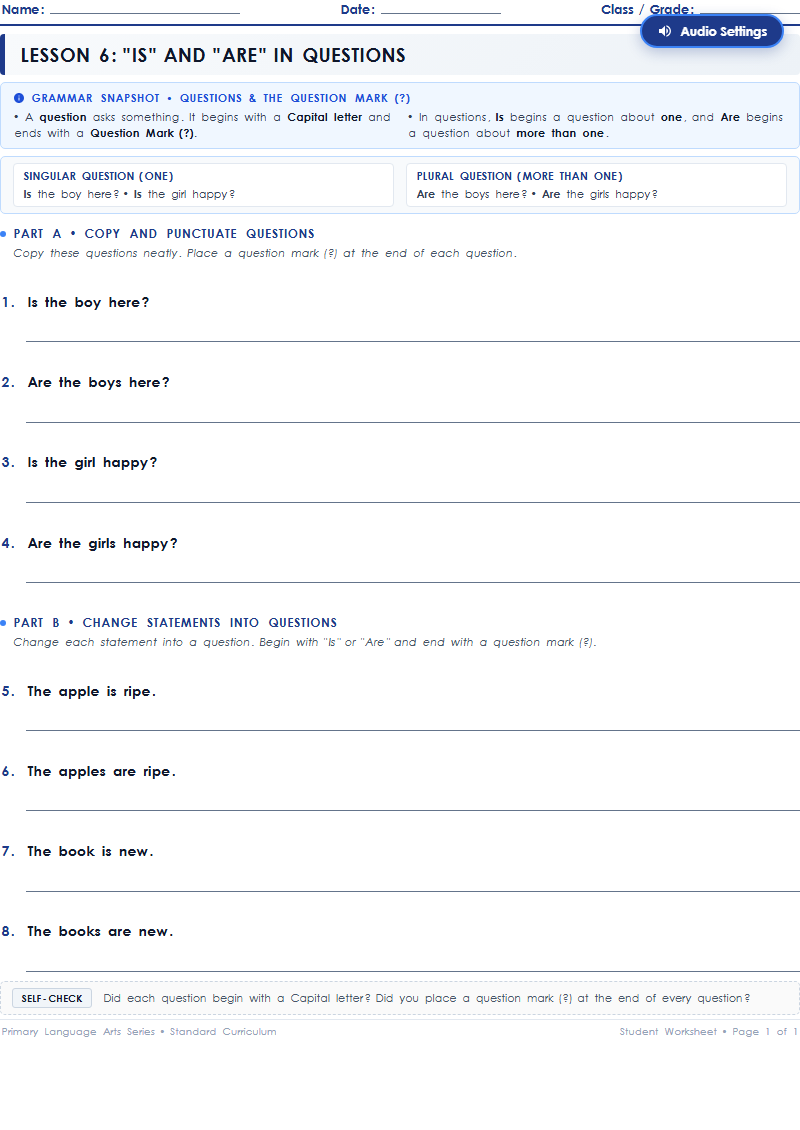
Lesson 6: Questions
Introduction to questions and the question mark (?). Practice subject-verb inversion with "Is" and "Are" and changing statements into questions.
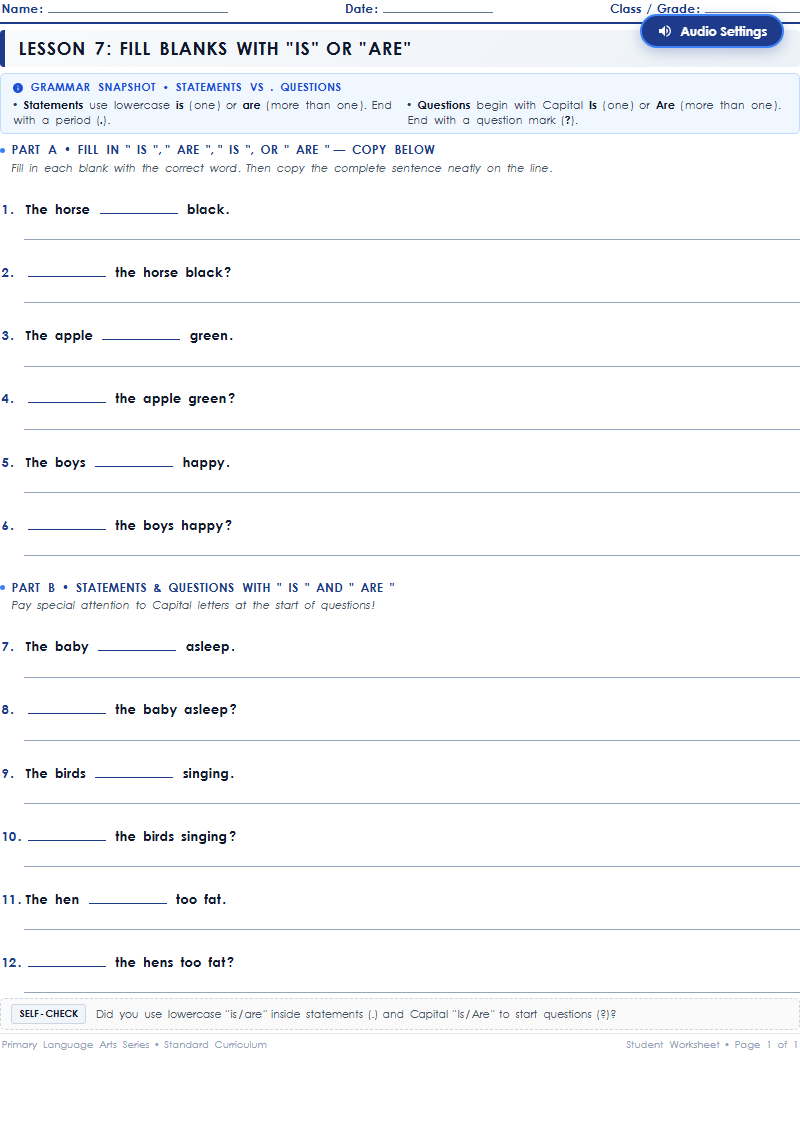
Lesson 7: "Is" or "Are"
Compare 6 pairs of statements and questions. Fill blanks with "is", "are", "Is", or "Are" and copy each complete sentence.
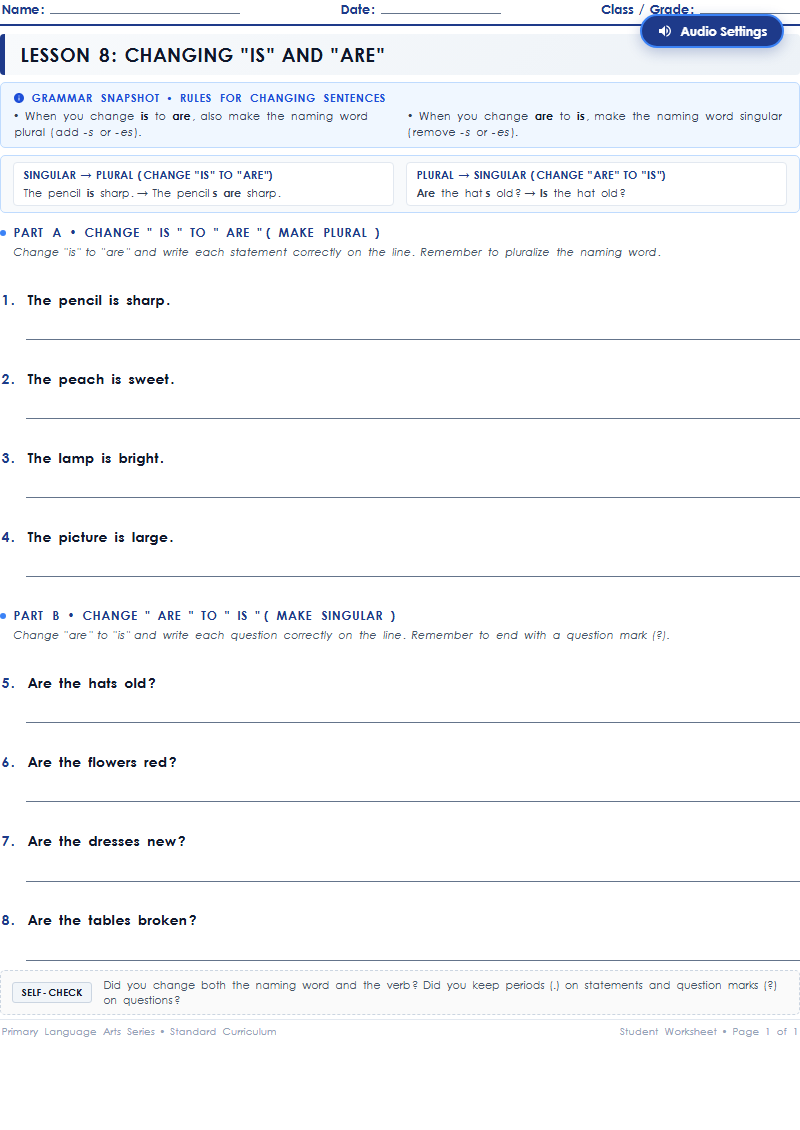
Lesson 8: Changing "Is" & "Are"
Transform statements (singular to plural) and questions (plural to singular). Practice two-way concord and "-es" spelling rules.
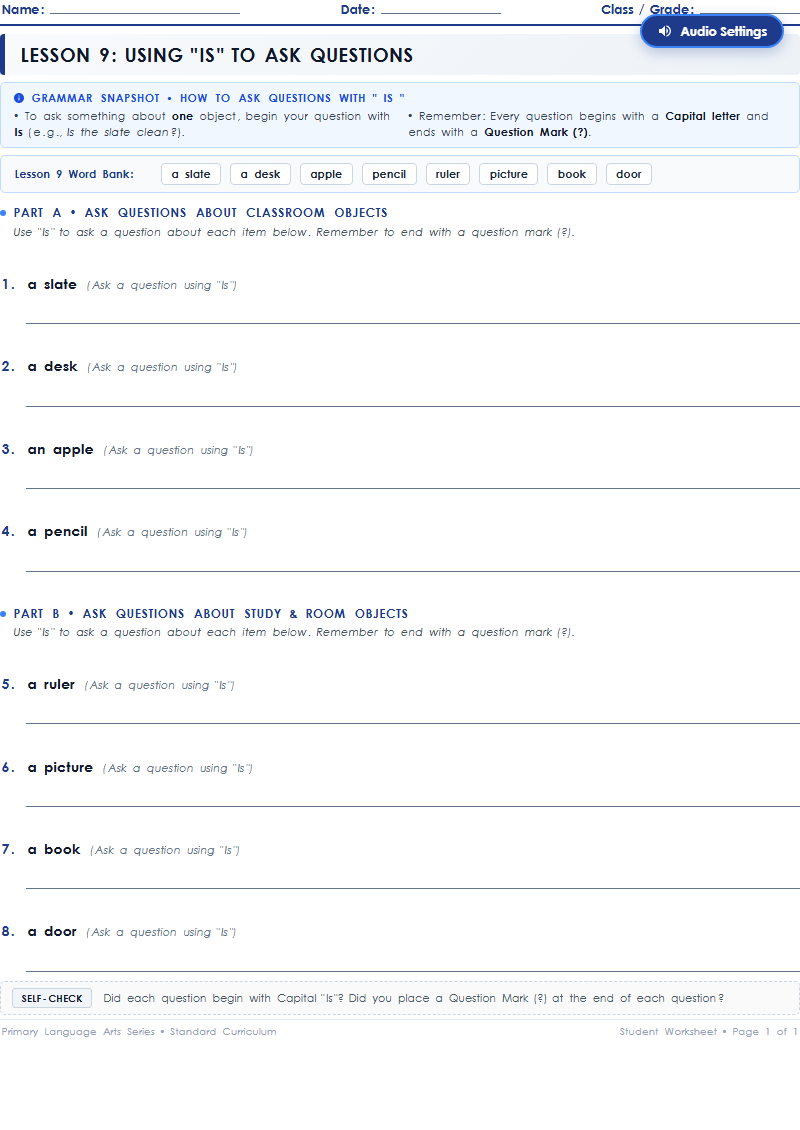
Lesson 9: Questions with "Is"
Compose original questions using "Is" about 8 singular classroom and study objects. Practice articles and question marks.

Lesson 10: Questions with "Are"
Formulate questions using "Are" about 8 plural items (slates, desks, apples, pencils, books, pictures, doors, windows).
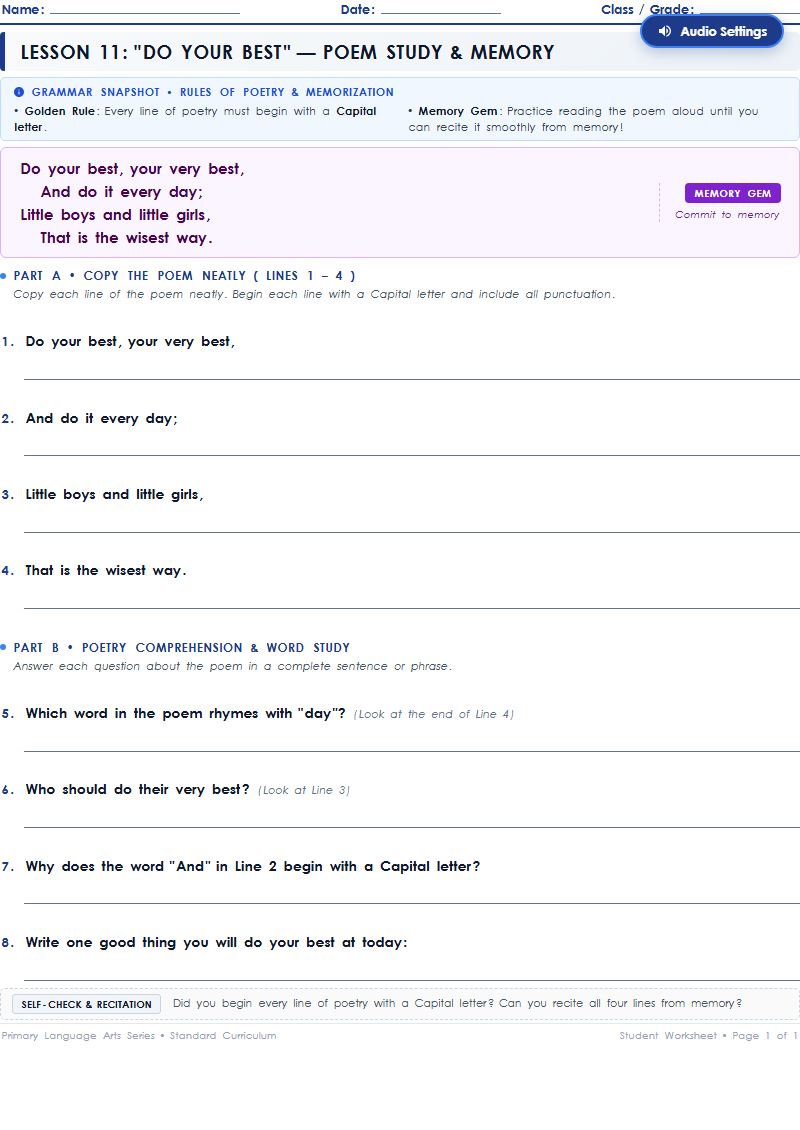
Lesson 11: "Do Your Best"
Study, copy, and memorize a classic 4-line poem. Master poetic capitalization rules, rhyme identification, and personal application.
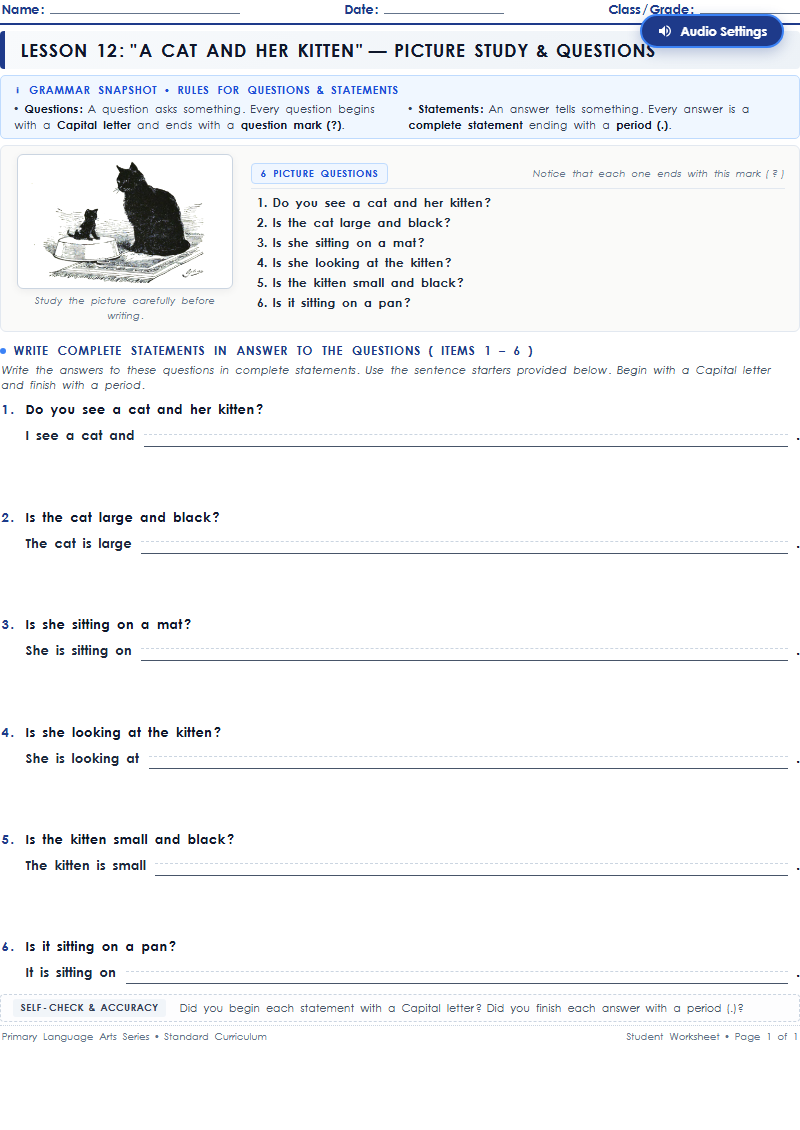
Lesson 12: Cat & Kitten
Study the vintage cat and kitten illustration. Read 6 interrogative sentences and formulate complete, punctuated declarative answers.
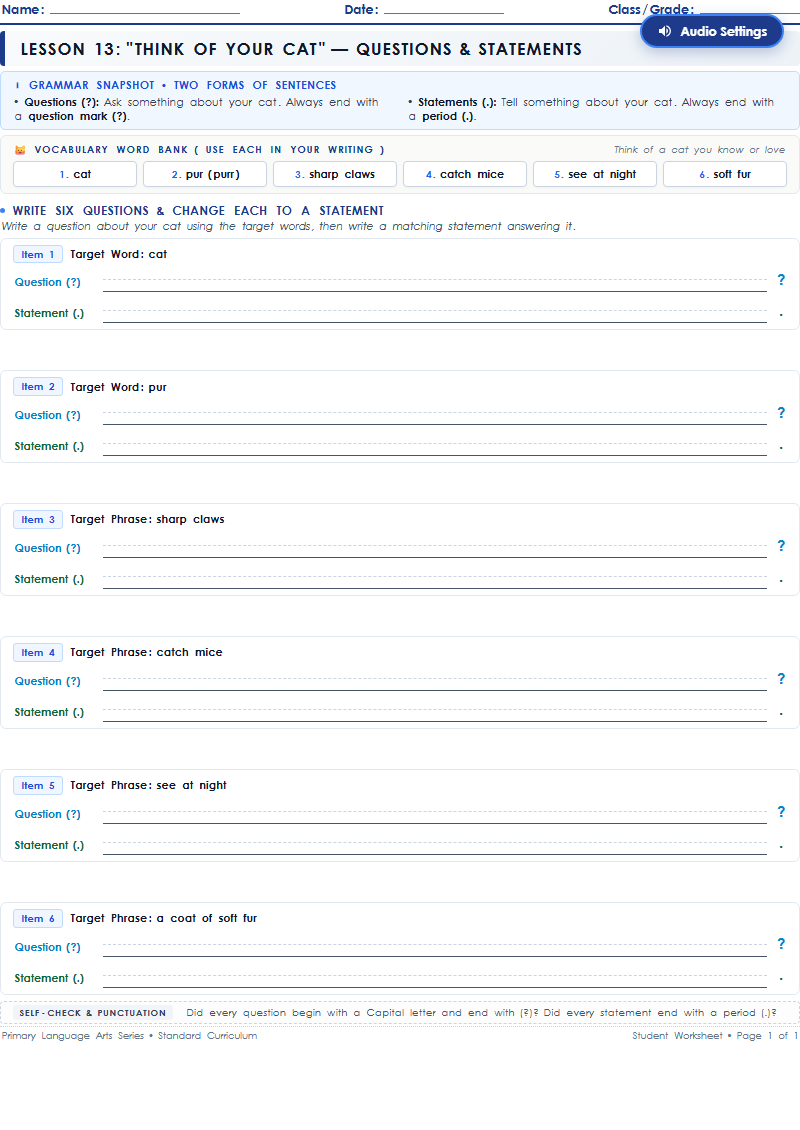
Lesson 13: Think of Your Cat
Compose 6 questions using cat vocabulary (pur, sharp claws, catch mice, soft fur), then transform each inquiry into a declarative statement.
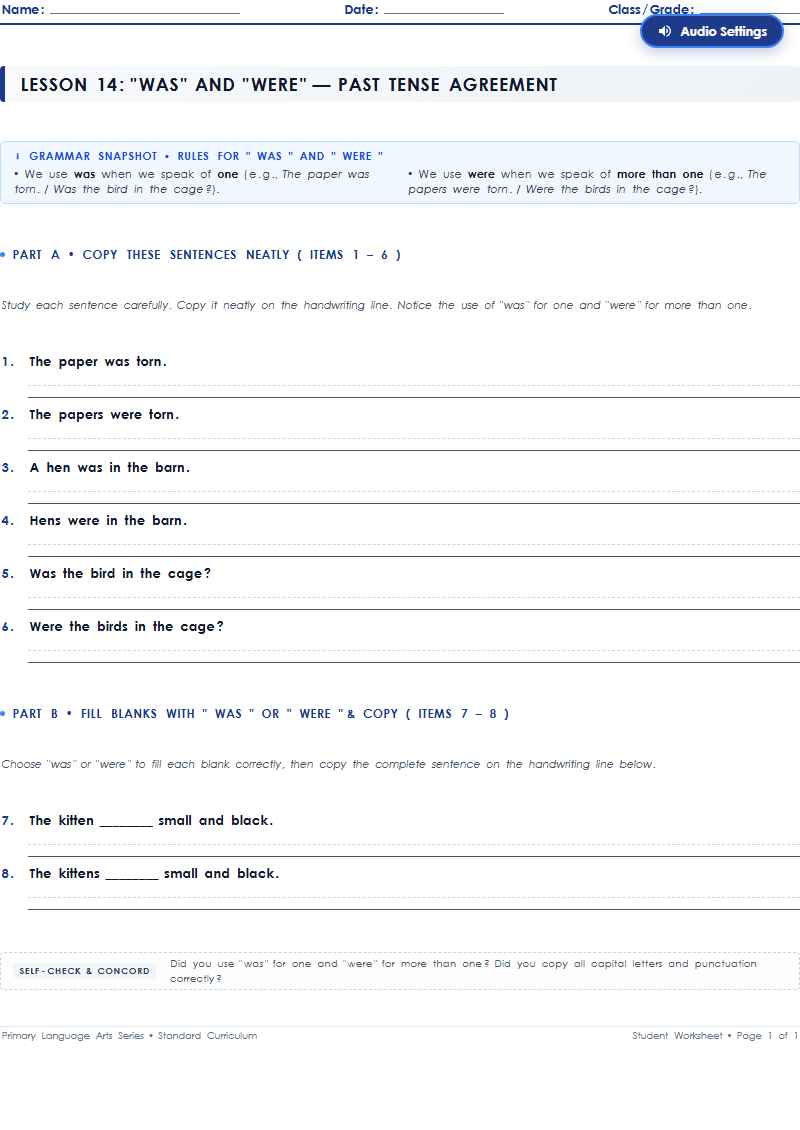
Lesson 14: "Was" & "Were"
Master past tense subject-verb agreement: use "was" for one and "were" for more than one across statements and questions.
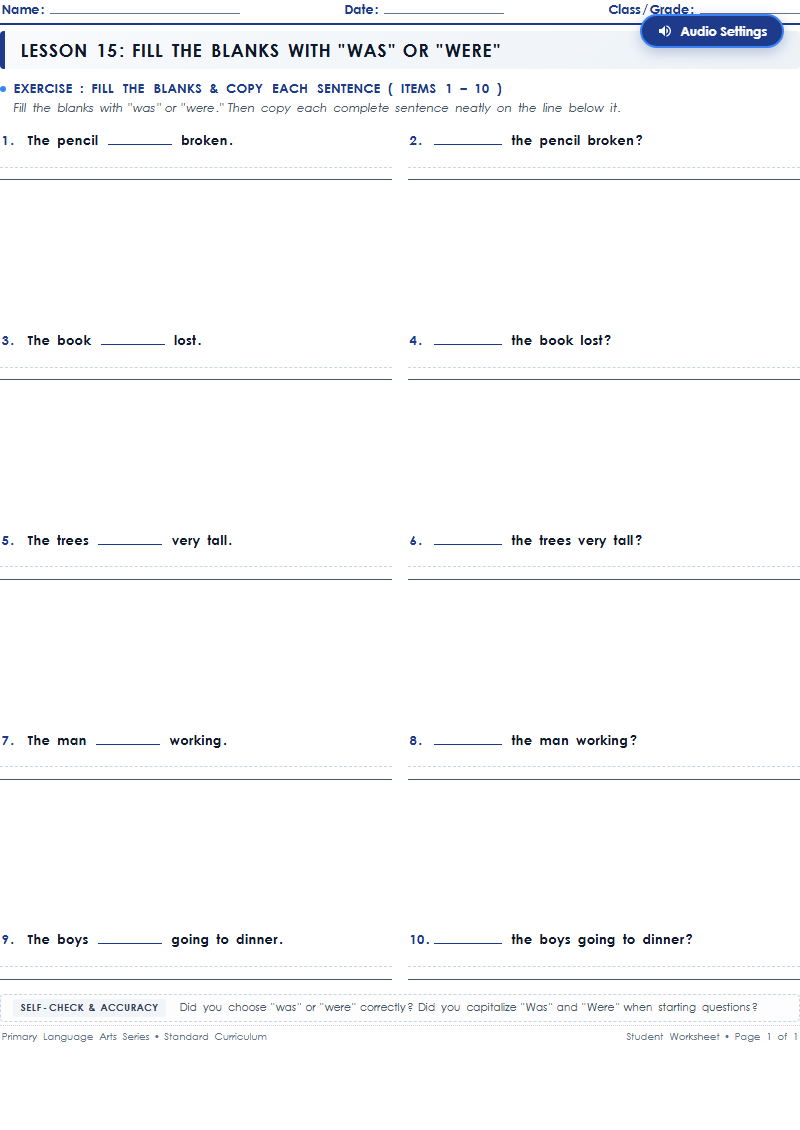
Lesson 15: "Was" or "Were"
Compare 5 pairs of statements and inverted questions. Fill blanks with was, were, Was, or Were and copy each complete sentence.
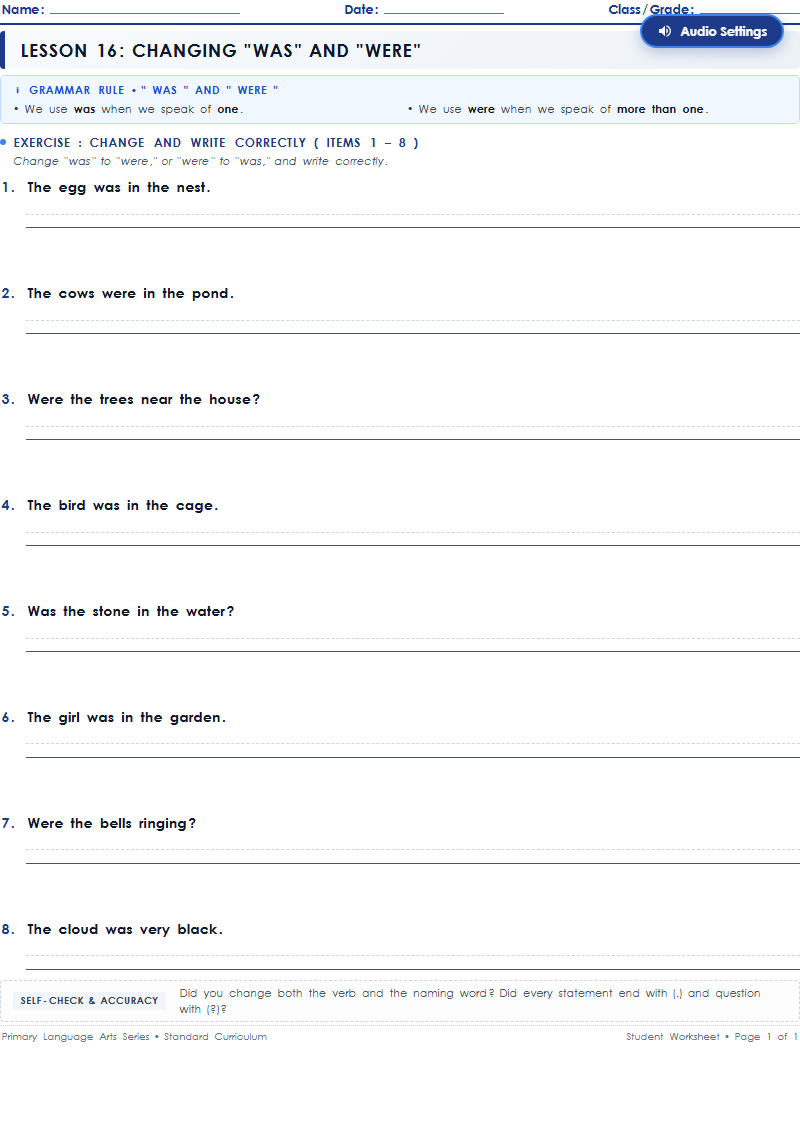
Lesson 16: Changing "Was" & "Were"
Change "was" to "were," or "were" to "was," and write correctly. Practice two-way concord across 8 declarative and interrogative sentences.
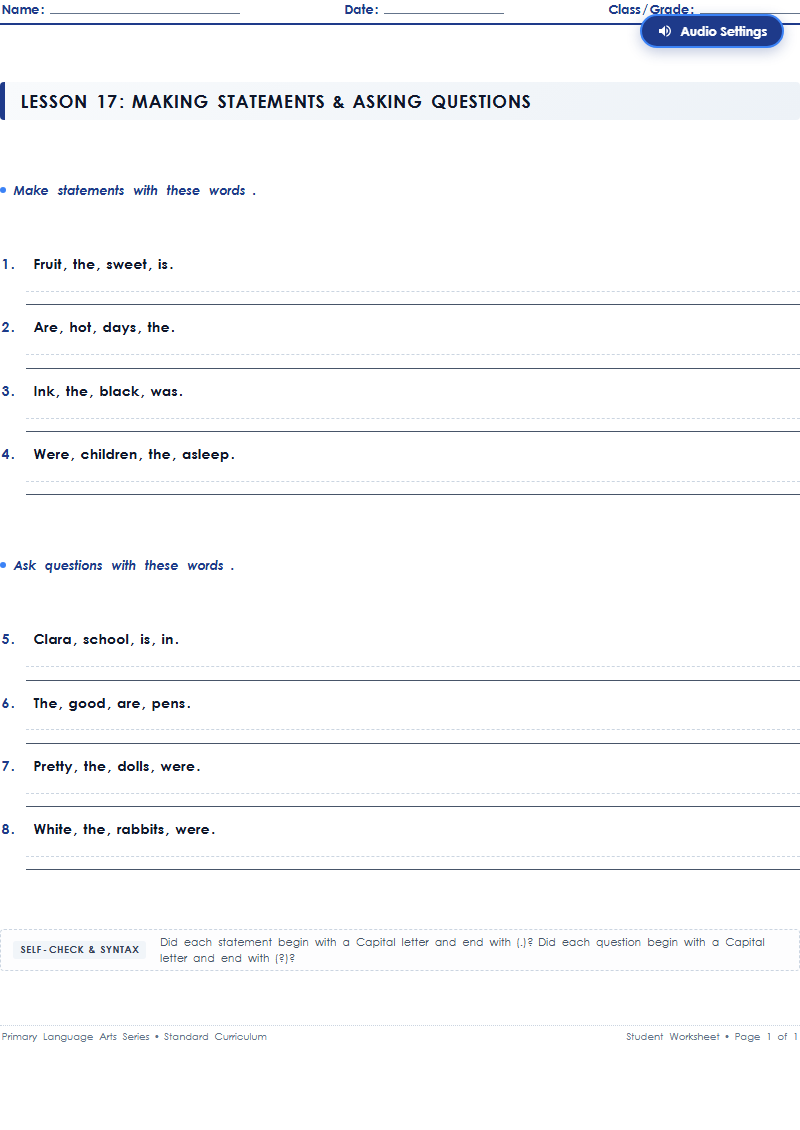
Lesson 17: Statements & Questions
Unscramble jumbled words into correct declarative statements and interrogative questions. Practice syntax, capitalization, and punctuation.
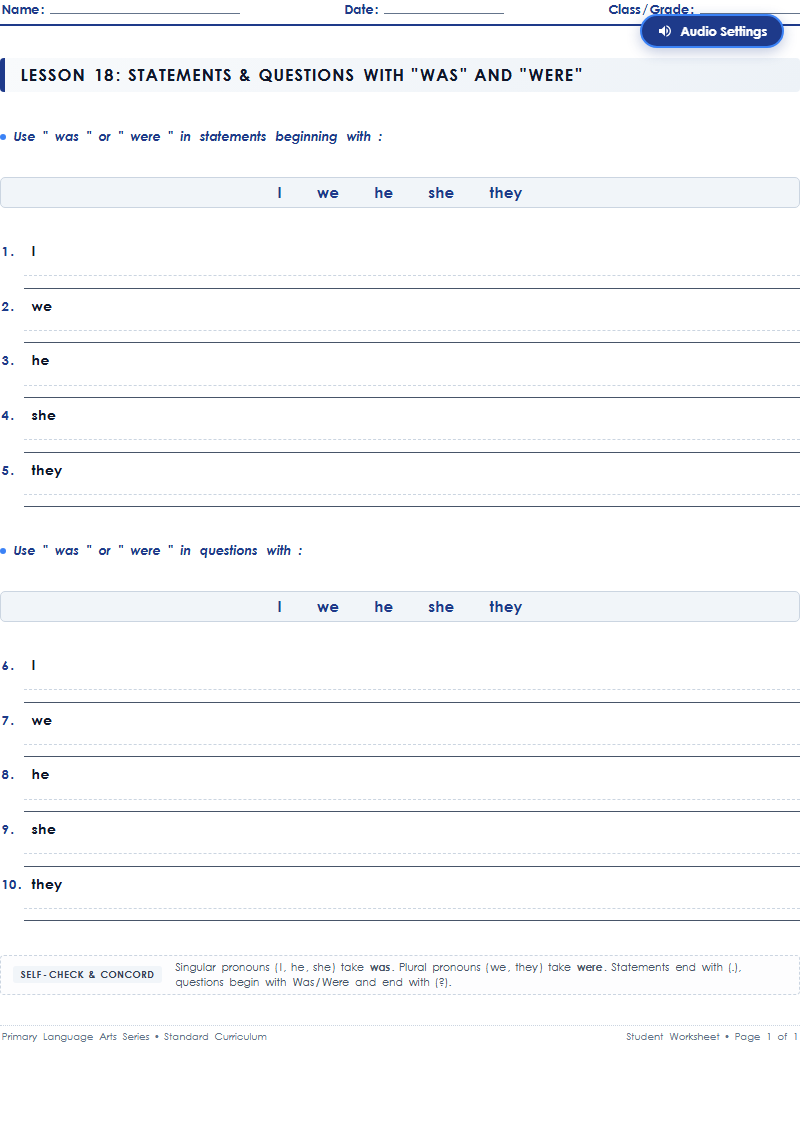
Lesson 18: "Was" & "Were" with Pronouns
Construct original statements and questions using "was" and "were" with personal pronouns (I, we, he, she, they). Master subject-verb agreement and interrogative inversion.
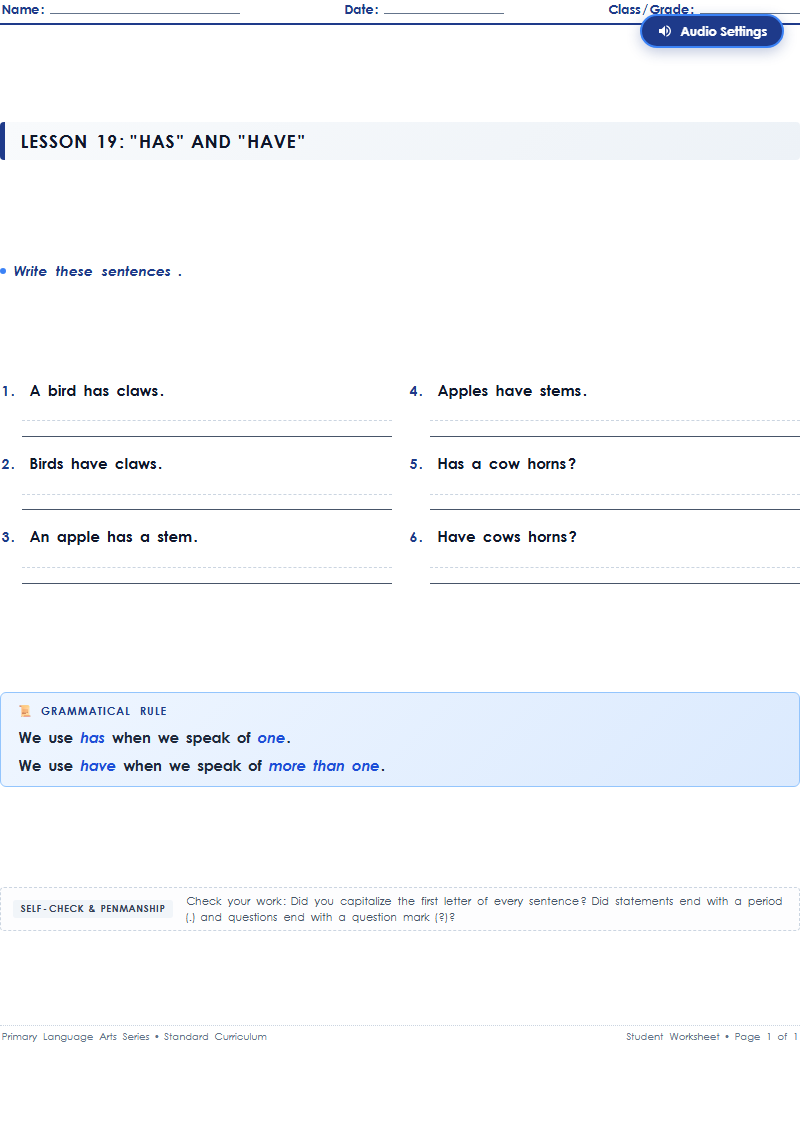
Lesson 19: "Has" and "Have"
Master the core rule: use has when speaking of one, and have when speaking of more than one. Practice contrast pairs and interrogative inversion.
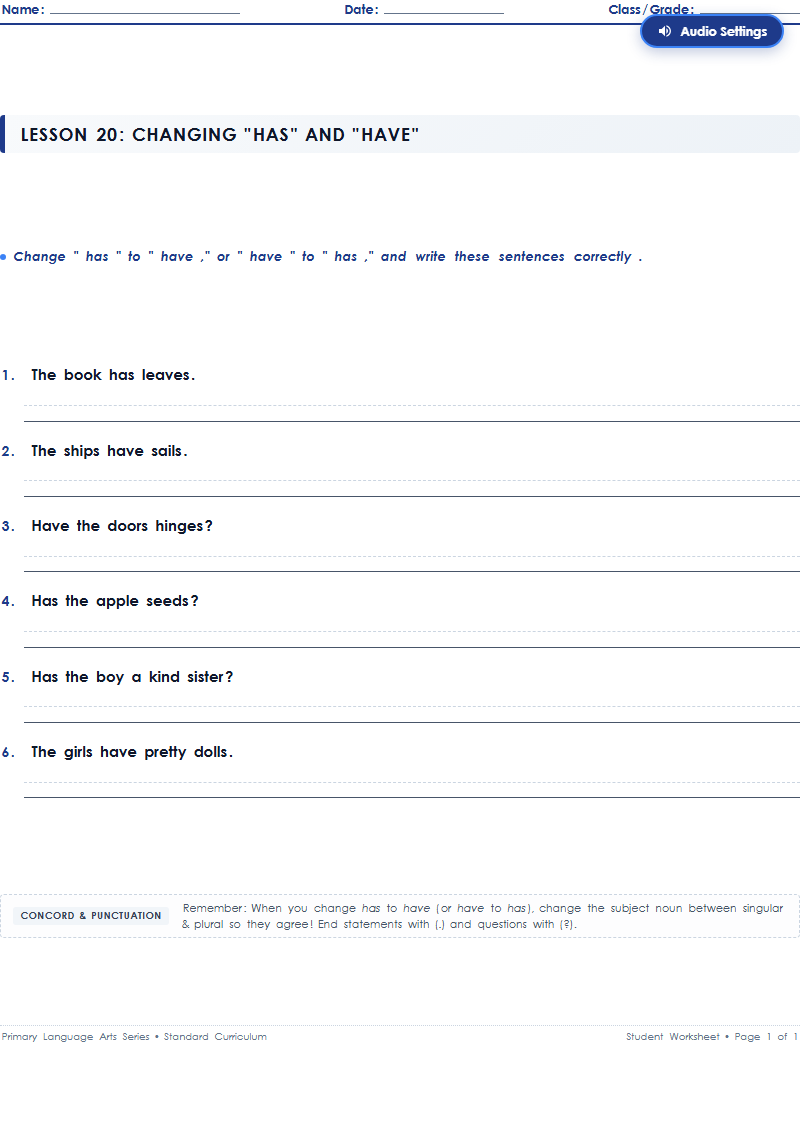
Lesson 20: Changing "Has" and "Have"
Transform sentences between singular and plural by changing "has" to "have" or "have" to "has". Practice two-way subject-verb agreement across statements and questions.
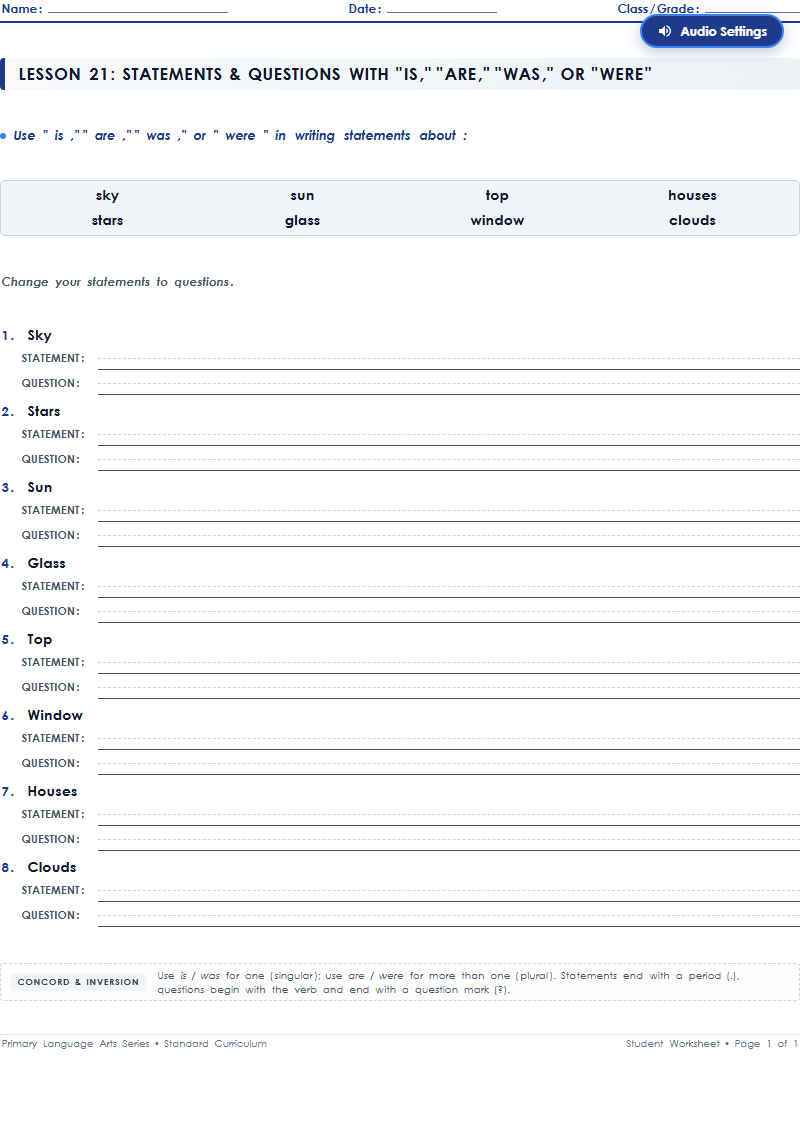
Lesson 21: Statements & Questions
Compose statements about 8 foundational nouns using "is," "are," "was," or "were," and transform each statement into an interrogative question. Master syntactic inversion and concord.
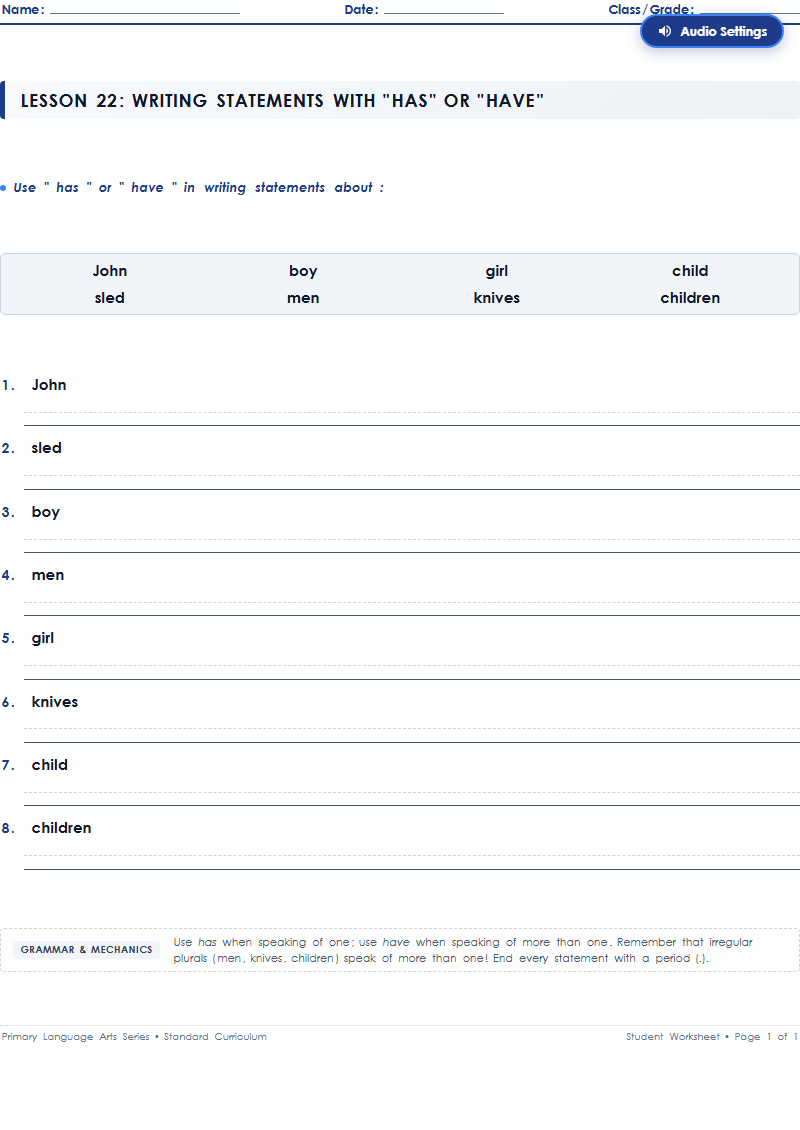
Lesson 22: Statements with "Has" or "Have"
Write declarative statements using "has" or "have" about 8 nouns, featuring proper nouns (John) and irregular plurals (men, knives, children). Solidify number agreement.
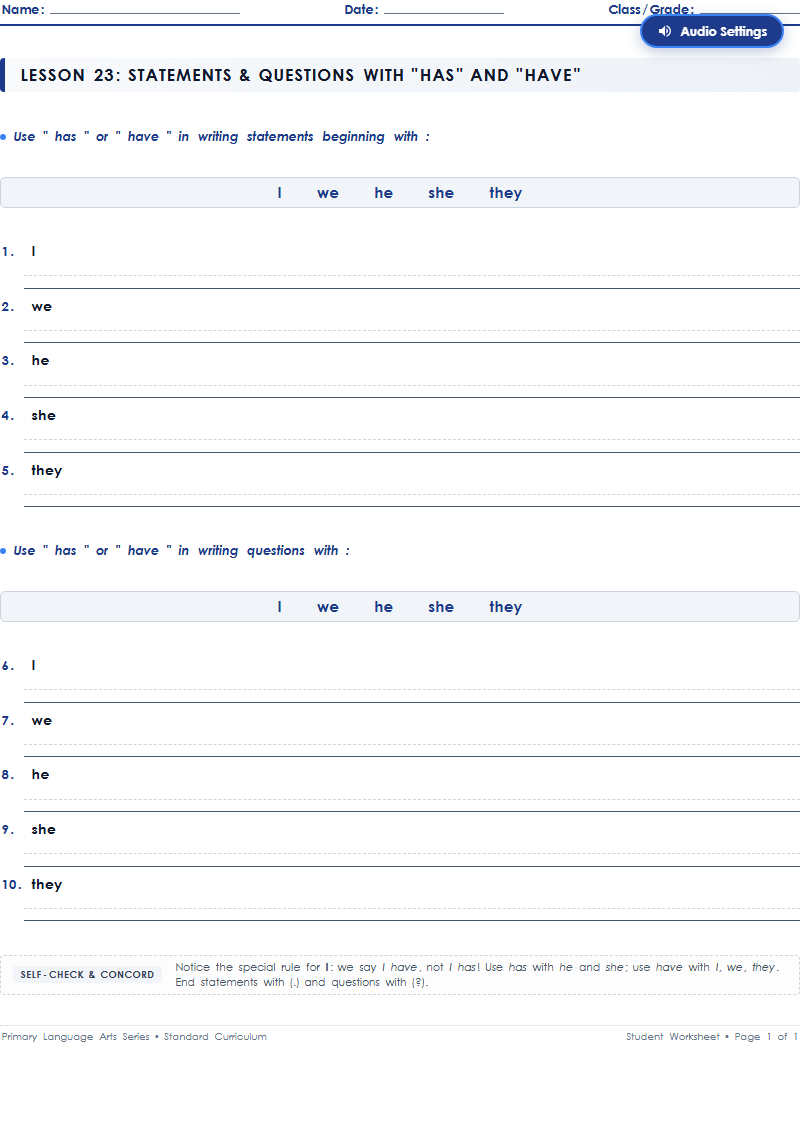
Lesson 23: Pronouns with "Has" & "Have"
Construct statements and questions using "has" or "have" with personal pronouns (I, we, he, she, they). Master the essential "I have" concord rule and interrogative inversion.
Lesson 24: Words to Use with "You"
Master the invariant rule of 2nd-person pronoun agreement: you always pairs with are, were, and have across both statements and questions. Eradicate dialectal errors.
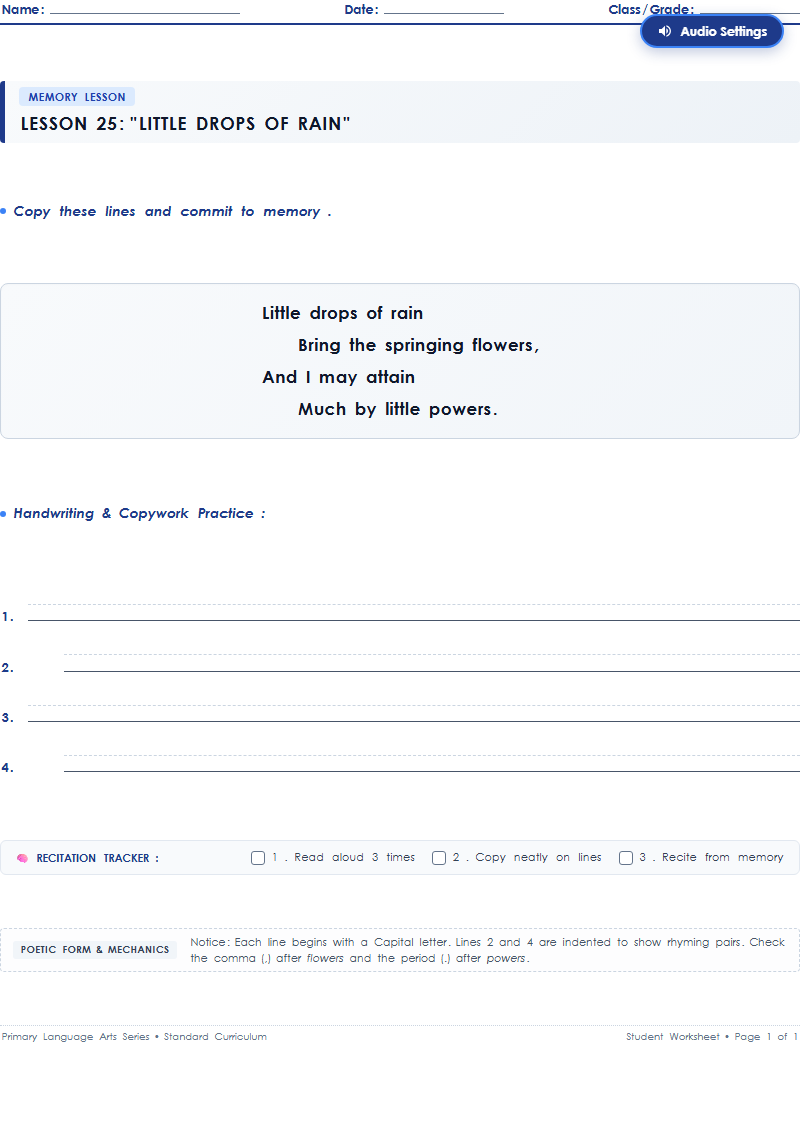
Lesson 25: "Little Drops of Rain"
Classical verse copywork and memory recitation: "Little drops of rain / Bring the springing flowers...". Practice poetic prosody, alternating indentation, and penmanship.
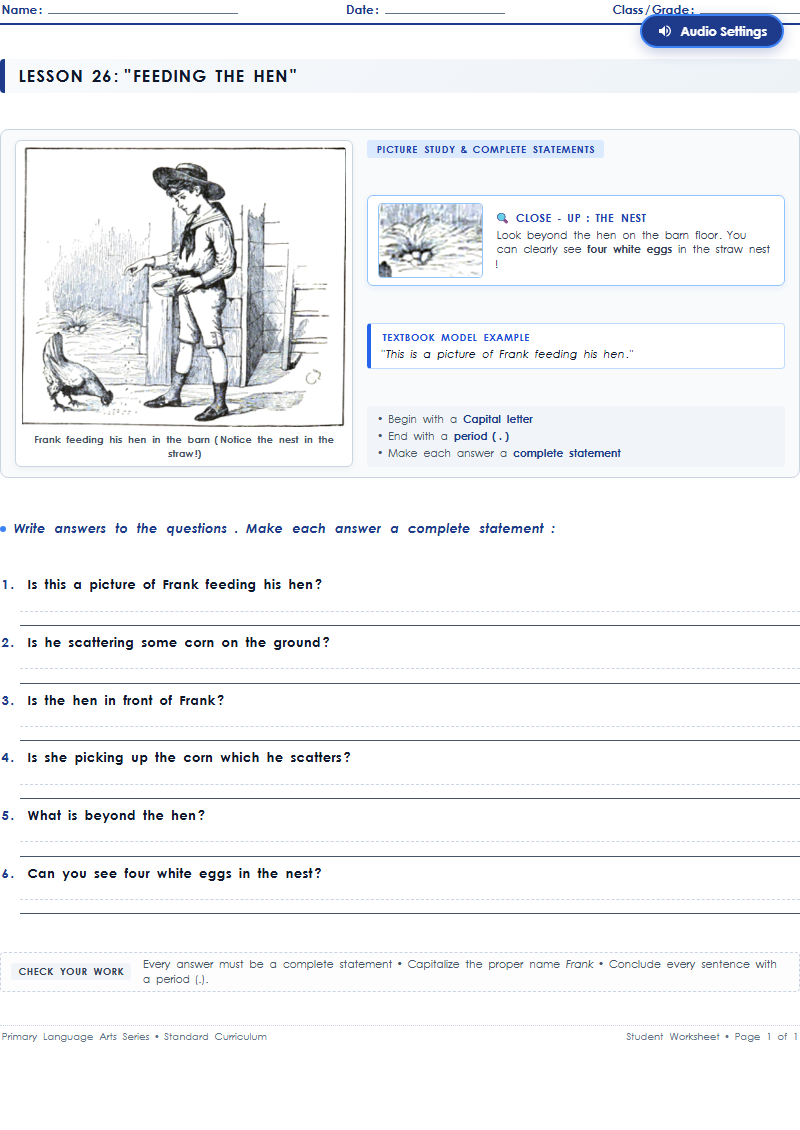
Lesson 26: "Feeding the Hen"
Carefully study the pen-and-ink drawing of Frank feeding his hen in the barn. Answer 6 observation questions in full declarative statements with proper capitalization and periods.
Lesson 27: Names of the Days
Master the capitalization rule for the days of the week (Sunday through Saturday). Practice copywork and answer the foundational inquiry question in a complete statement.
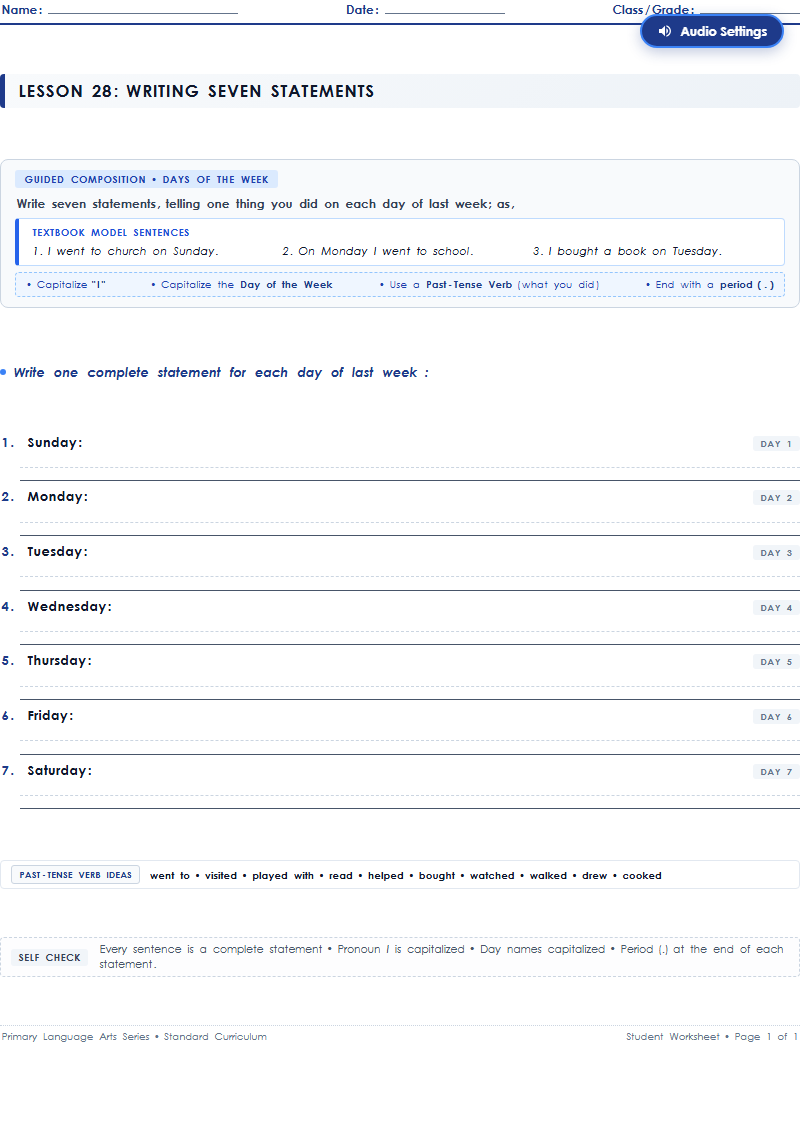
Lesson 28: Writing Seven Statements
Write seven complete statements describing one activity done on each day of last week. Practice past-tense action verbs, varied sentence openers, and proper capitalization.
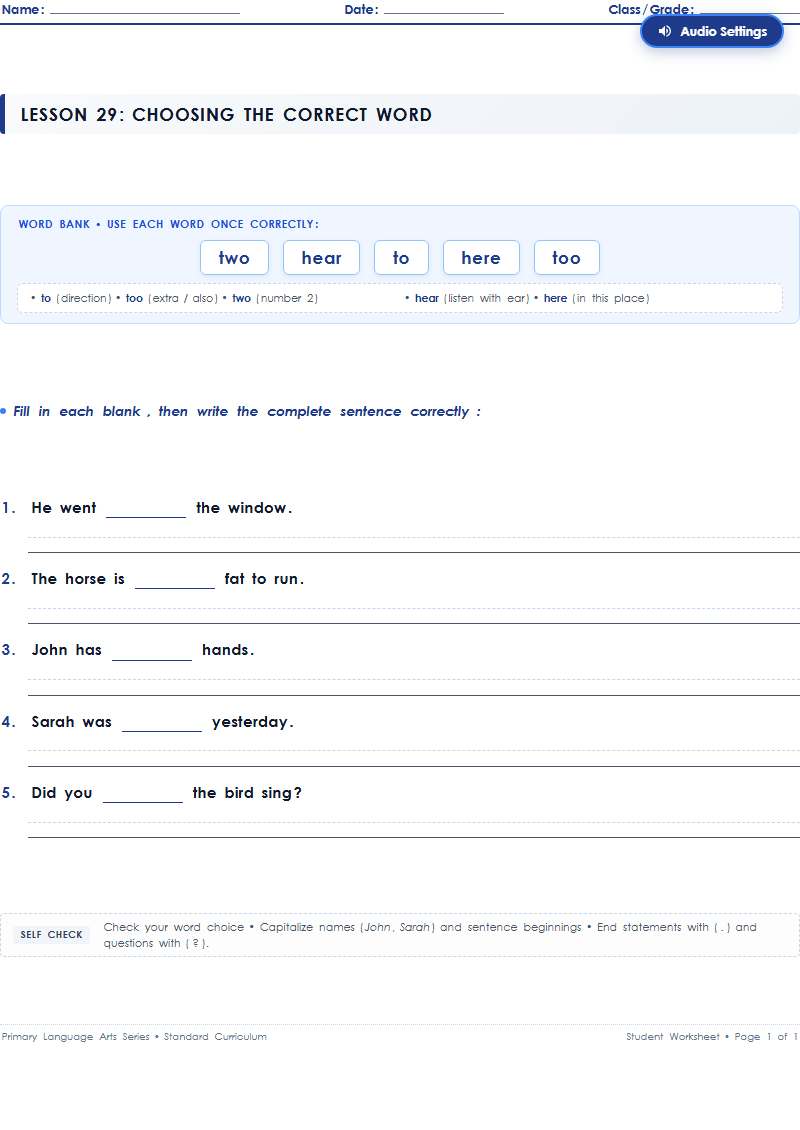
Lesson 29: Choosing the Correct Word
Master spelling discrimination for essential homophone pairs: "to / too / two" and "hear / here". Fill blanks in contextual sentences and transcribe complete statements.
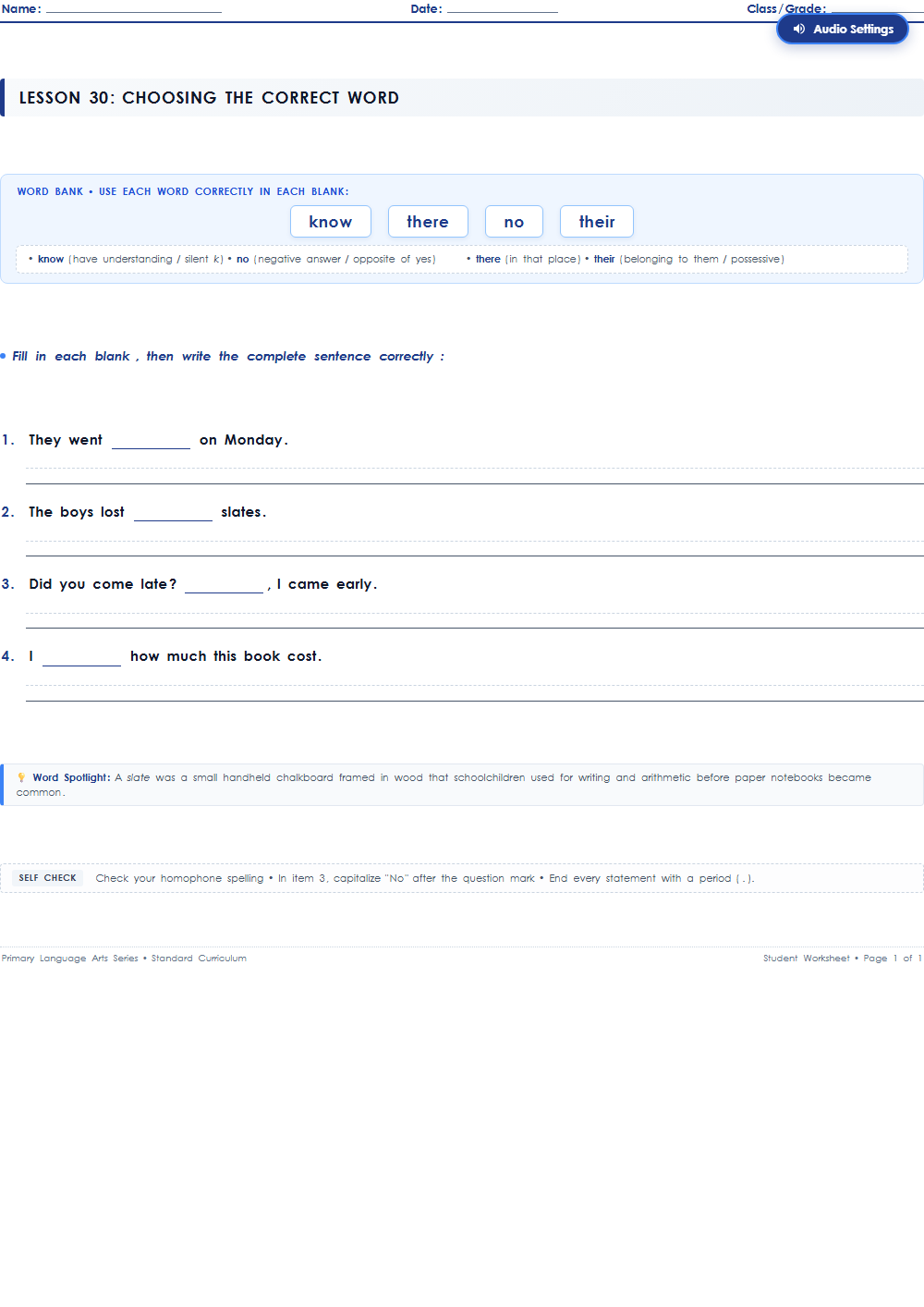
Lesson 30: Choosing the Correct Word
Master spelling discrimination for homophone pairs: "know / no" and "there / their". Complete contextual sentences and write out full statements with proper capitalization.
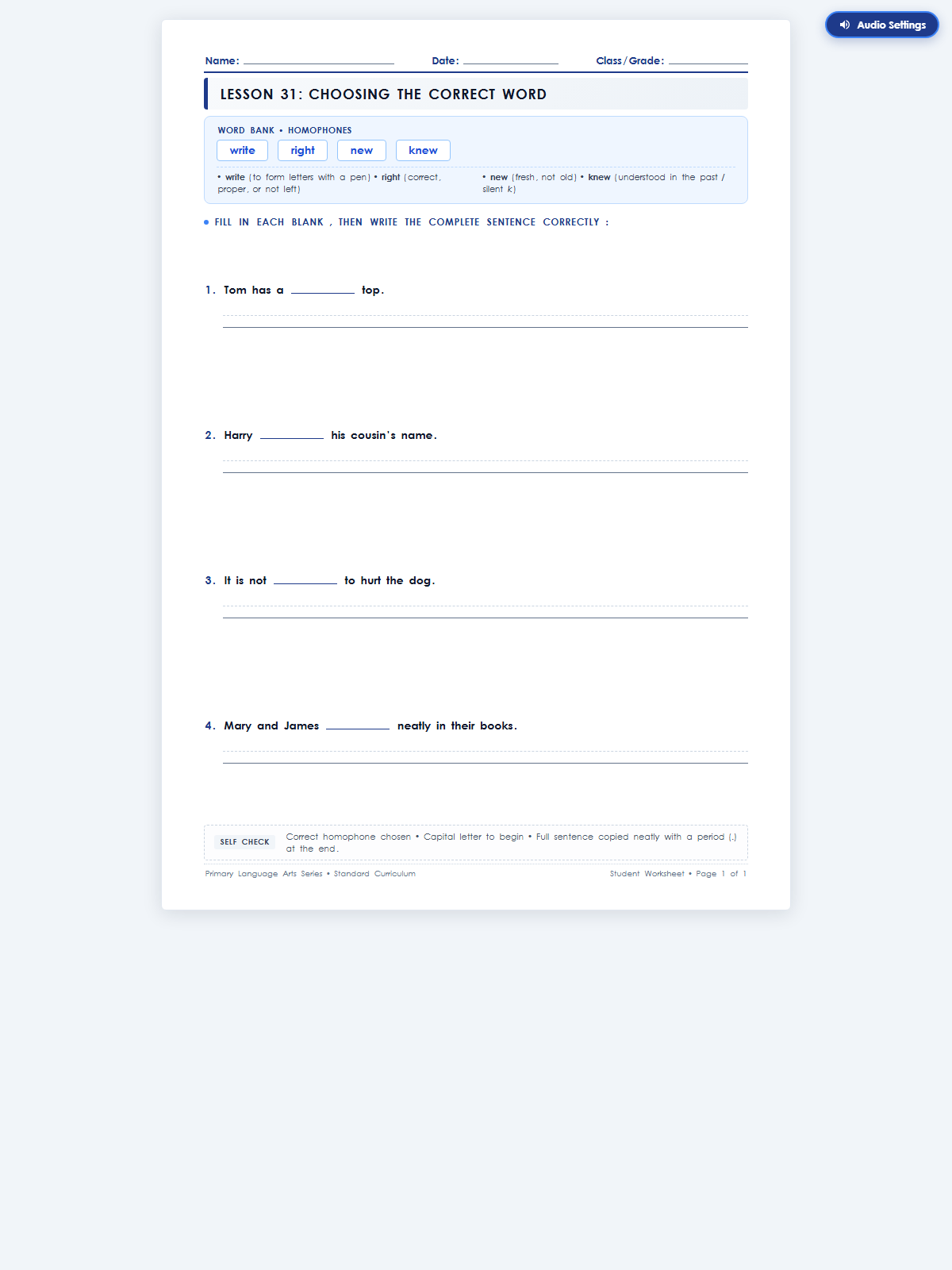
Lesson 31: Choosing the Correct Word
Master spelling discrimination for homophone pairs: "write / right" and "new / knew". Complete contextual sentences and write out full statements with proper capitalization.
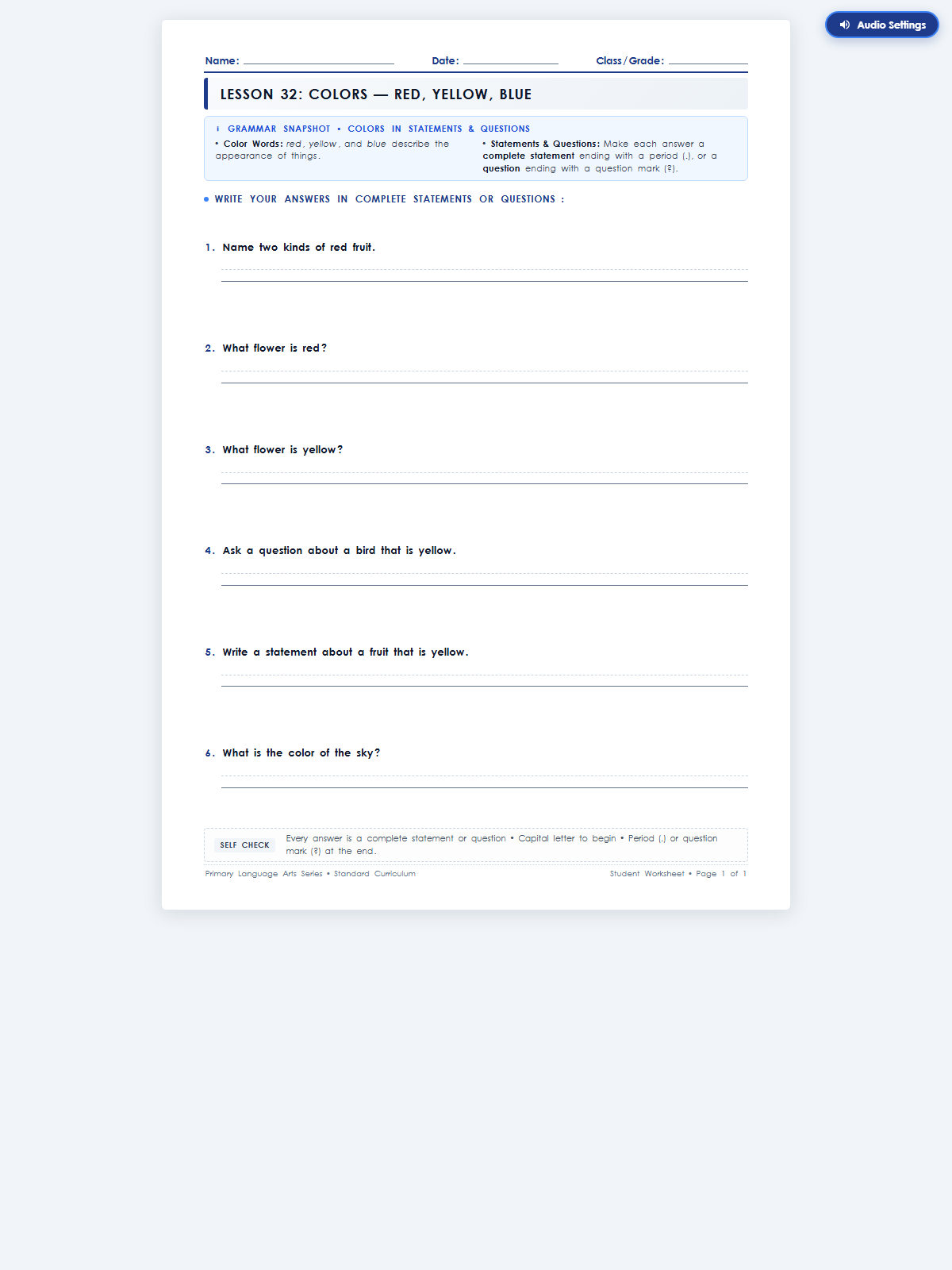
Lesson 32: Colors
Explore primary colors (red, yellow, blue). Answer observation questions in complete statements and write clear questions about colored objects.
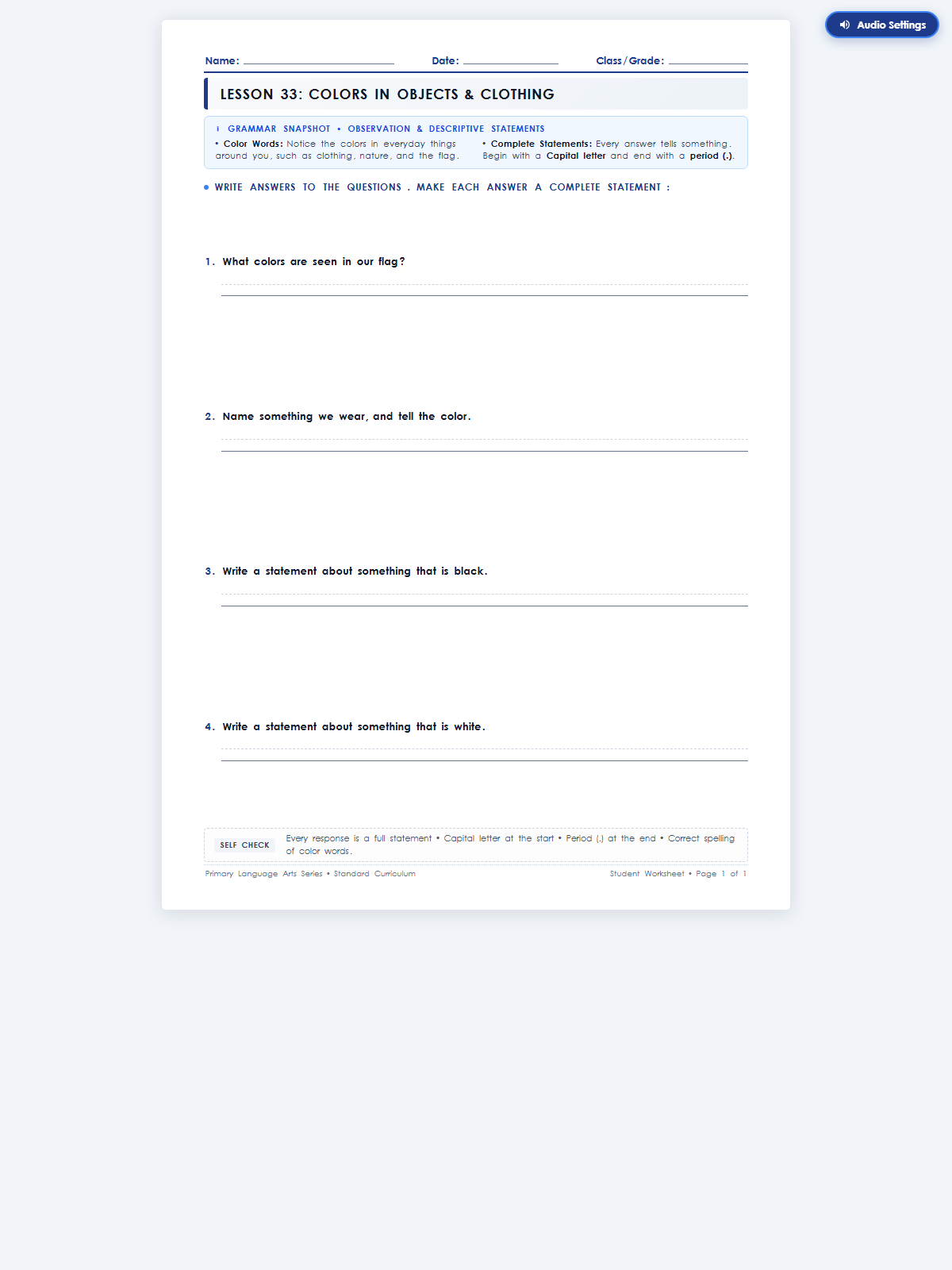
Lesson 33: Colors in Objects & Clothing
Identify and write statements about colors in everyday items, personal clothing, and the national flag with proper punctuation and complete sentence structure.
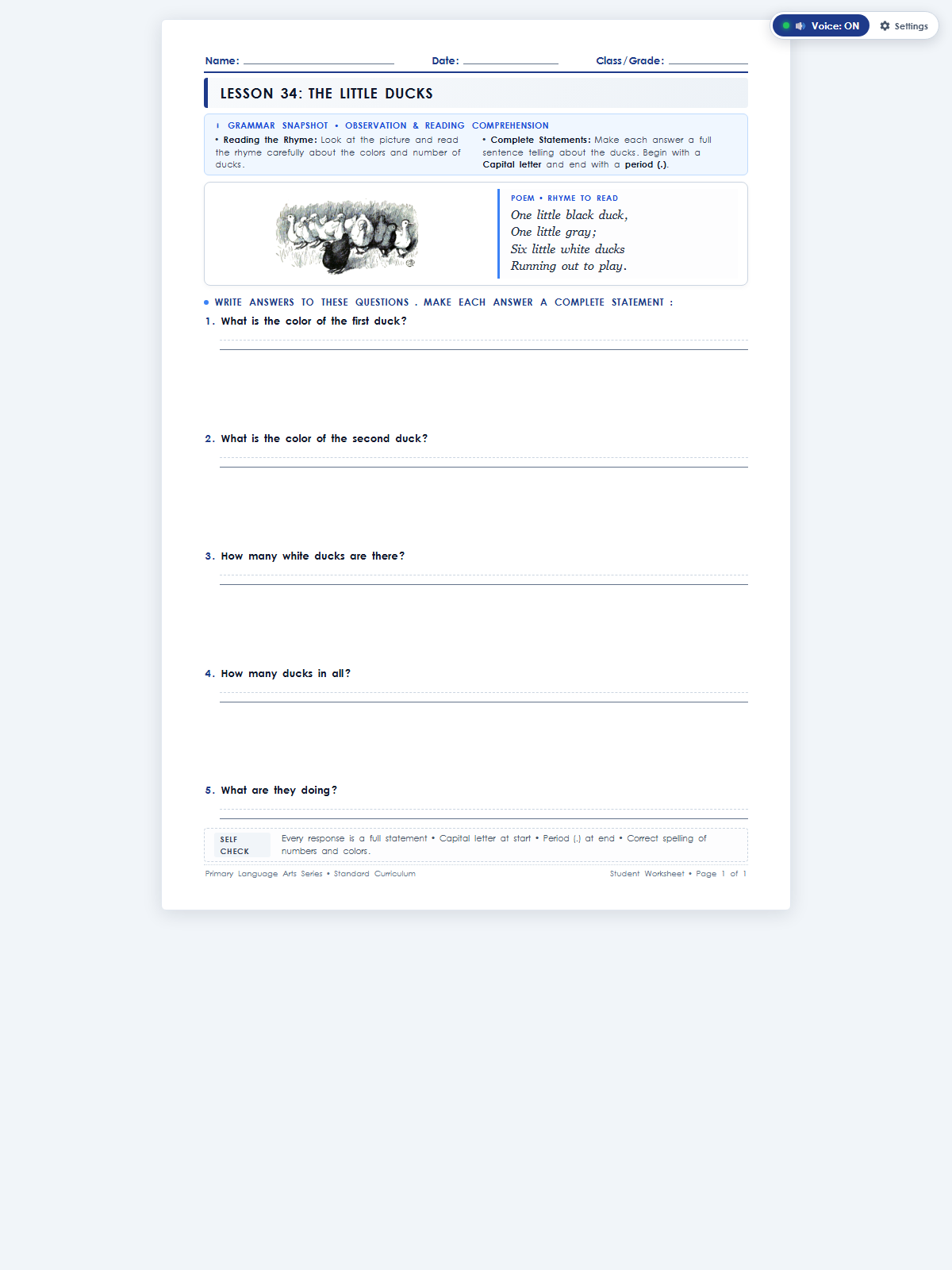
Lesson 34: The Little Ducks
Study the vintage duck illustration and rhyme. Answer 5 reading comprehension and observation questions in full declarative statements with proper punctuation and capitalization.

Lesson 35: Parts of Objects
Learn to combine two statements describing parts of an object into a single compound statement using the coordinating conjunction "and".

Lesson 36: More Parts of Objects
Practice combining statements with repeated indefinite articles ("a ... and a ...") describing tools and everyday items (knife, hat, teacup, clock).

Lesson 37: Qualities of Objects
Learn to combine two descriptive adjectives sharing the linking verb "is" into a single statement using "and" (paper, lemon, grass, rose).

Lesson 38: Qualities of Materials
Describe natural substances and metals (iron, gold, silver, glass) using mass nouns without articles, combined with two descriptive adjectives.

Lesson 39: Selecting Qualities
Select two fitting adjectives from a 10-word vocabulary bank to compose five complete descriptive statements (crayon, orange, coal, glass, wool).

Lesson 40: Combining Subjects with "Are"
Master subject-verb agreement with compound subjects joined by "and", shifting the linking verb from singular "is" to plural "are" when sharing one quality.

Lesson 41: Shared Qualities & "Are"
Synthesize groups of objects sharing physical properties into complete plural statements using the linking verb "are".
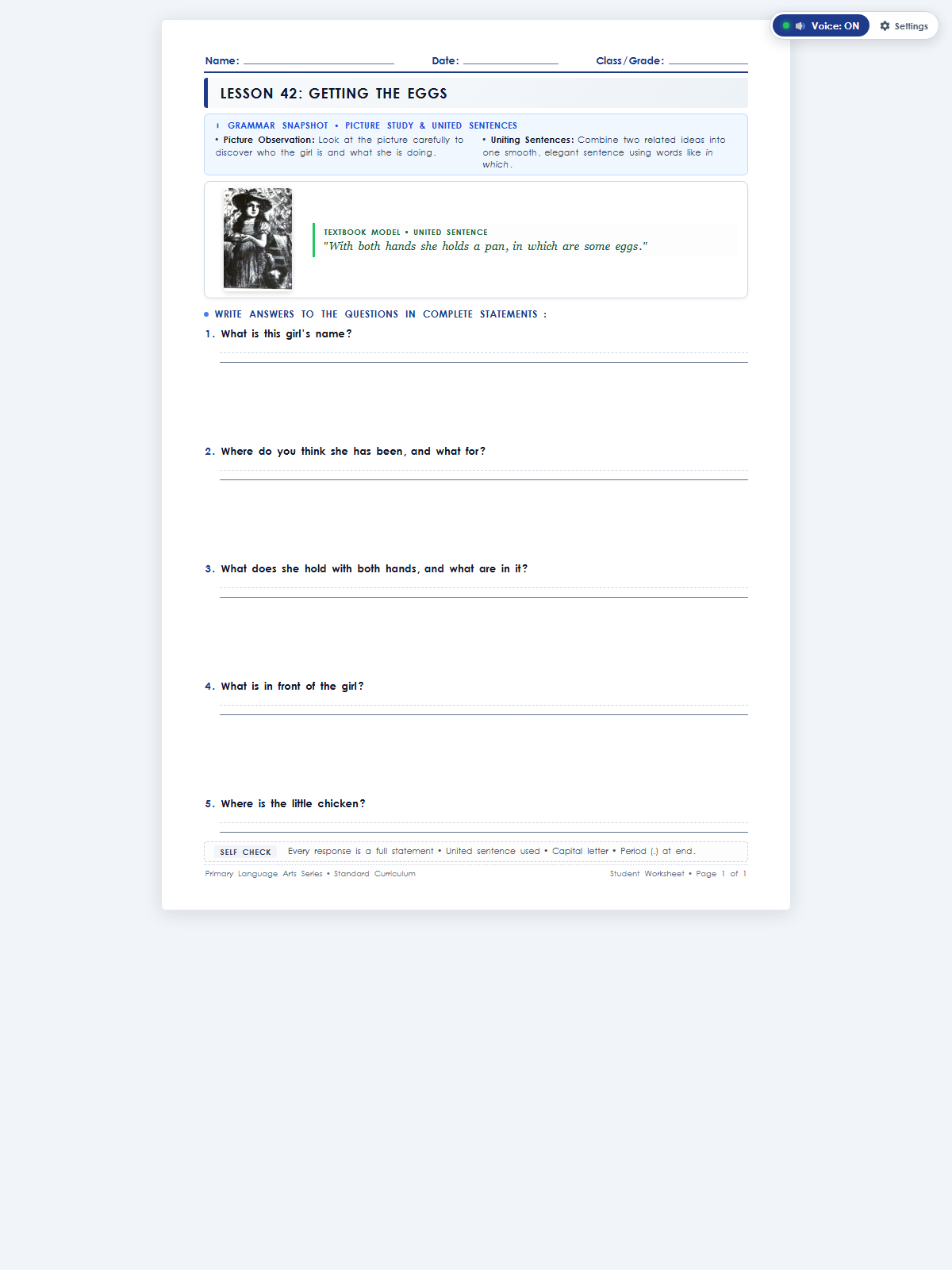
Lesson 42: Getting the Eggs
Carefully observe the scene of a young girl gathering fresh eggs, answer guided questions, and synthesize details into a compound statement.
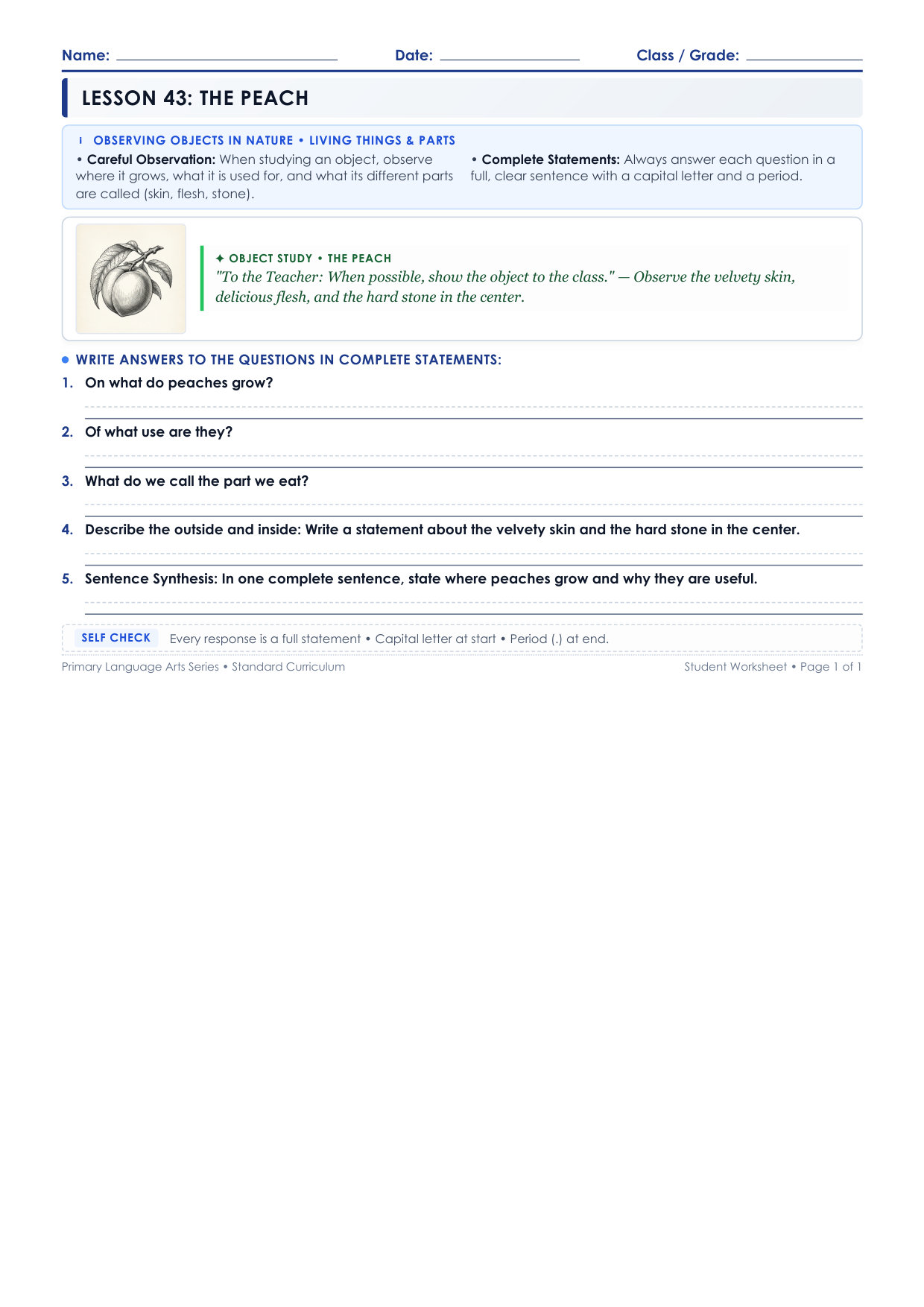
Lesson 43: The Peach
Observe a ripe peach in nature, analyze its skin, flesh, and central stone, and compose complete descriptive inquiry statements.
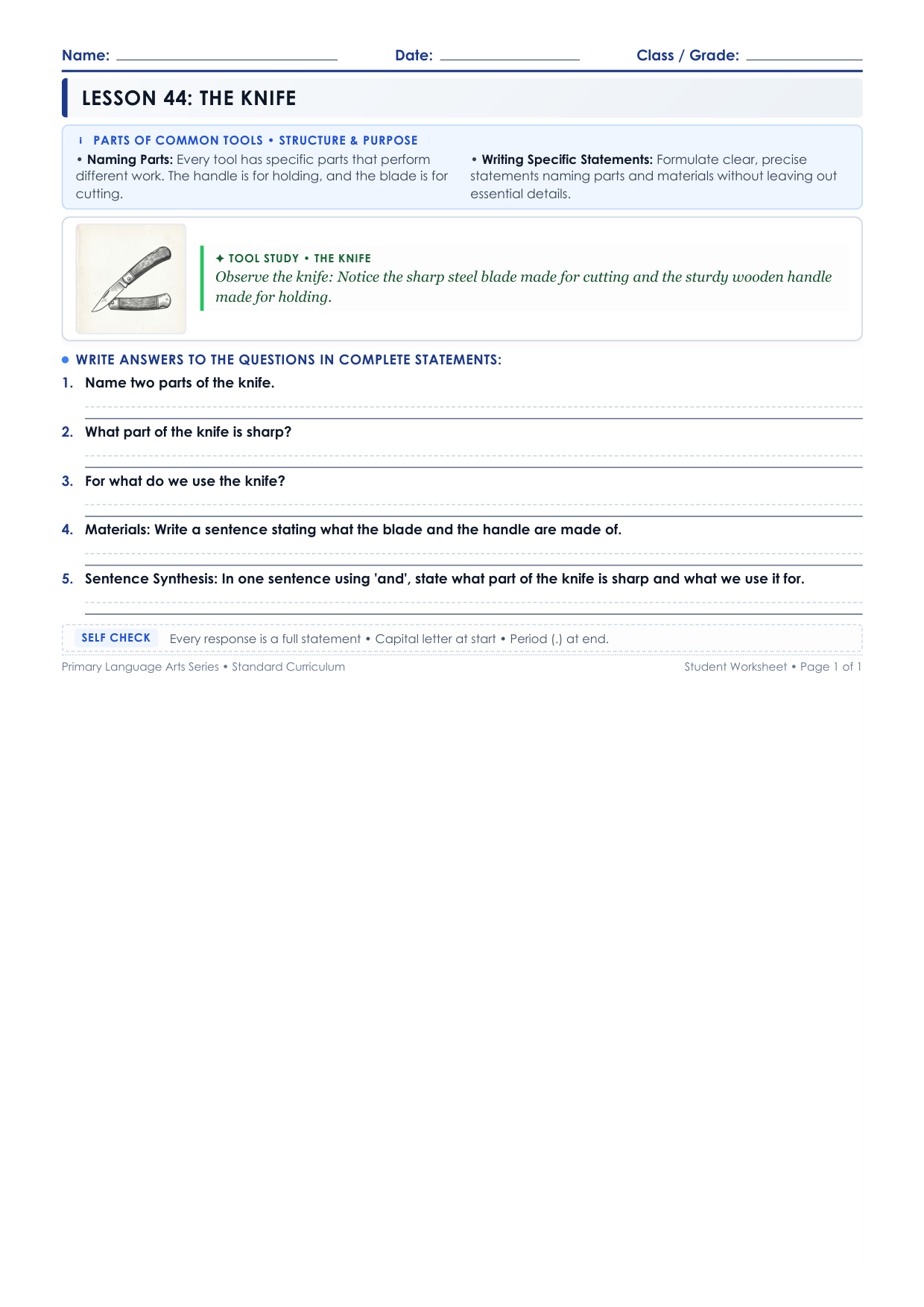
Lesson 44: The Knife
Examine the components of a cutting tool, identify the blade and handle, and formulate precise compound statements on its utility.
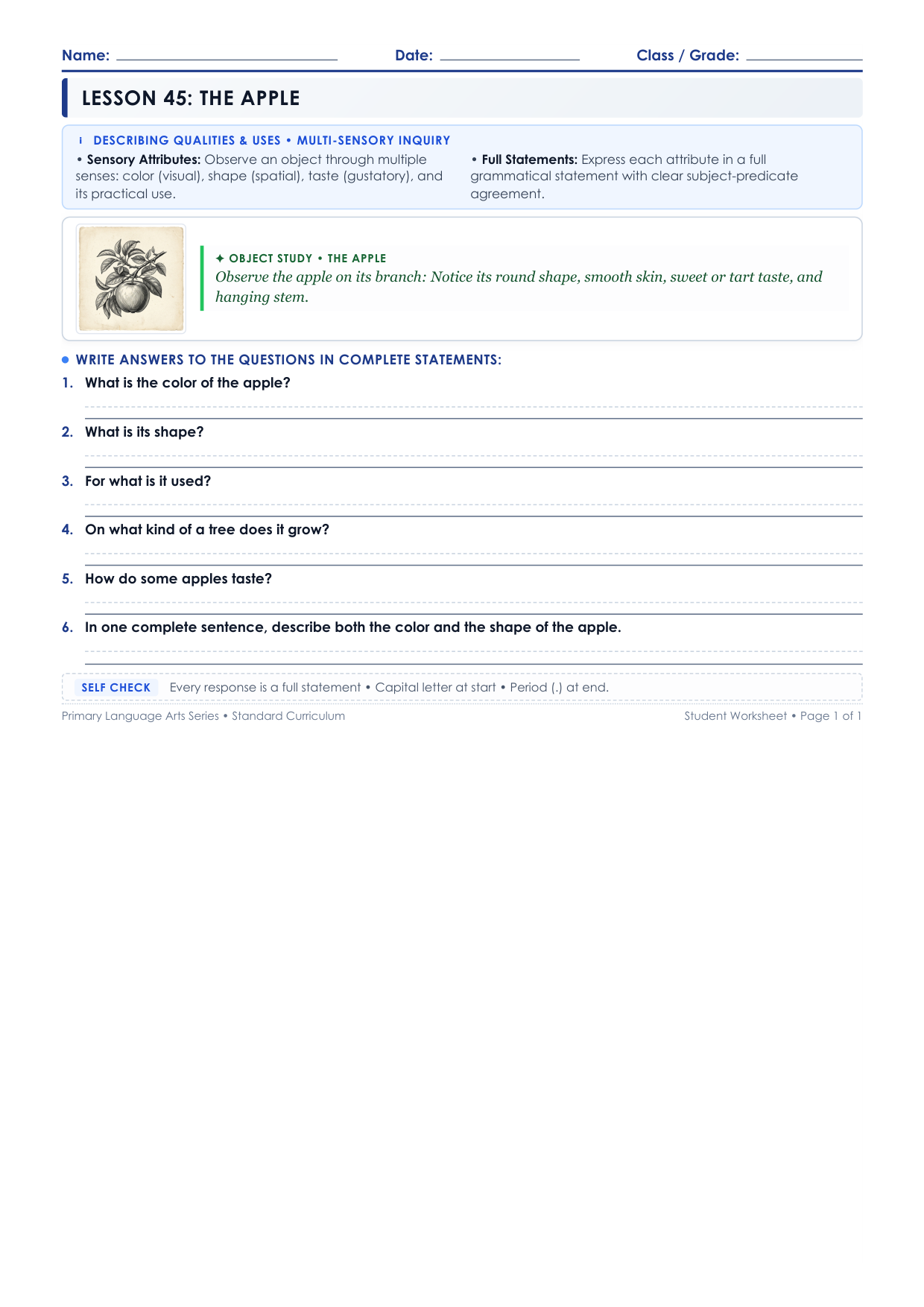
Lesson 45: The Apple
Inquire into the color, geometric shape, taste, and growth of the apple, synthesizing observations into compound descriptive sentences.
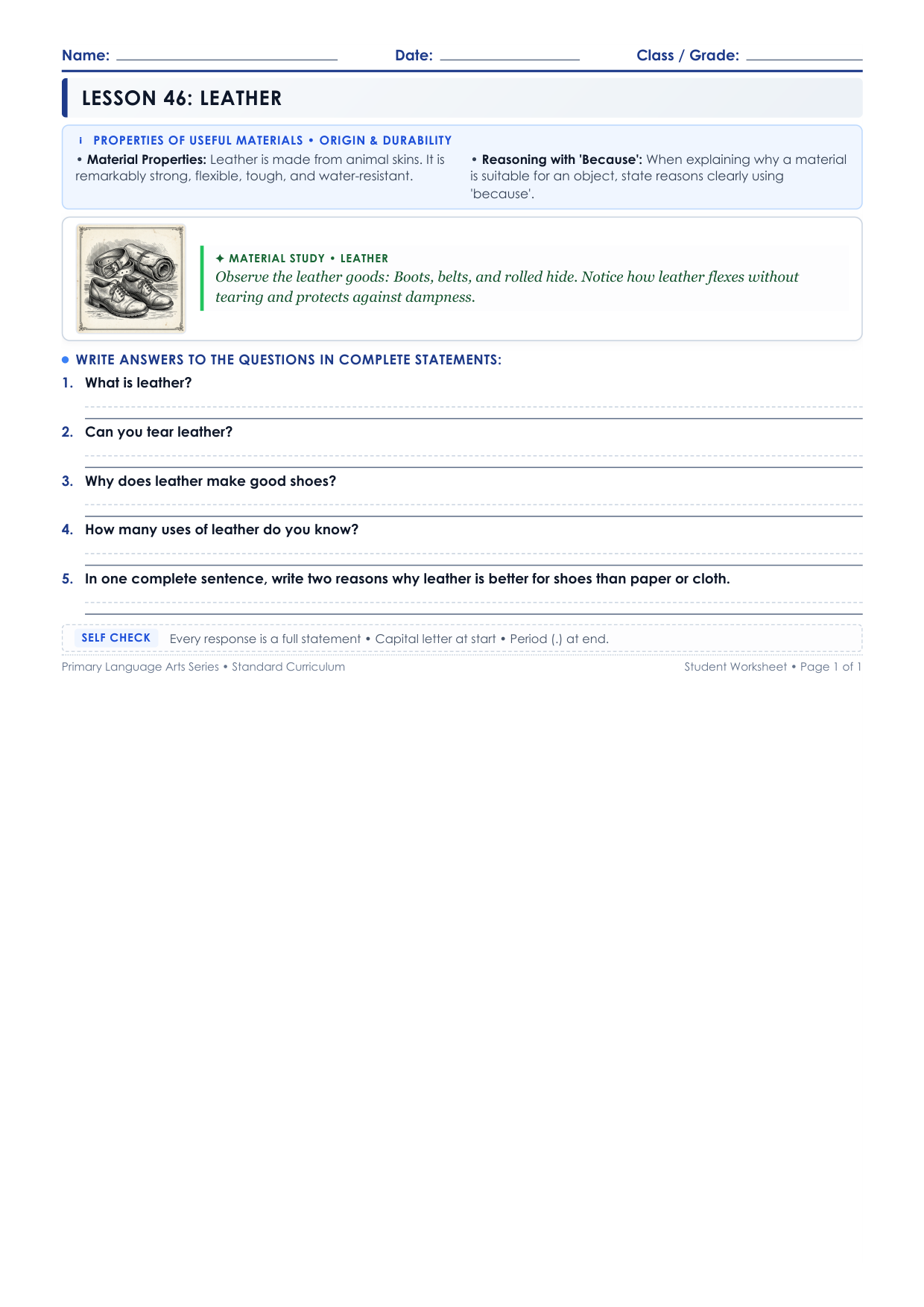
Lesson 46: Leather
Analyze the physical qualities of leather (tough, flexible, water-resistant), explaining causal reasons why it makes durable shoes.
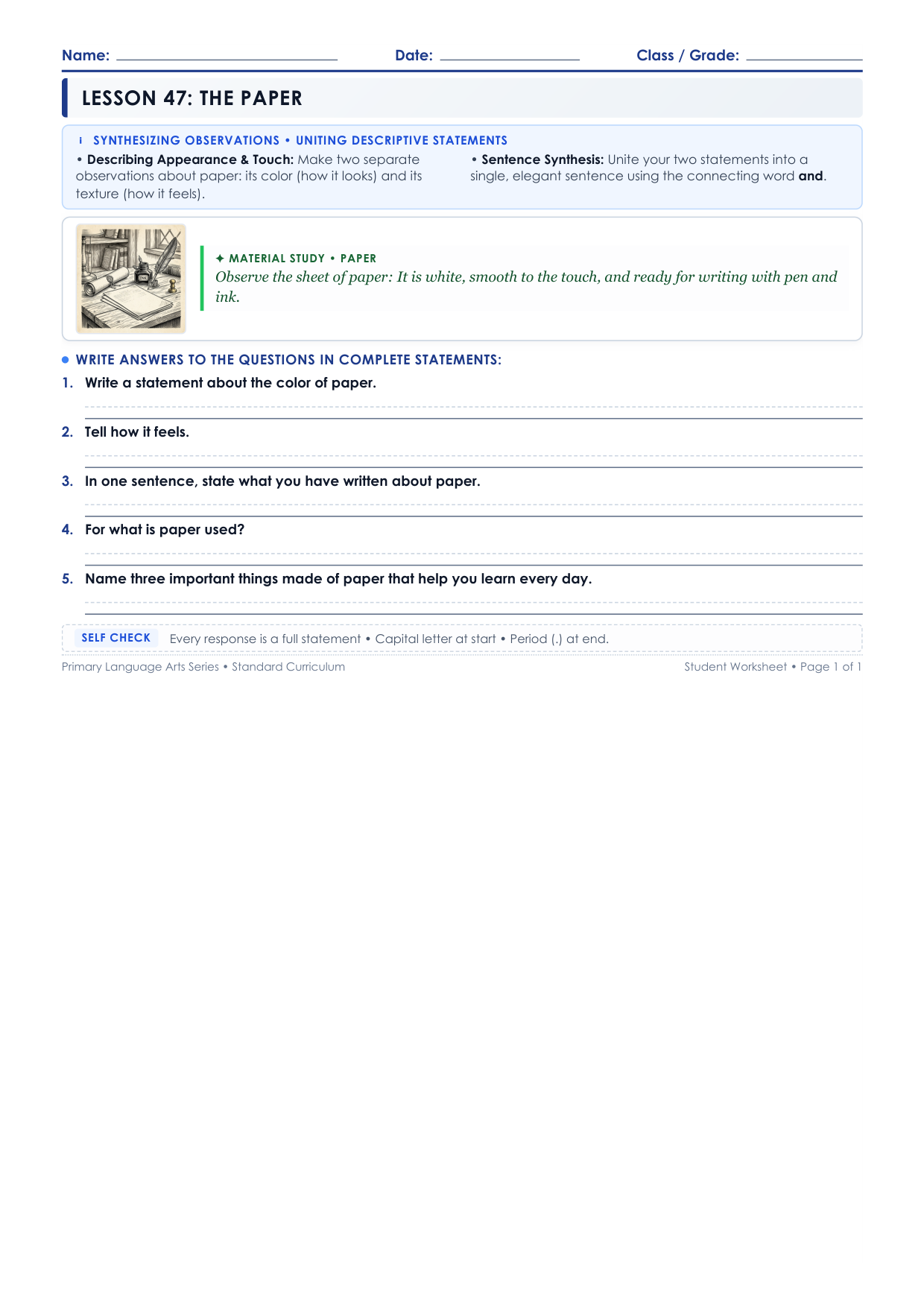
Lesson 47: The Paper
Synthesize separate observations of color and texture into a single compound statement, and explore the essential uses of paper.
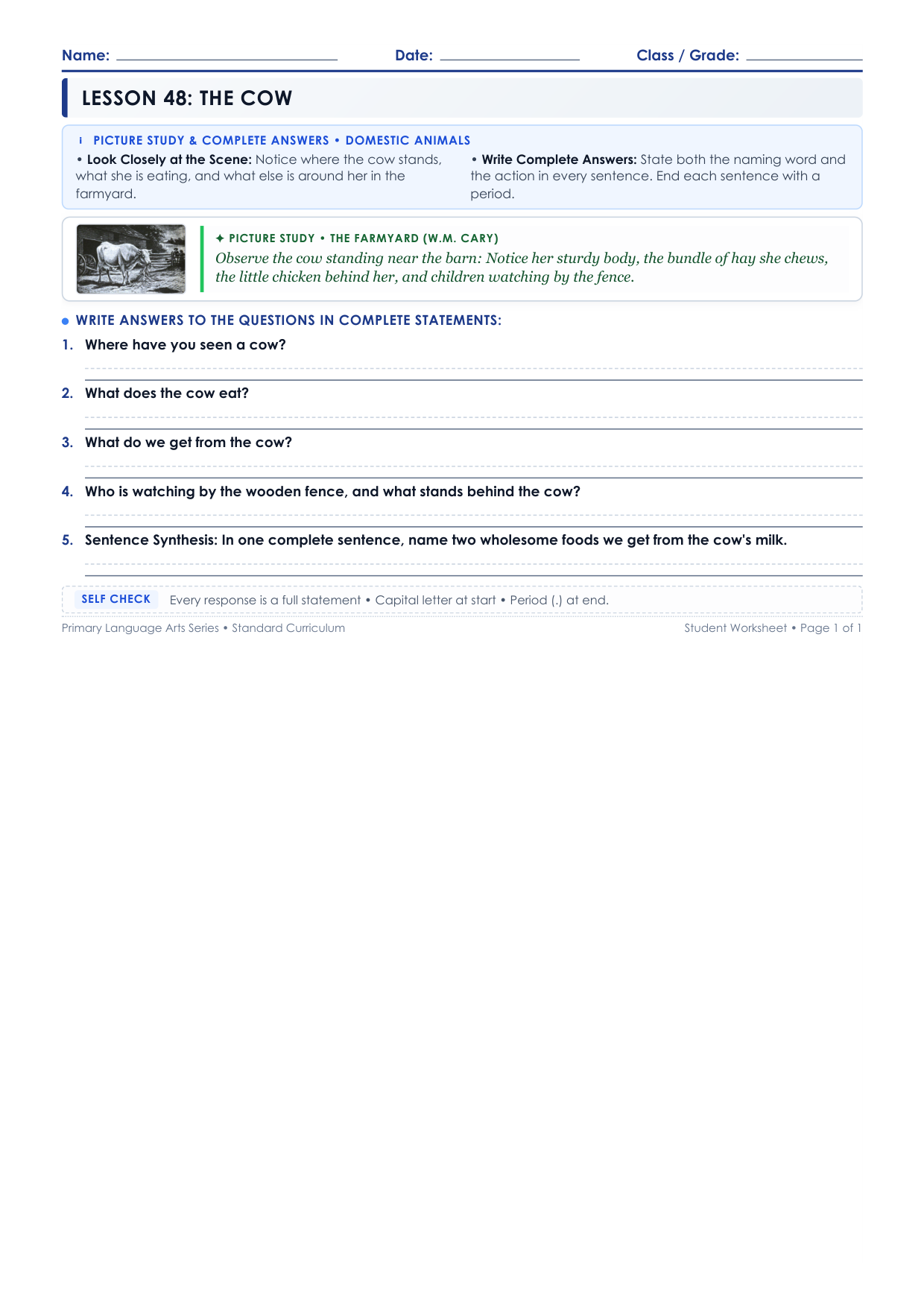
Lesson 48: The Cow
Analyze W.M. Cary's farmyard engraving of the cow, identify surrounding animals and children, and compose complete answers about dairy products.
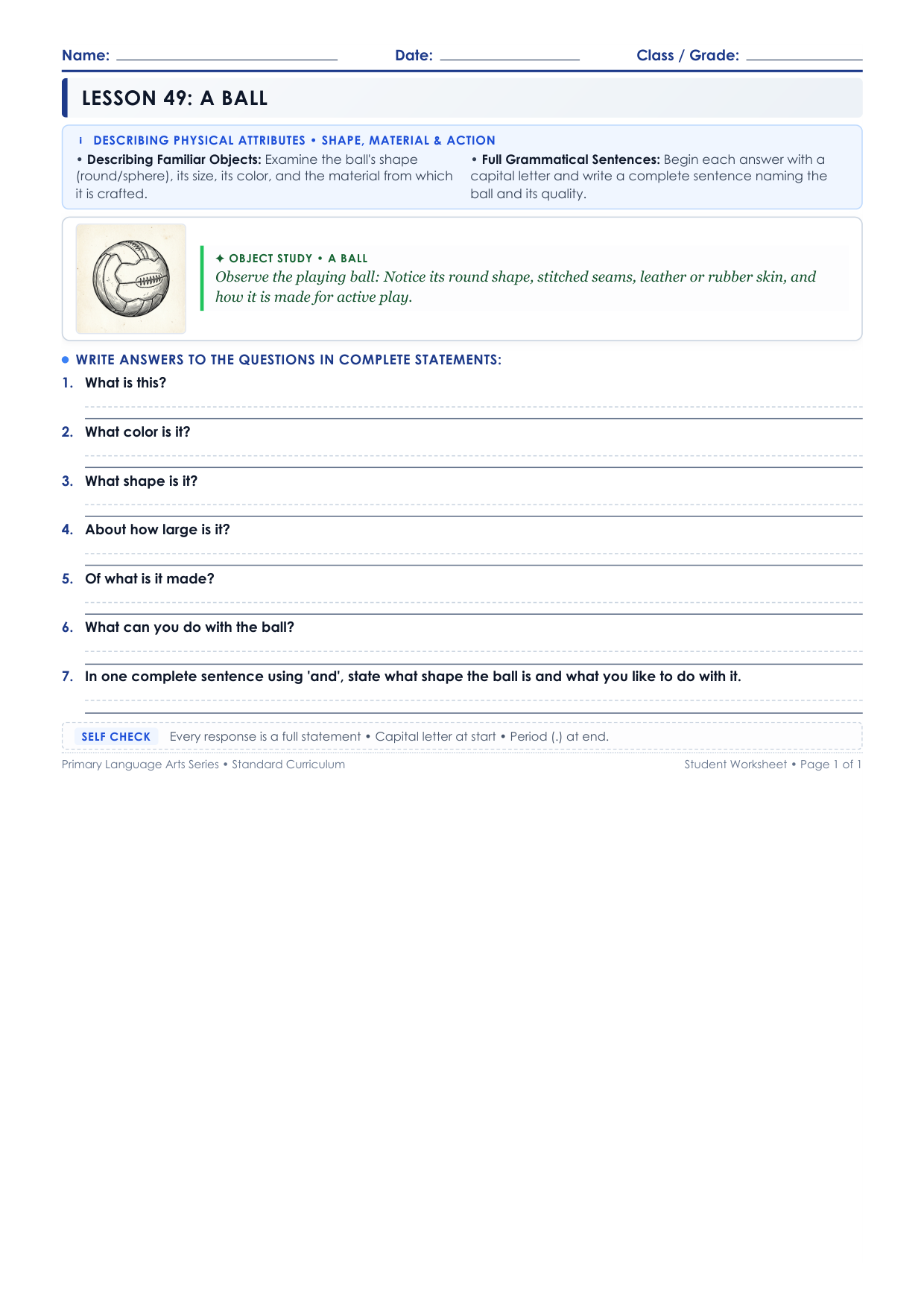
Lesson 49: A Ball
Investigate the spherical geometry, leather materials, and active motion of a playing ball, uniting shape and action in a compound statement.
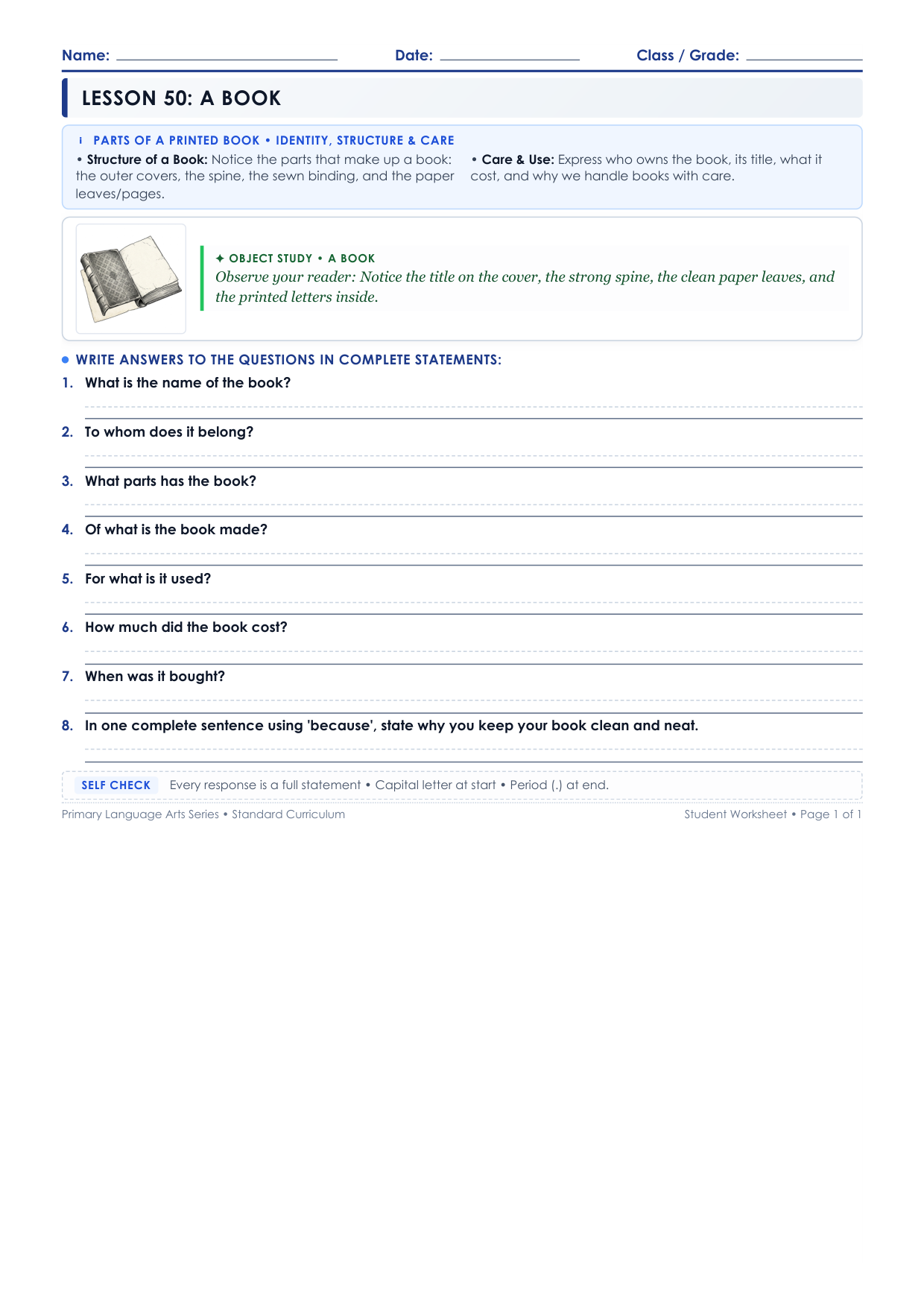
Lesson 50: A Book
Examine the covers, spine, and paper leaves of a school reader, explore ownership and value, and formulate statements on book care.
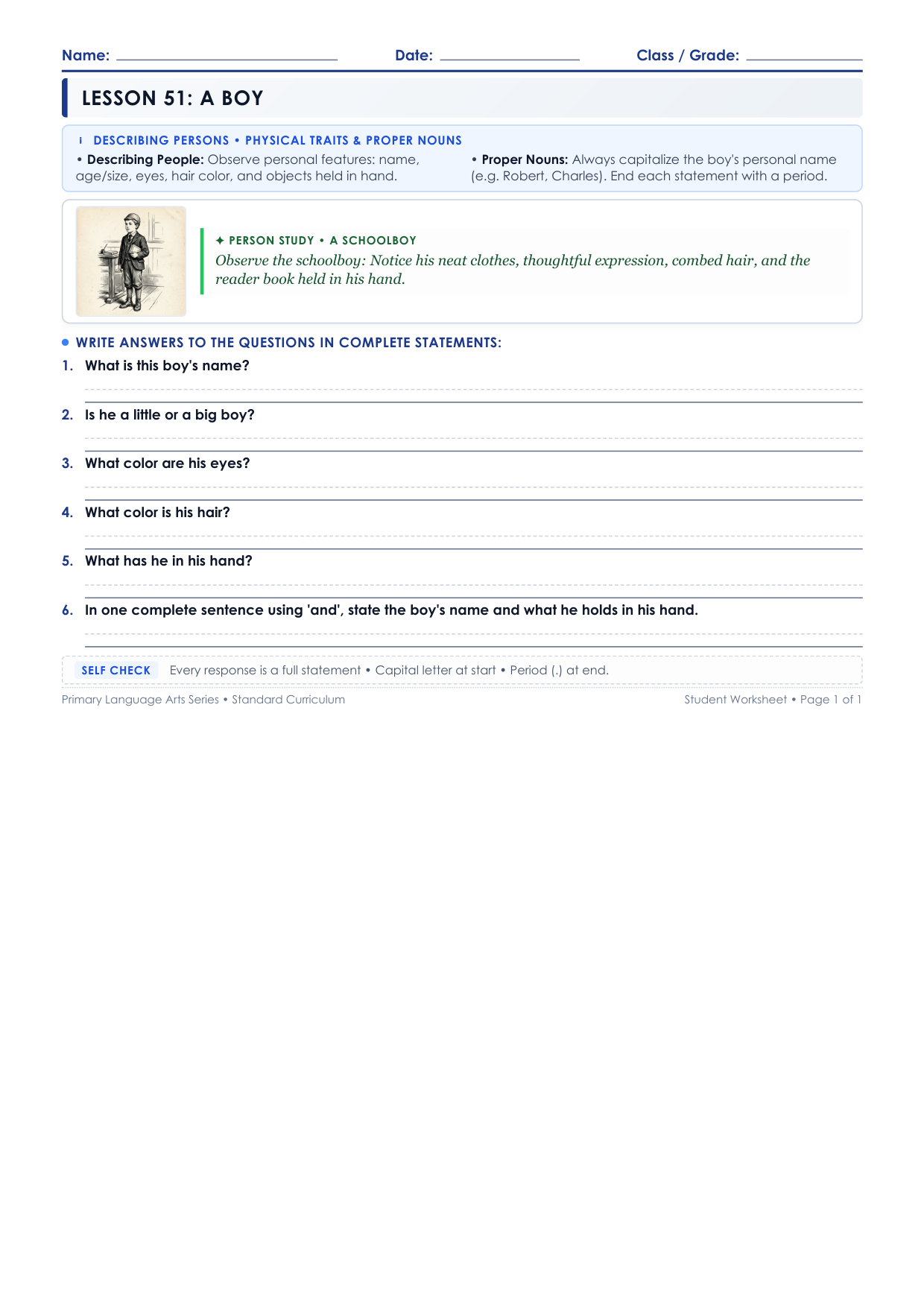
Lesson 51: A Boy
Observe a schoolboy's physical appearance, capitalize personal proper names, and formulate descriptive statements on carried objects.
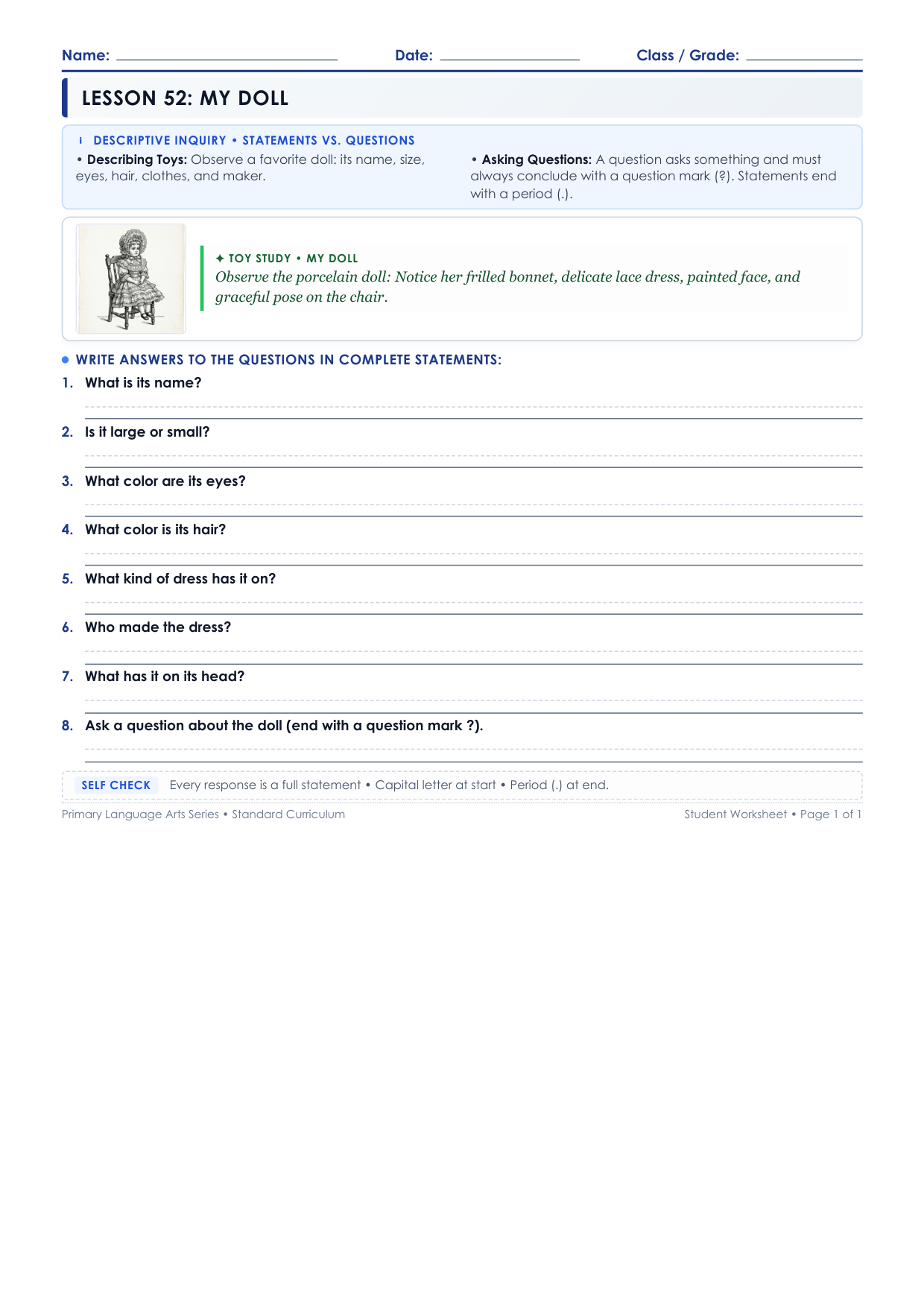
Lesson 52: My Doll
Describe a favorite porcelain doll in detail, distinguishing between declarative statements and constructing an original inquisitive question.
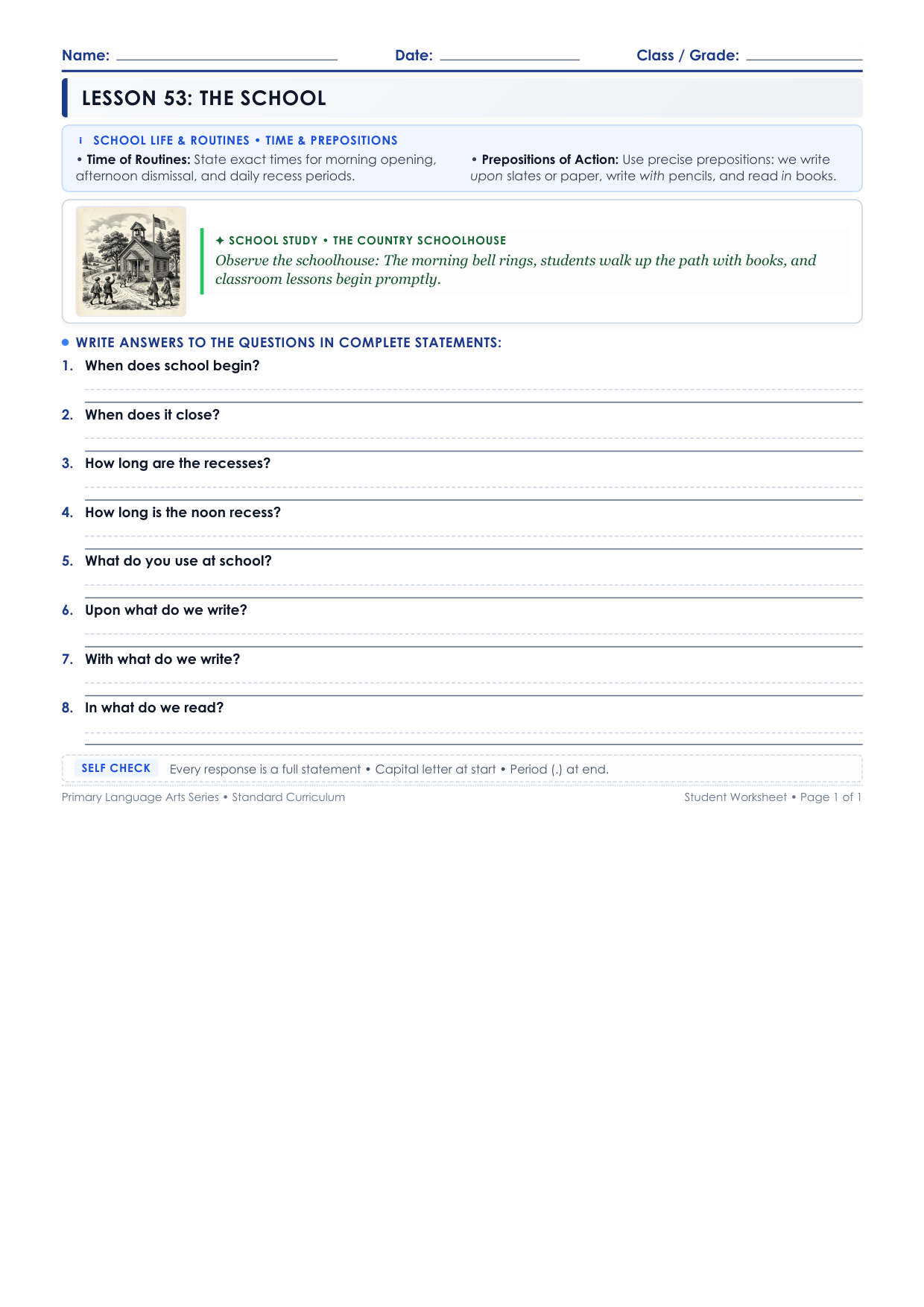
Lesson 53: The School
Inquire into school opening hours, recesses, and learning tools, mastering prepositions of instrument and surface (upon, with, in).
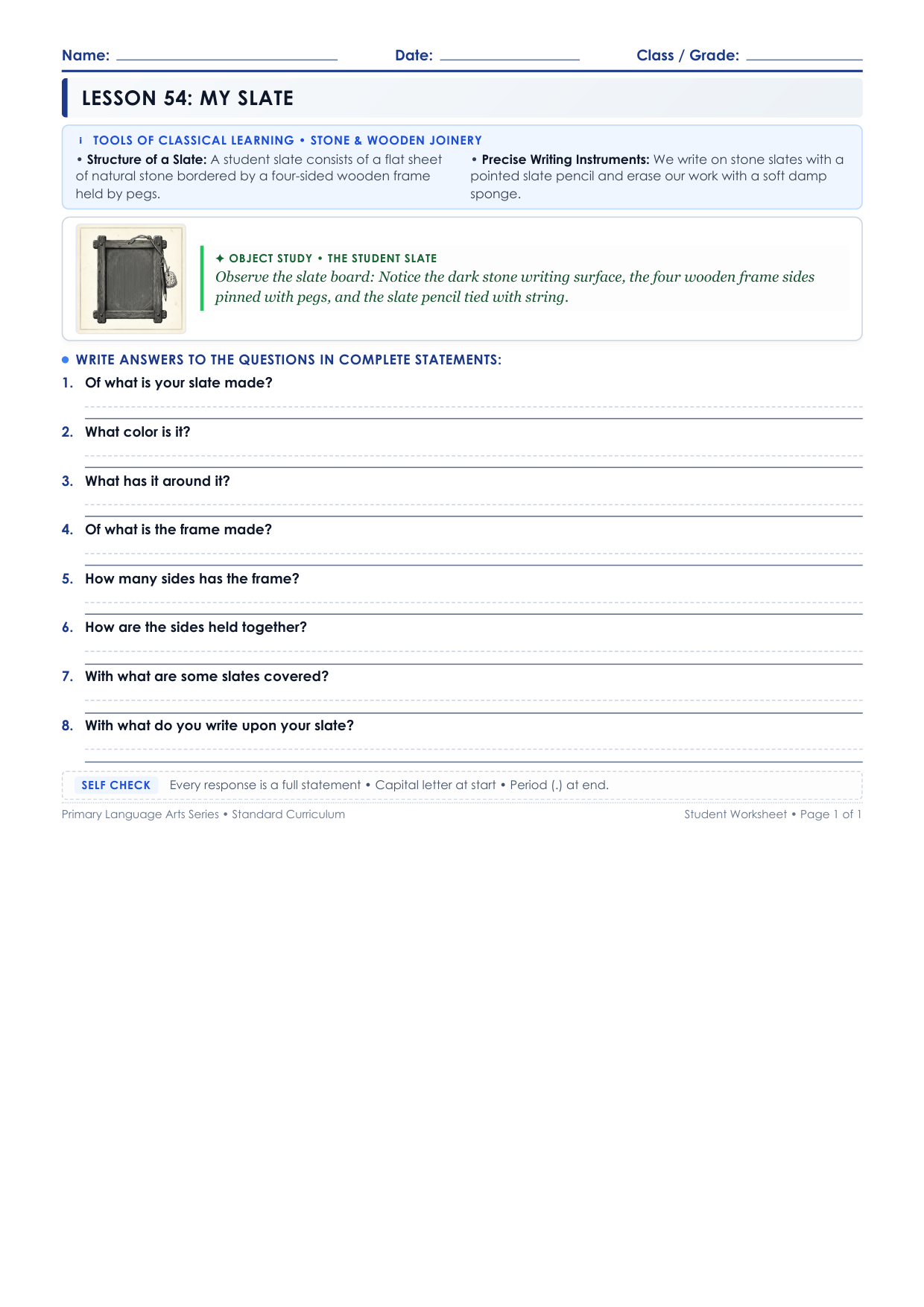
Lesson 54: My Slate
Examine the stone slab, wooden peg joinery, and pencil of a traditional student slate, describing tools of classical handwriting.
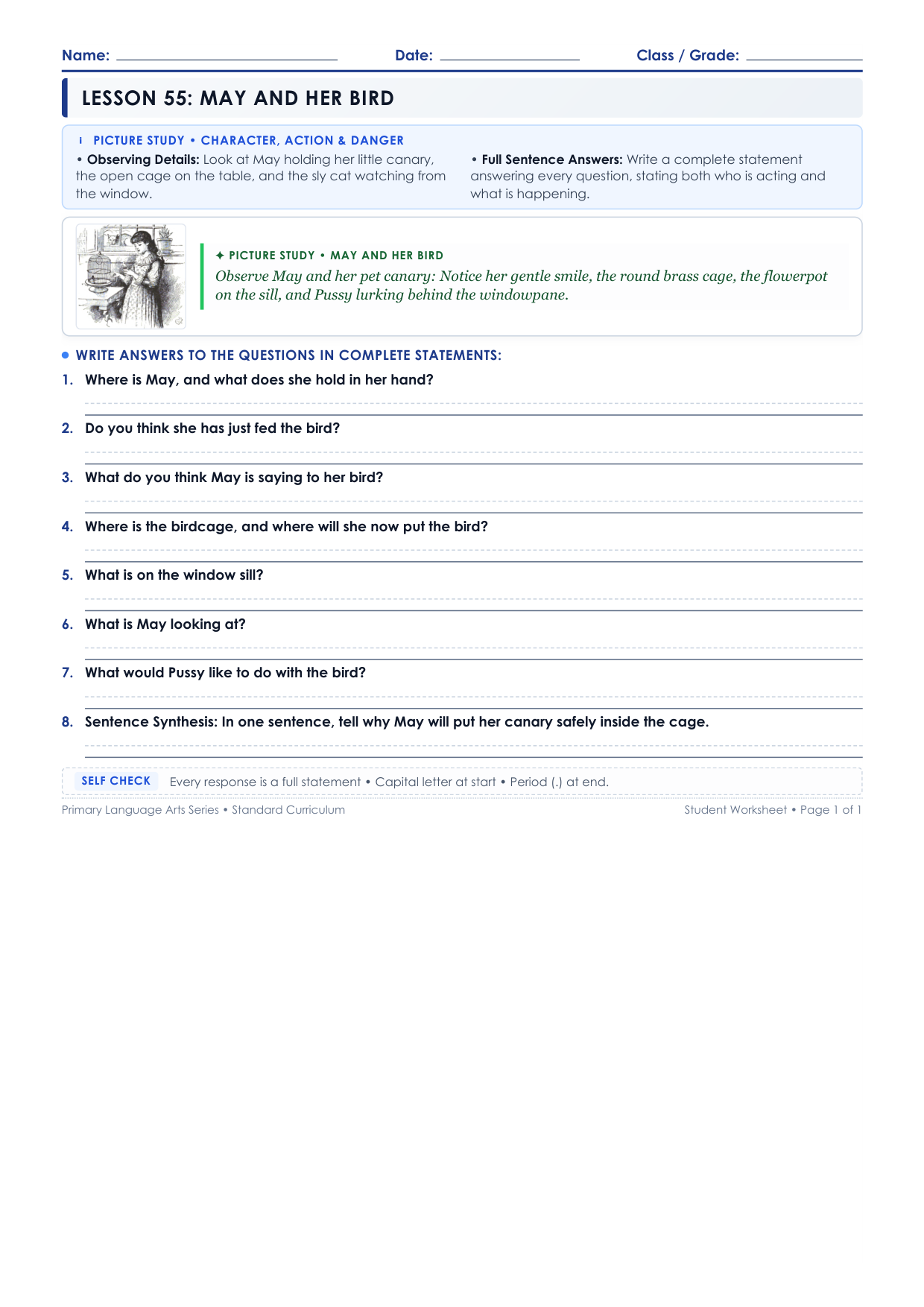
Lesson 55: May and Her Bird
Analyze the domestic scene of May holding her pet canary, identify the lurking cat outside the window, and compose complete answers.
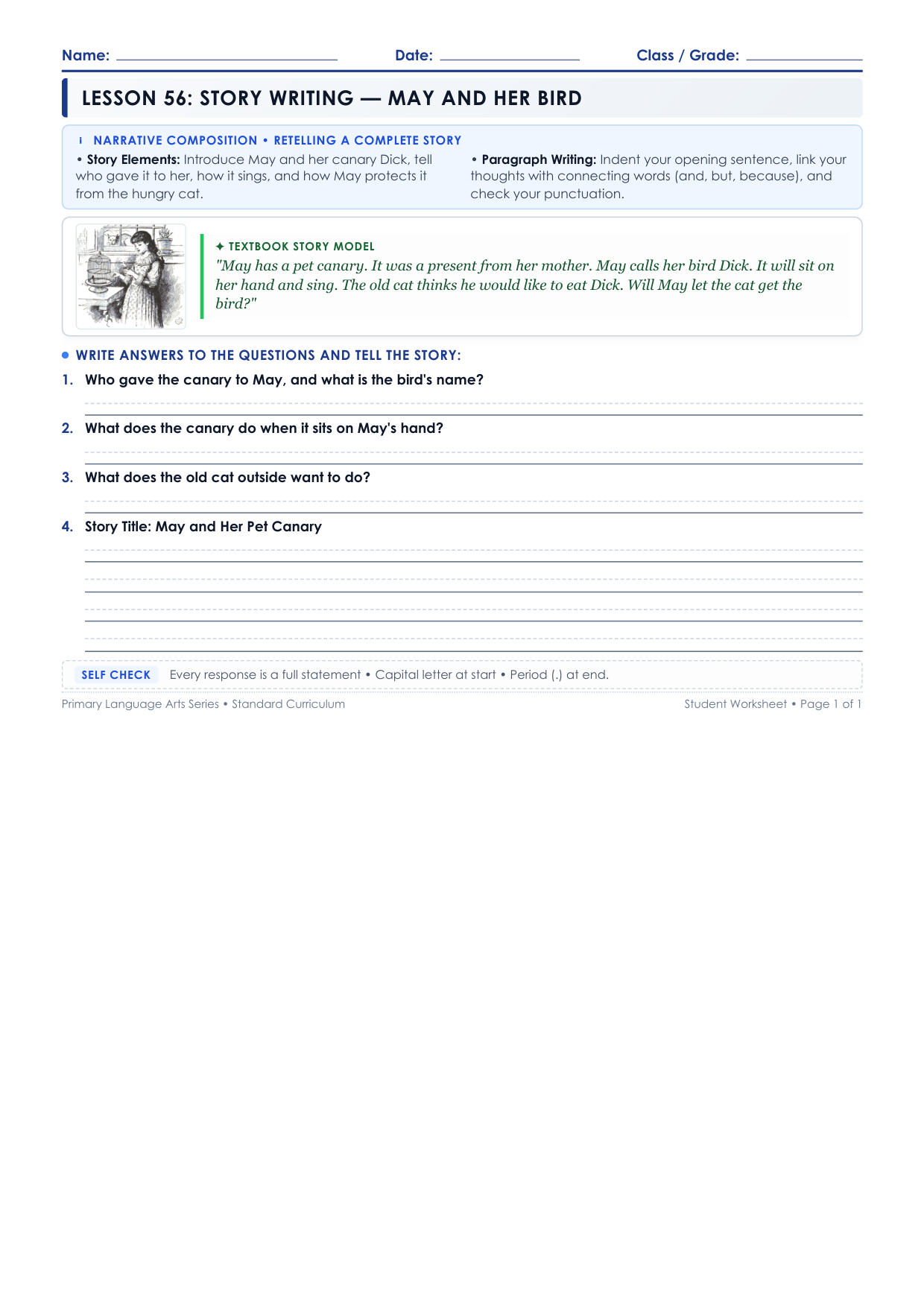
Lesson 56: Story Writing — May and Her Bird
Retell the complete story of May and her canary Dick, detailing mother's gift, the bird's singing, and how May protects Dick from the cat.
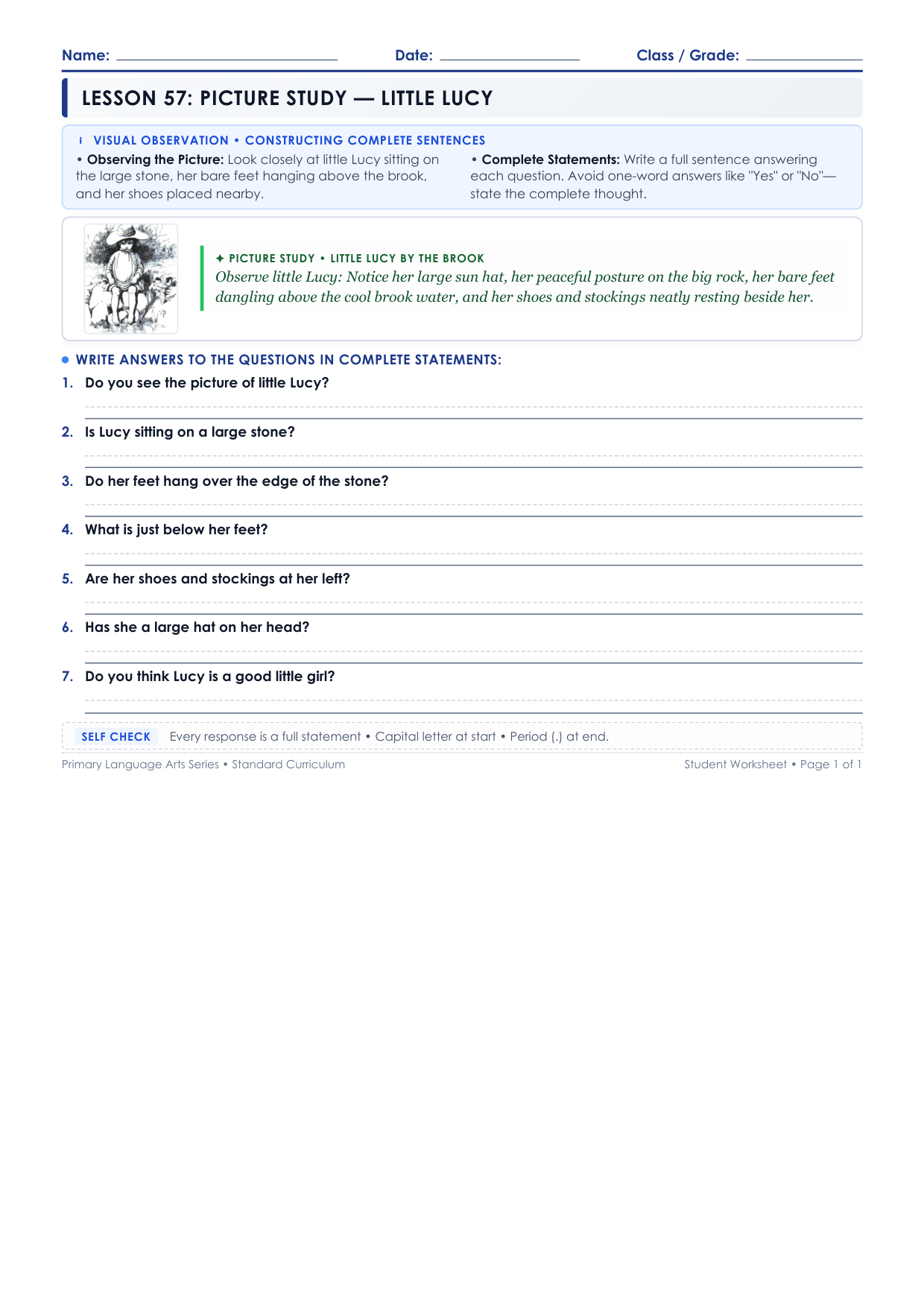
Lesson 57: Picture Study — Little Lucy
Observe little Lucy sitting quietly on a large rock by the brook, examine her bare feet and shoes, and formulate complete answers.
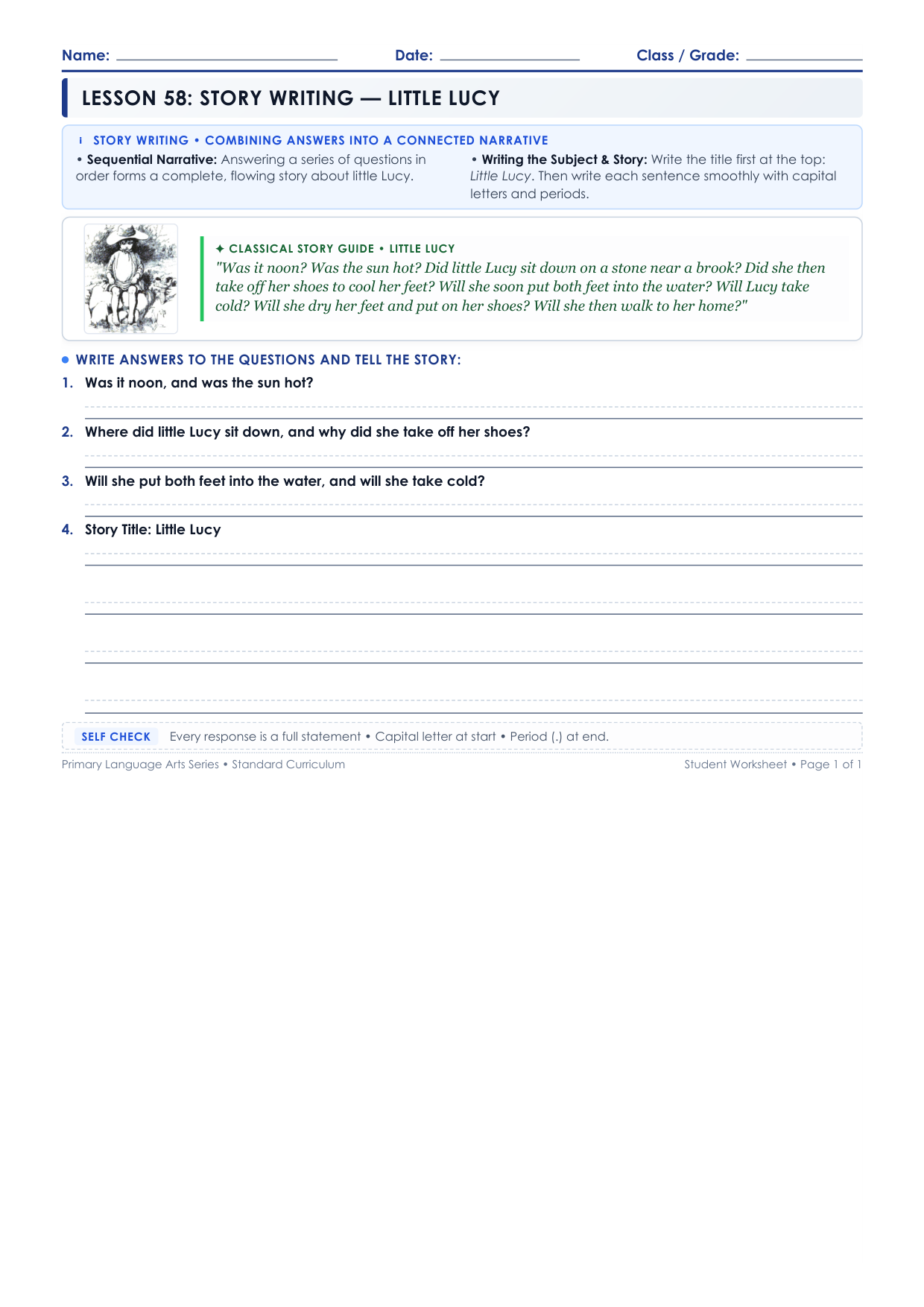
Lesson 58: Story Writing — Little Lucy
Compose a connected narrative from sequential questions, telling how Lucy cooled her feet in the brook on a hot summer noon and walked safely home.
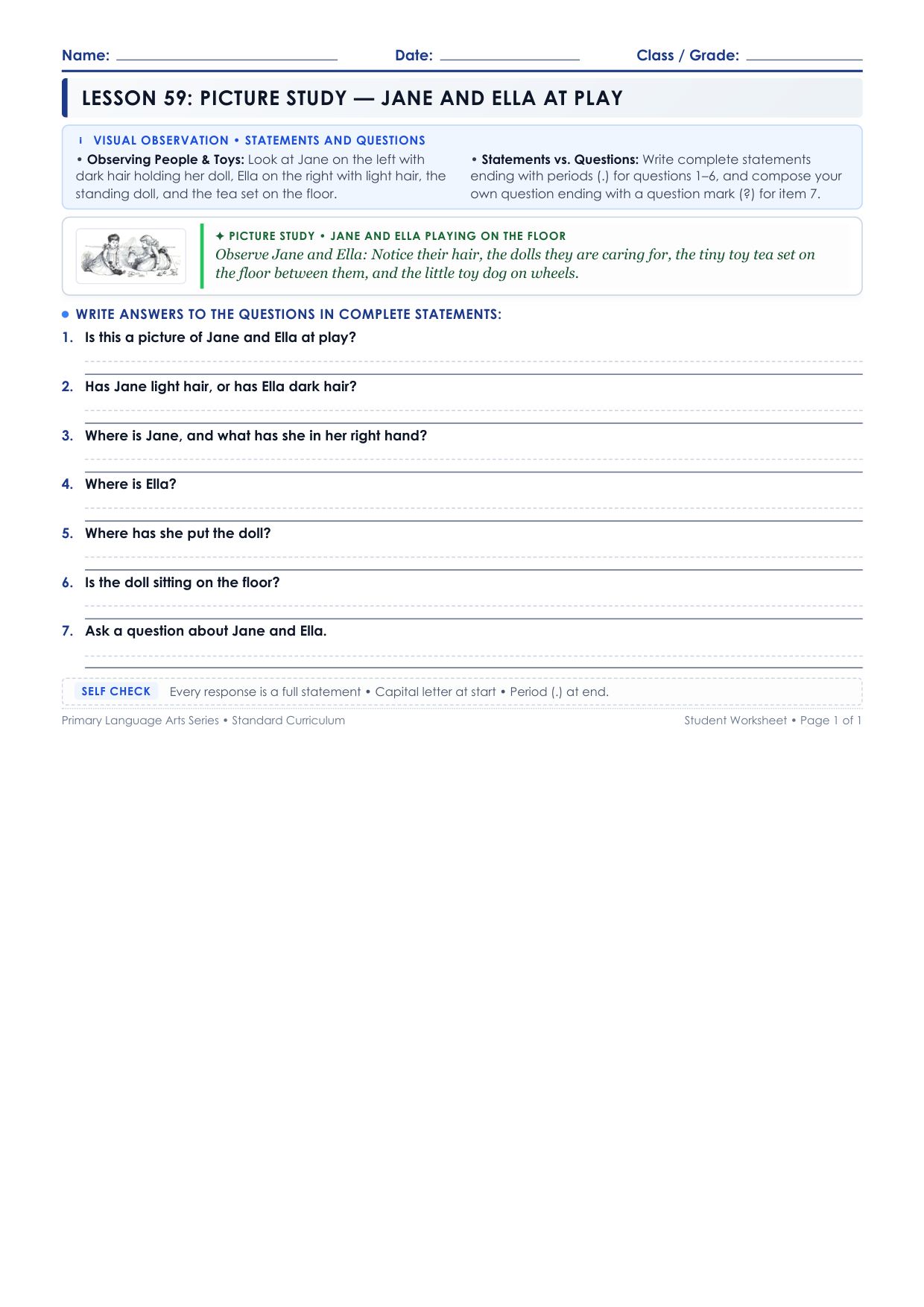
Lesson 59: Jane and Ella at Play
Study Jane and Ella playing with dolls and tea sets on the floor, examine hair and actions, and practice writing both statements and questions.
Lesson 60: Story Writing — Jane and Her Doll
Compose an imaginative narrative paragraph telling Jane's age, her doll's name, pretend play games, and how lovingly she cares for her doll.
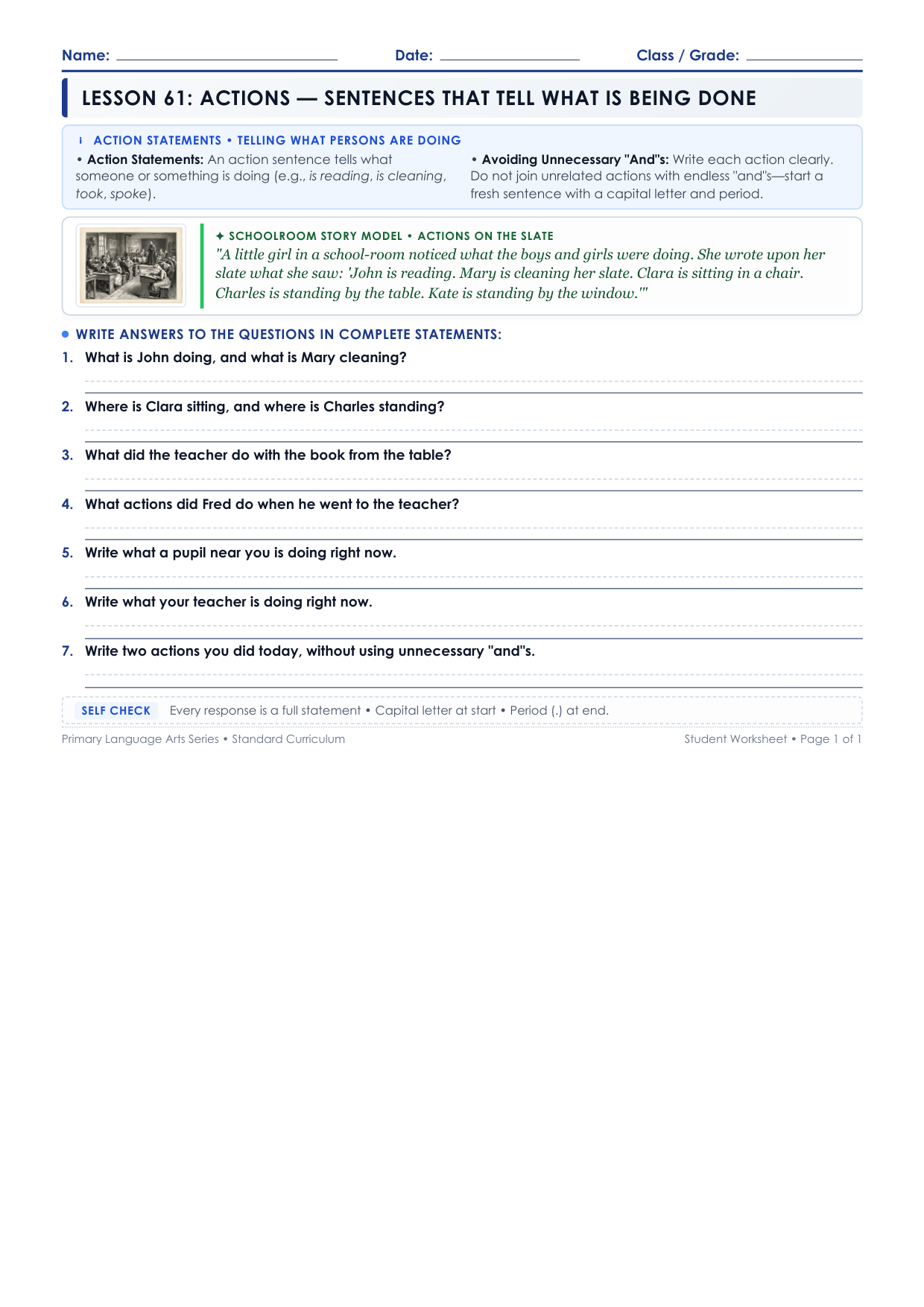
Lesson 61: Actions — Sentences of Action
Discover action verbs in the schoolroom, describe what classmates and teachers do, and practice writing clean sentences without unnecessary "and"s.
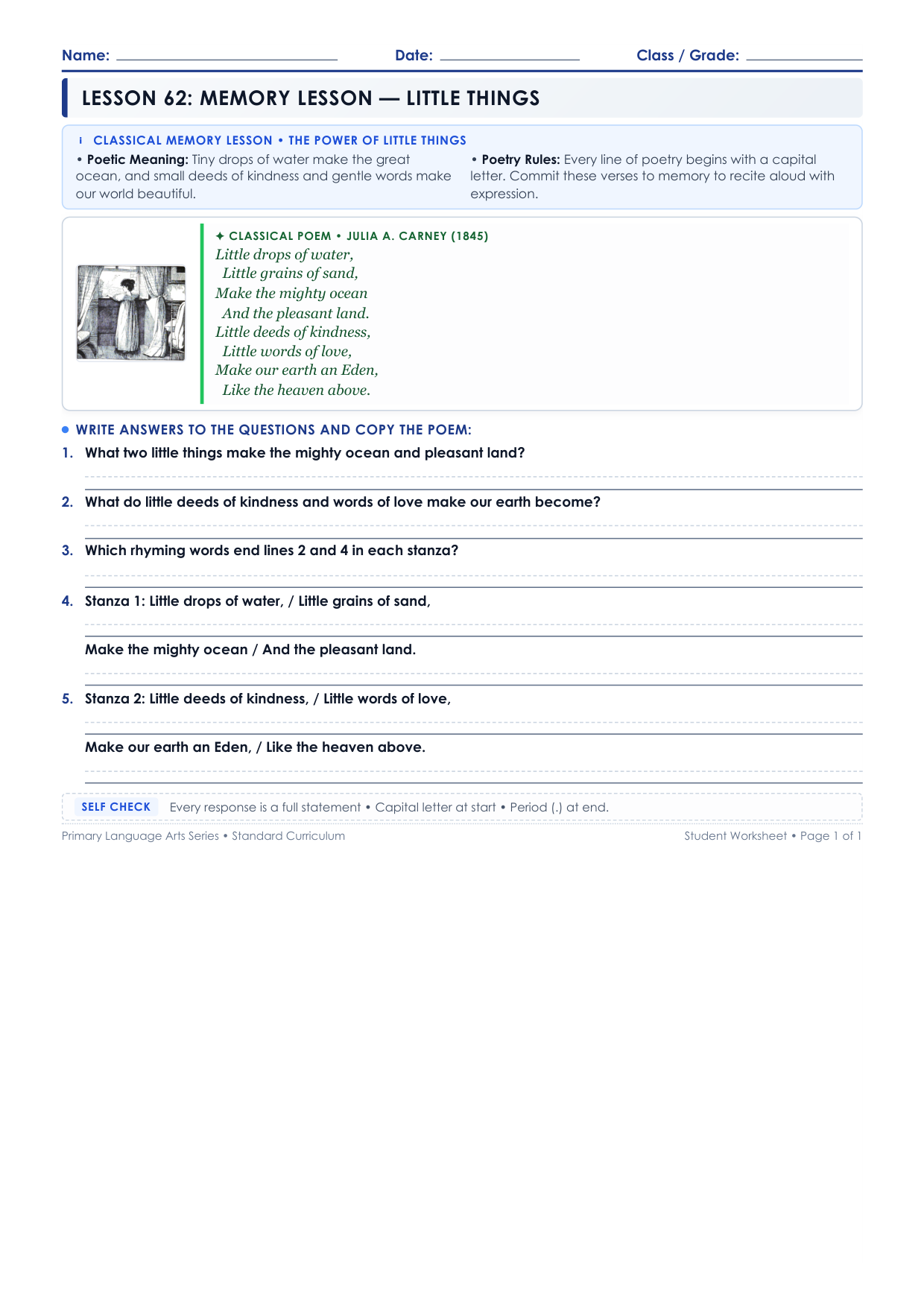
Lesson 62: Memory Lesson — Little Things
Study Julia A. Carney's classical poem "Little Things", analyze rhyming patterns, copy verses with capital letters, and commit the lines to memory.
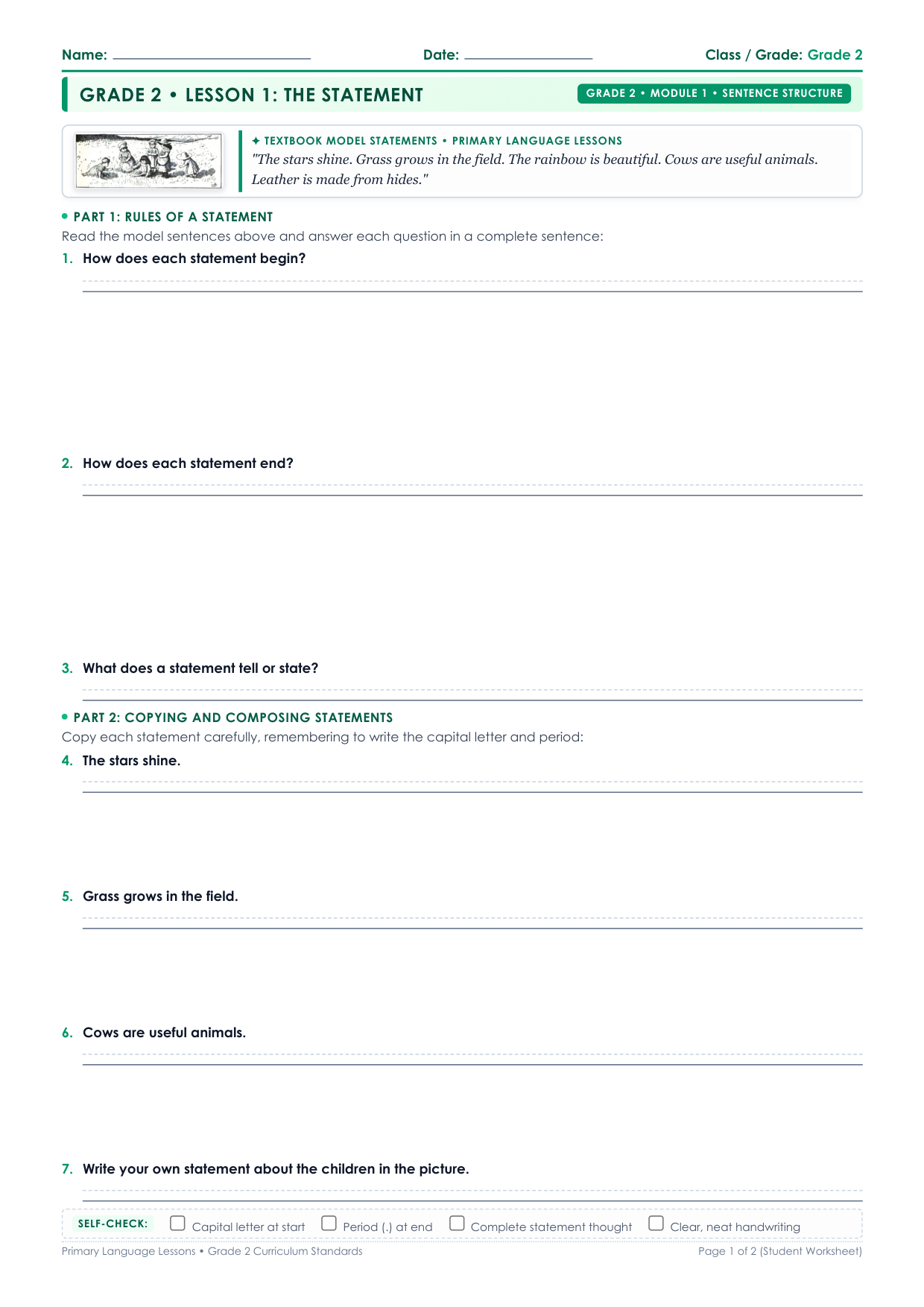
Grade 2 • Lesson 1: The Statement
Master the foundational unit of syntax: define what a statement is, practice initial capitalization and terminal periods, and write original statements.
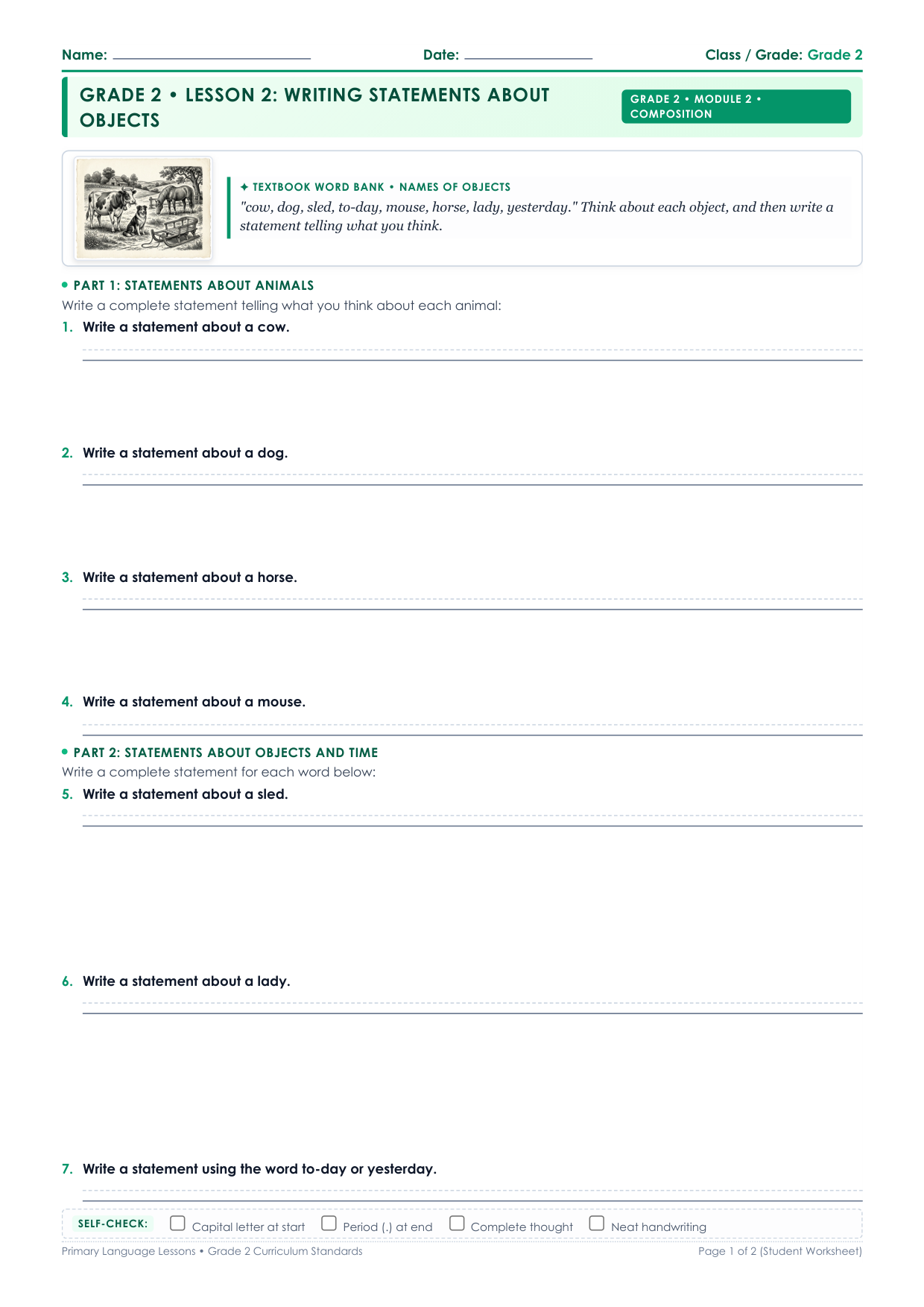
Grade 2 • Lesson 2: Writing Statements
Compose complete declarative statements using 8 target nouns (cow, dog, sled, to-day, mouse, horse, lady, yesterday) with proper capitalization and terminal punctuation.
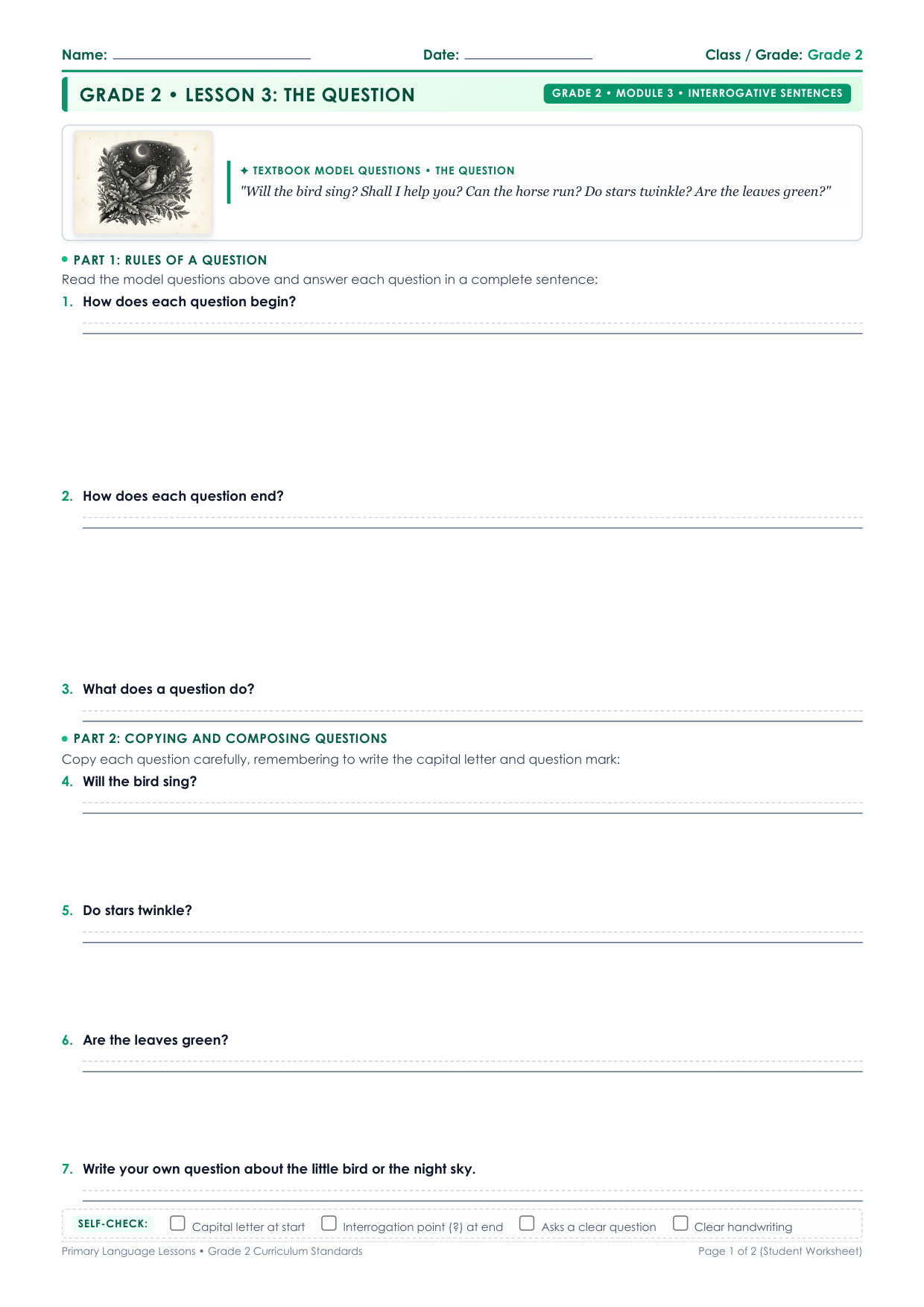
Grade 2 • Lesson 3: The Question
Distinguish questions from statements, master the interrogation point (?), and practice terminal punctuation cadences across interrogative inquiries.
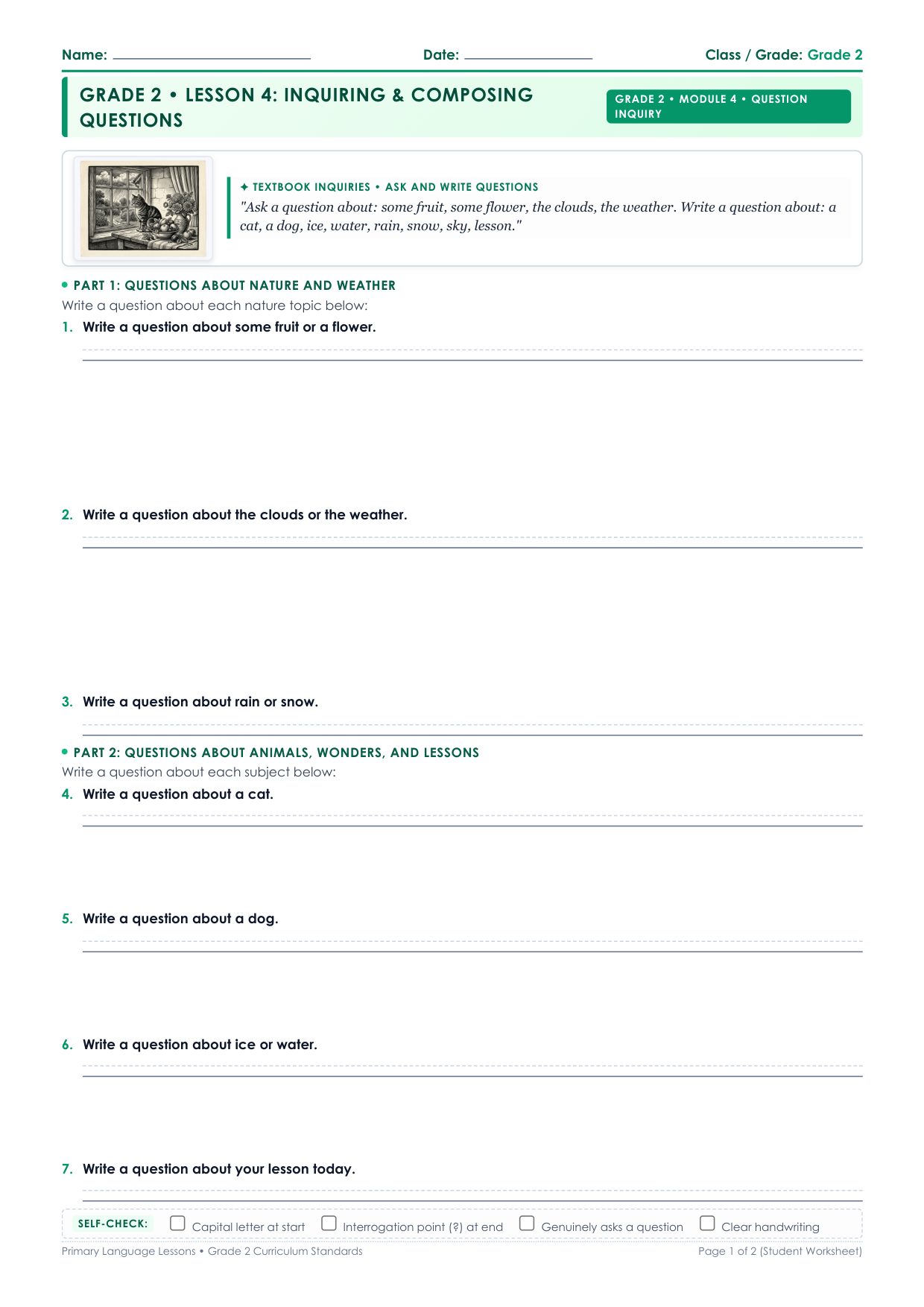
Grade 2 • Lesson 4: Asking Questions
Formulate original questions about 12 nouns spanning nature, animals, and weather (fruit, flower, clouds, weather, cat, dog, ice, water, rain, snow, sky, lesson).
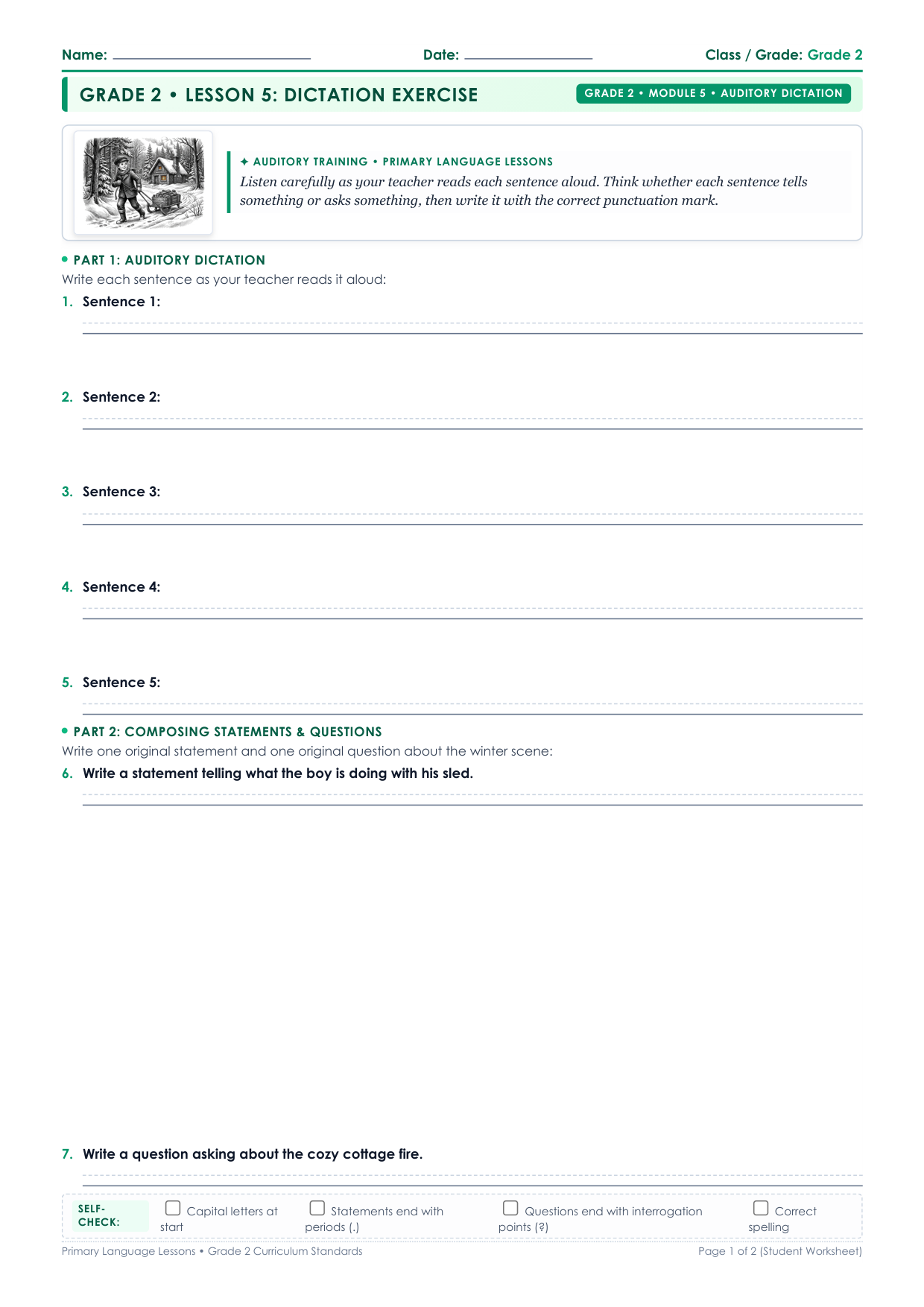
Grade 2 • Lesson 5: Dictation Exercise
Classical auditory dictation exercise: listen attentively without repetition to transcribe declarative and interrogative sentences, mastering terminal punctuation.
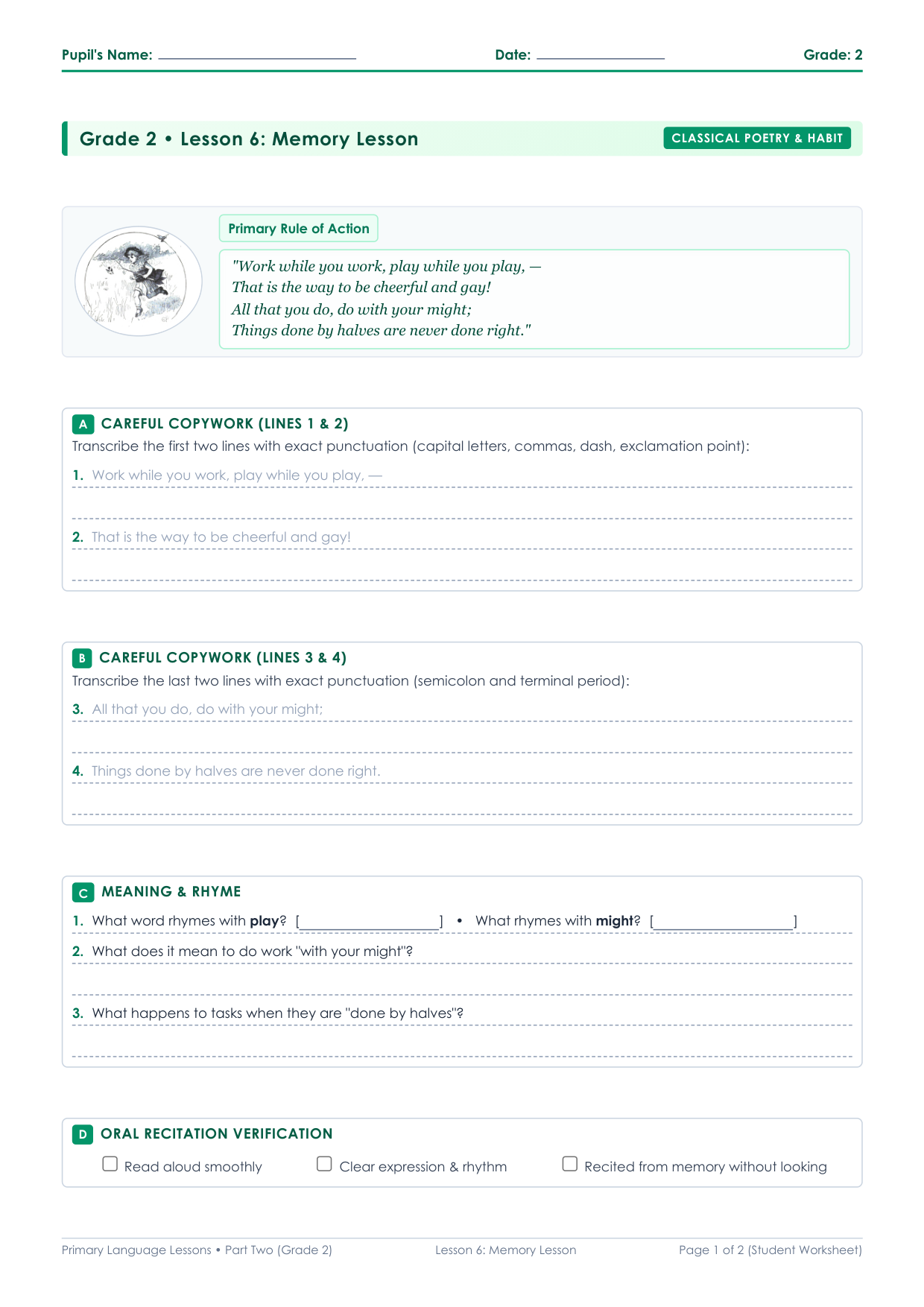
Grade 2 • Lesson 6: Memory Lesson
Copy, commit to memory, and recite classical verses ("Work while you work, play while you play"). Cultivate habits of single-minded focus, rhyme recognition, and clear oral recitation.
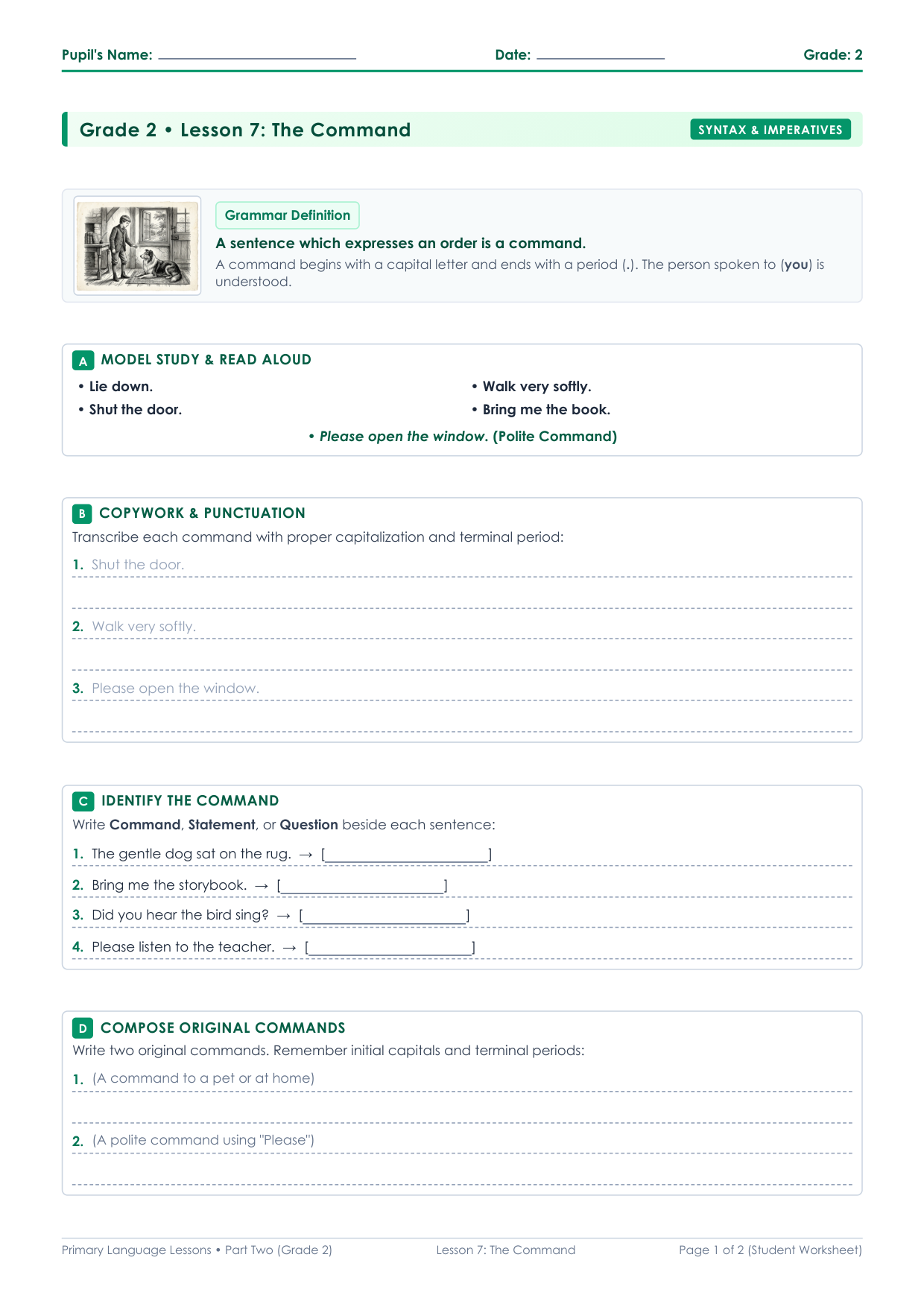
Grade 2 • Lesson 7: The Command
Learn the definition and syntactic structure of a command (imperative sentence). Understand understood subjects ("you"), practice copywork, and distinguish commands from statements and questions.
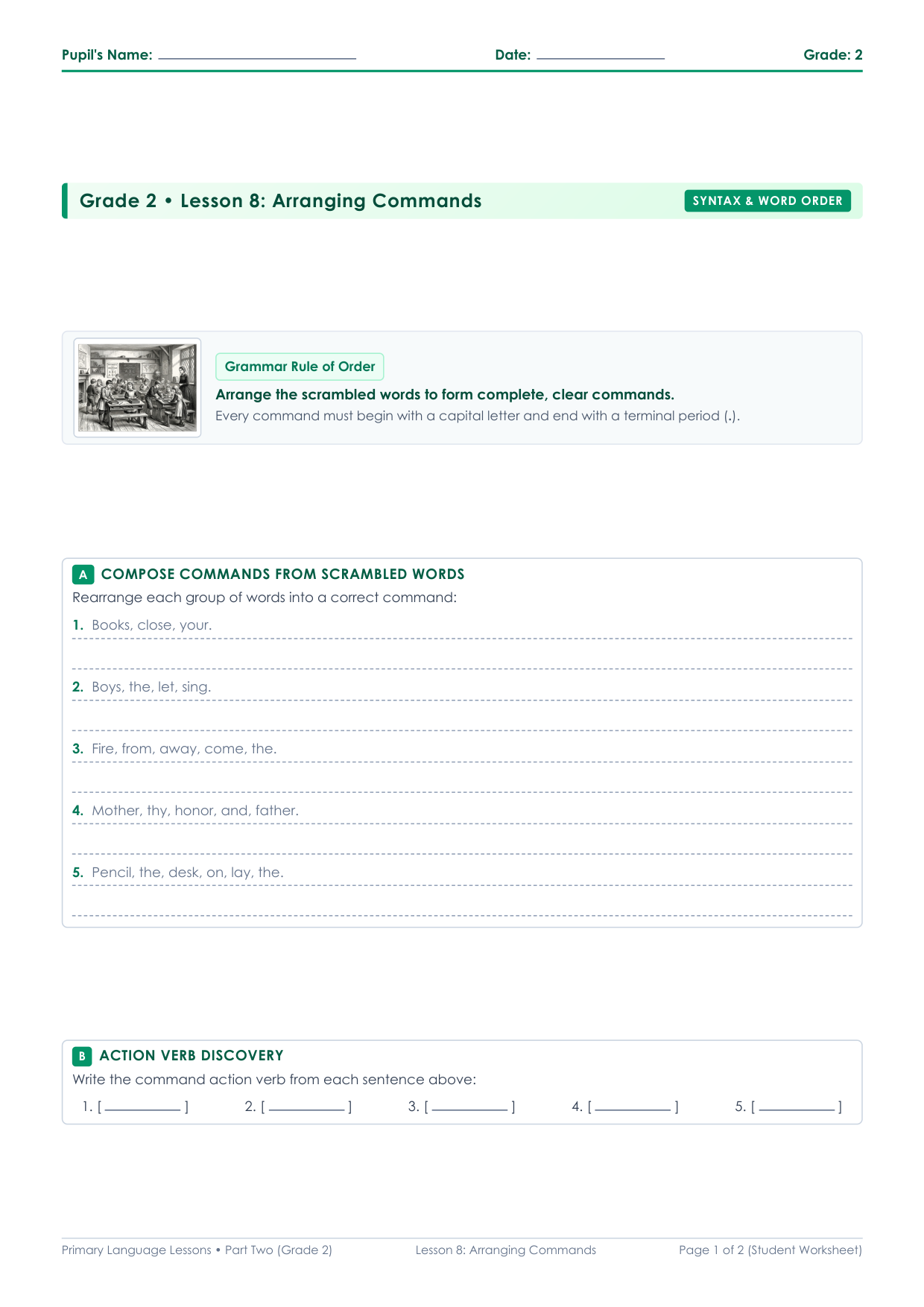
Grade 2 • Lesson 8: Arranging Commands
Rearrange scrambled word groups into grammatically complete commands. Observe imperative action verbs, practice initial capitalization, and ensure terminal periods.
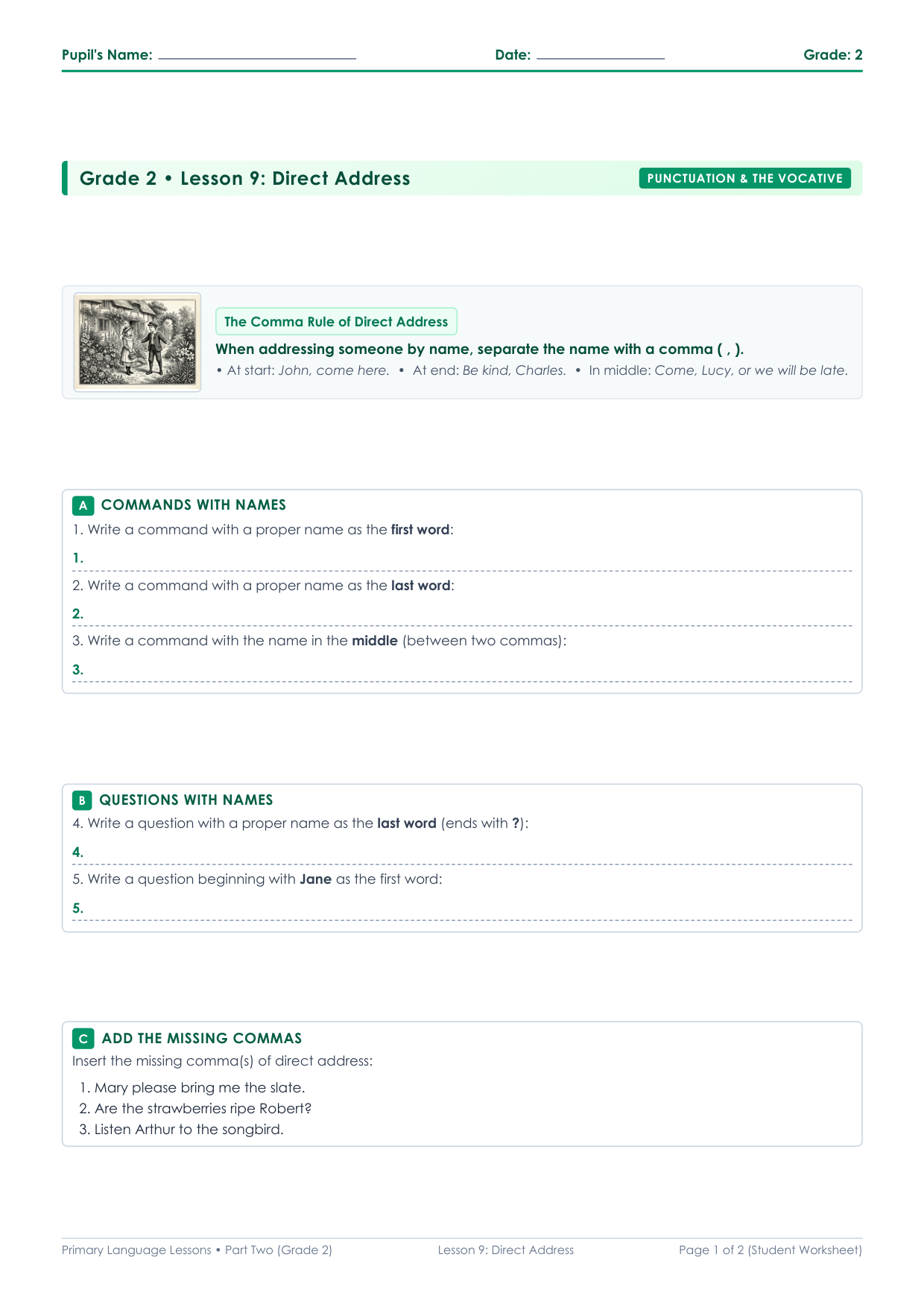
Grade 2 • Lesson 9: Direct Address
Master the comma rule of direct address: punctuate proper names at the beginning, middle, or end of commands and questions. Write original sentences using vocative nouns.
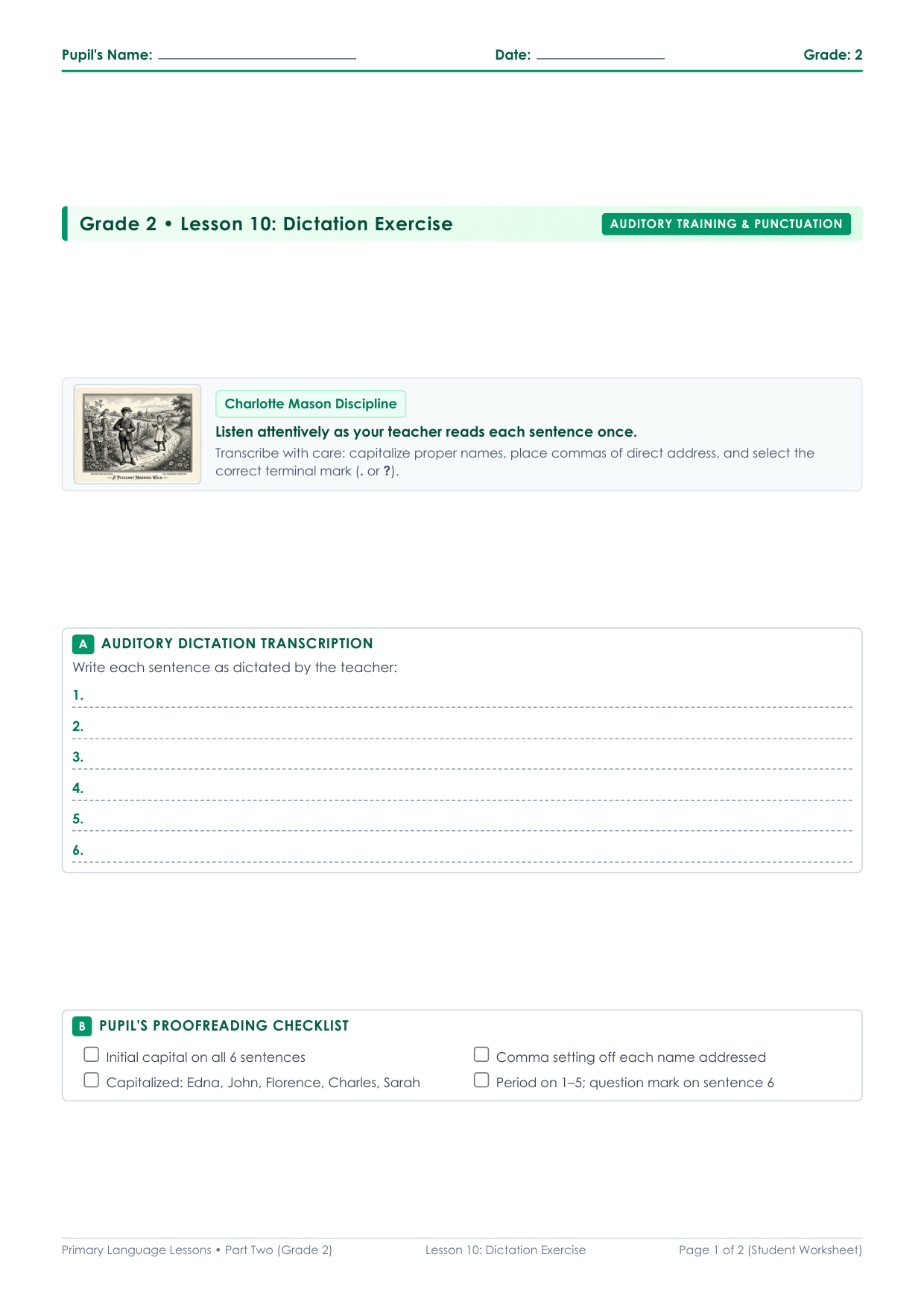
Grade 2 • Lesson 10: Dictation Exercise
Classical auditory dictation training unbroken attention: listen once to transcribe 6 sentences with vocative commas, proper name capitals, and terminal cadences (. or ?).
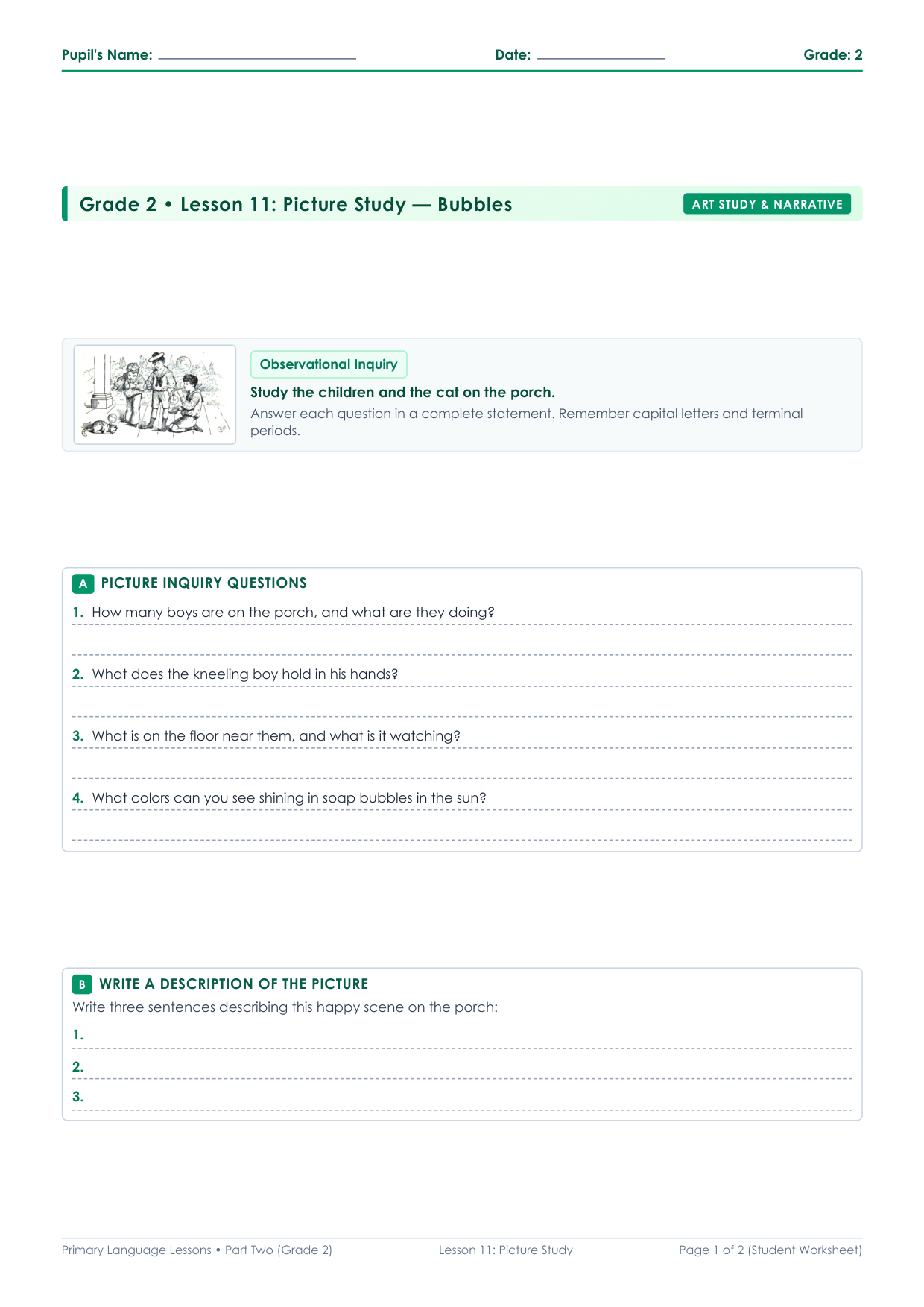
Grade 2 • Lesson 11: Picture Study — Bubbles
Engage in classical observational inquiry: examine three boys blowing soap bubbles with clay pipes and a playful cat. Formulate complete descriptive sentences and write a short narrative.
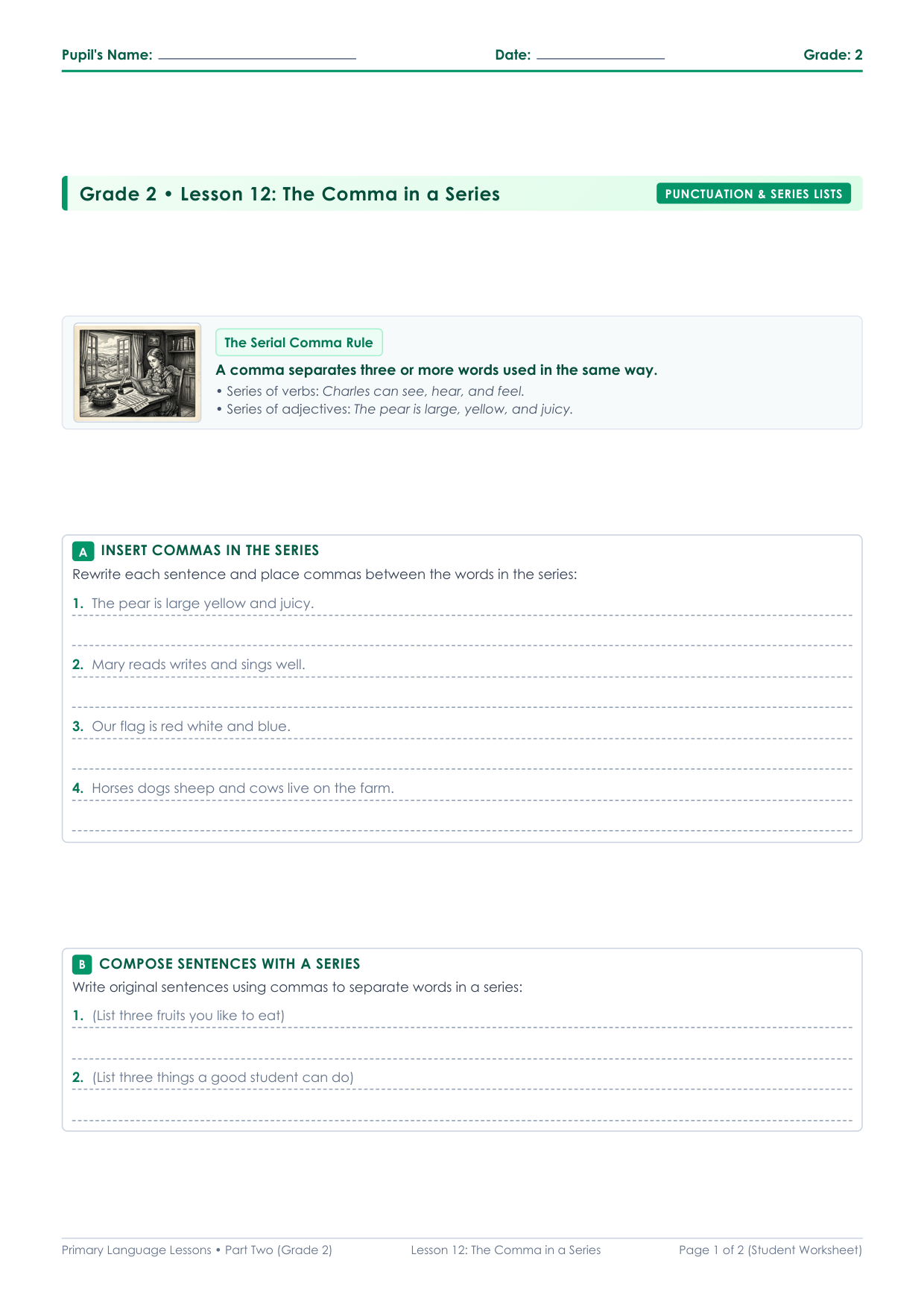
Grade 2 • Lesson 12: The Comma in a Series
Learn the fundamental serial (Oxford) comma rule separating three or more coordinate words. Punctuate lists of adjectives, action verbs, and nouns, and compose original series sentences.
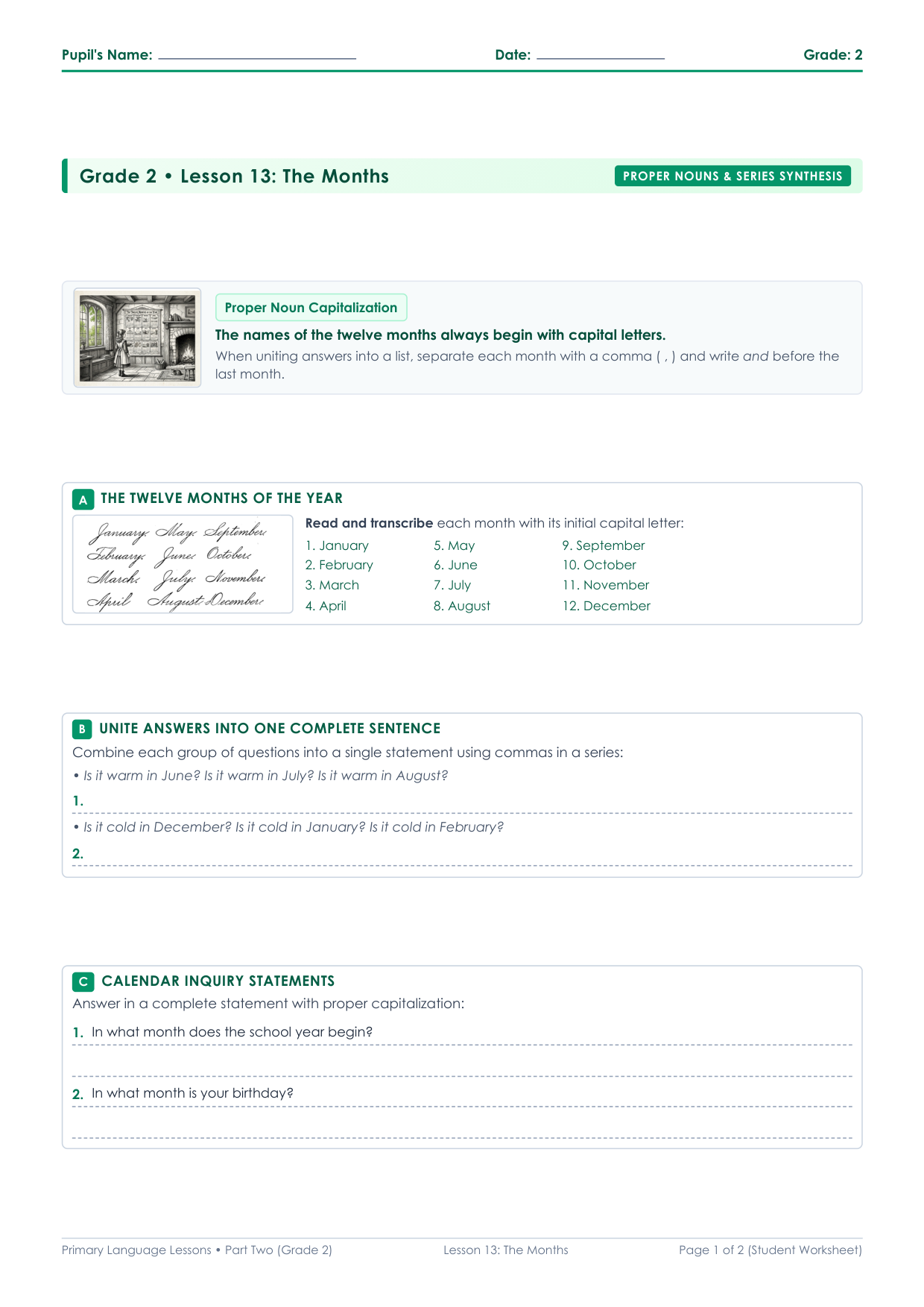
Grade 2 • Lesson 13: The Months
Study the twelve months in classical Spencerian script. Master proper noun capitalization, and combine answers into elegant coordinate series with serial commas.
Grade 2 • Lesson 14: The Seasons
Learn the crucial distinction between common nouns (seasons) and proper nouns (months and holidays). Punctuate lists of seasons, months, and compound holiday names.
Grade 2 • Lesson 15: Seasons & Weather
Compose complete declarative statements answering questions about the four seasons, temperature extremes, and temperate weather patterns.
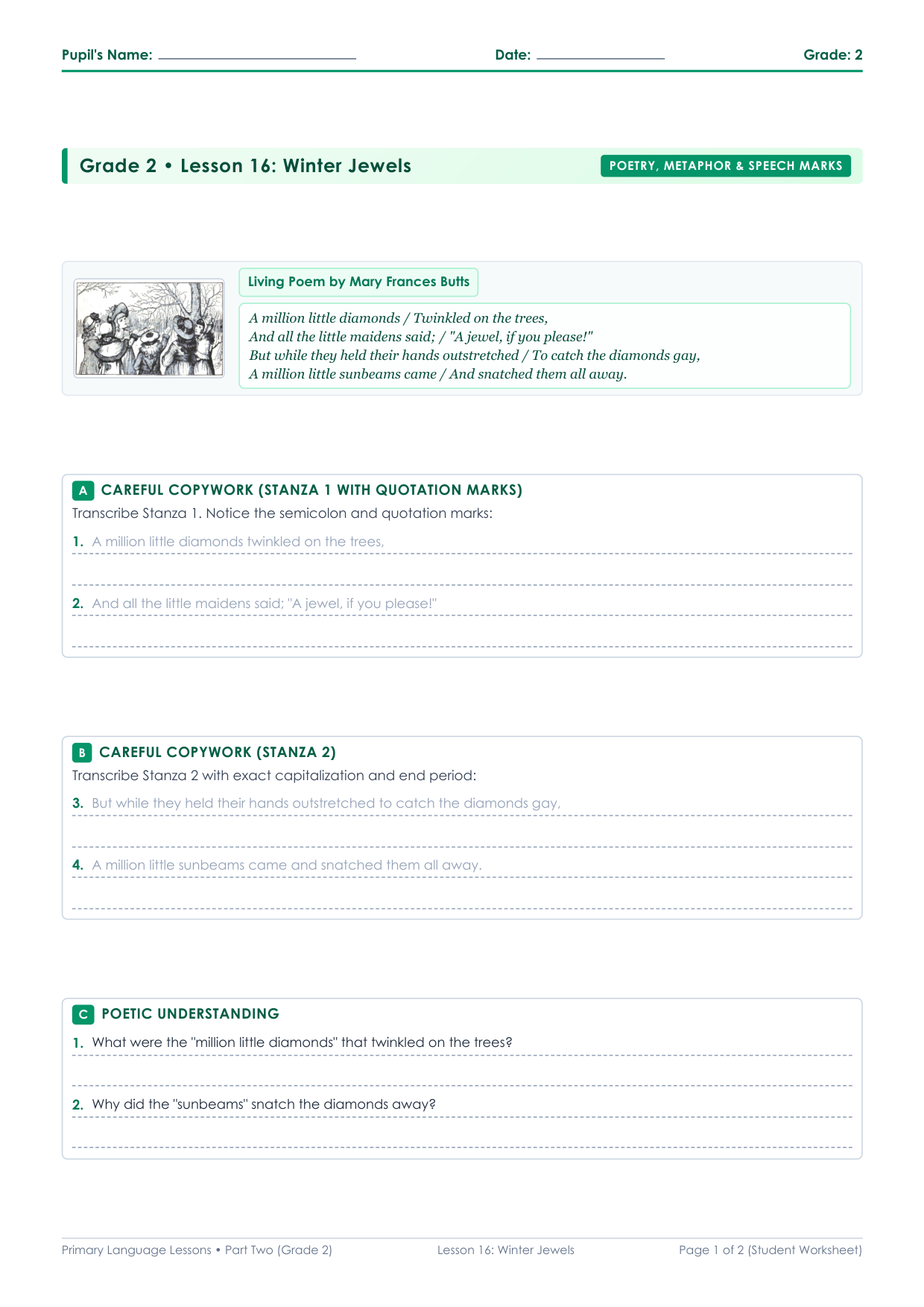
Grade 2 • Lesson 16: Winter Jewels
Study Mary Frances Butts's classic winter poem. Analyze poetic metaphors, identify rhyming pairs, and practice punctuating direct quotations with speech marks.
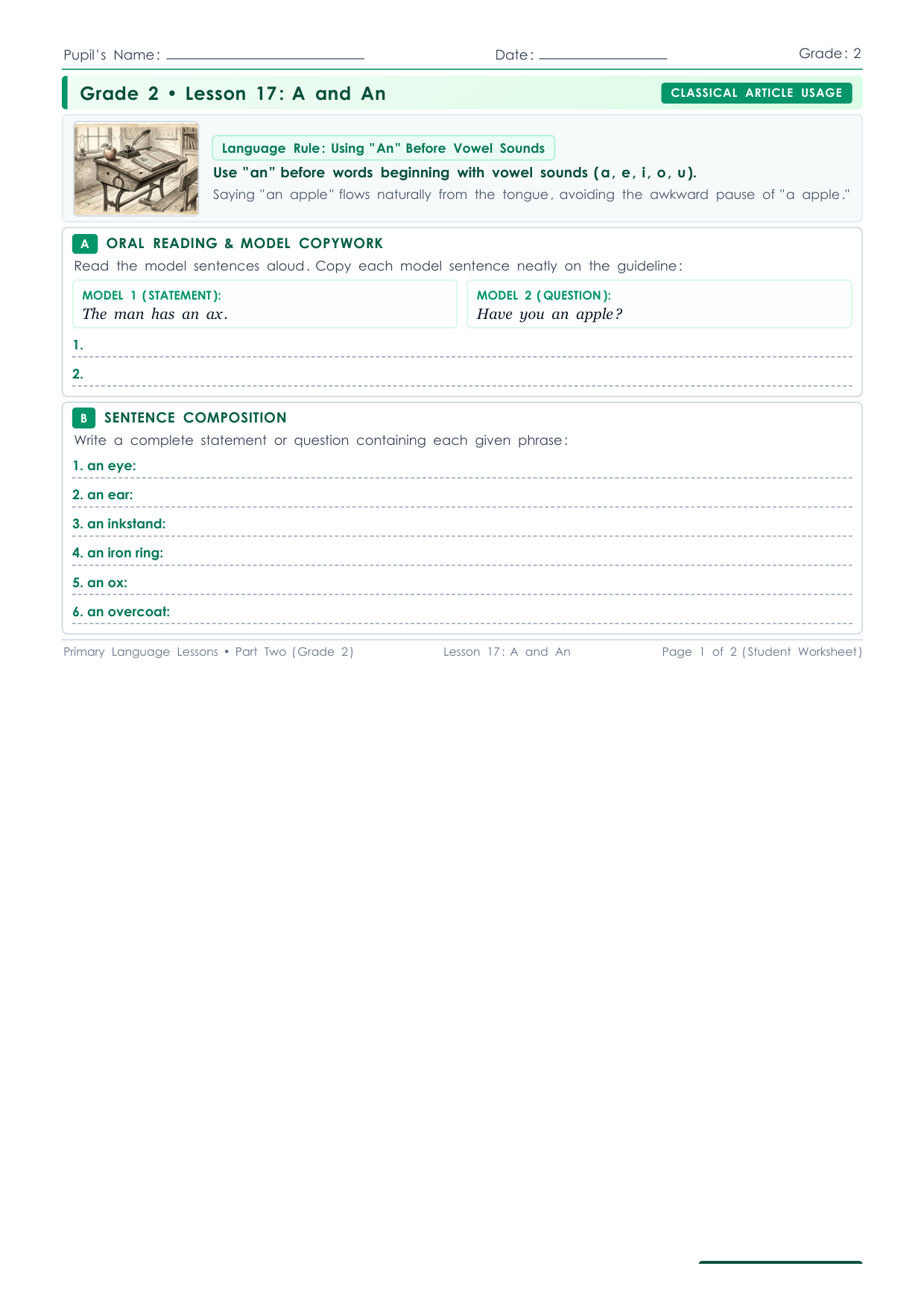
Grade 2 • Lesson 17: A and An
Discover the euphonic rule for using "an" before initial vowel sounds. Practice copywork of model statements and questions, and compose original sentences.
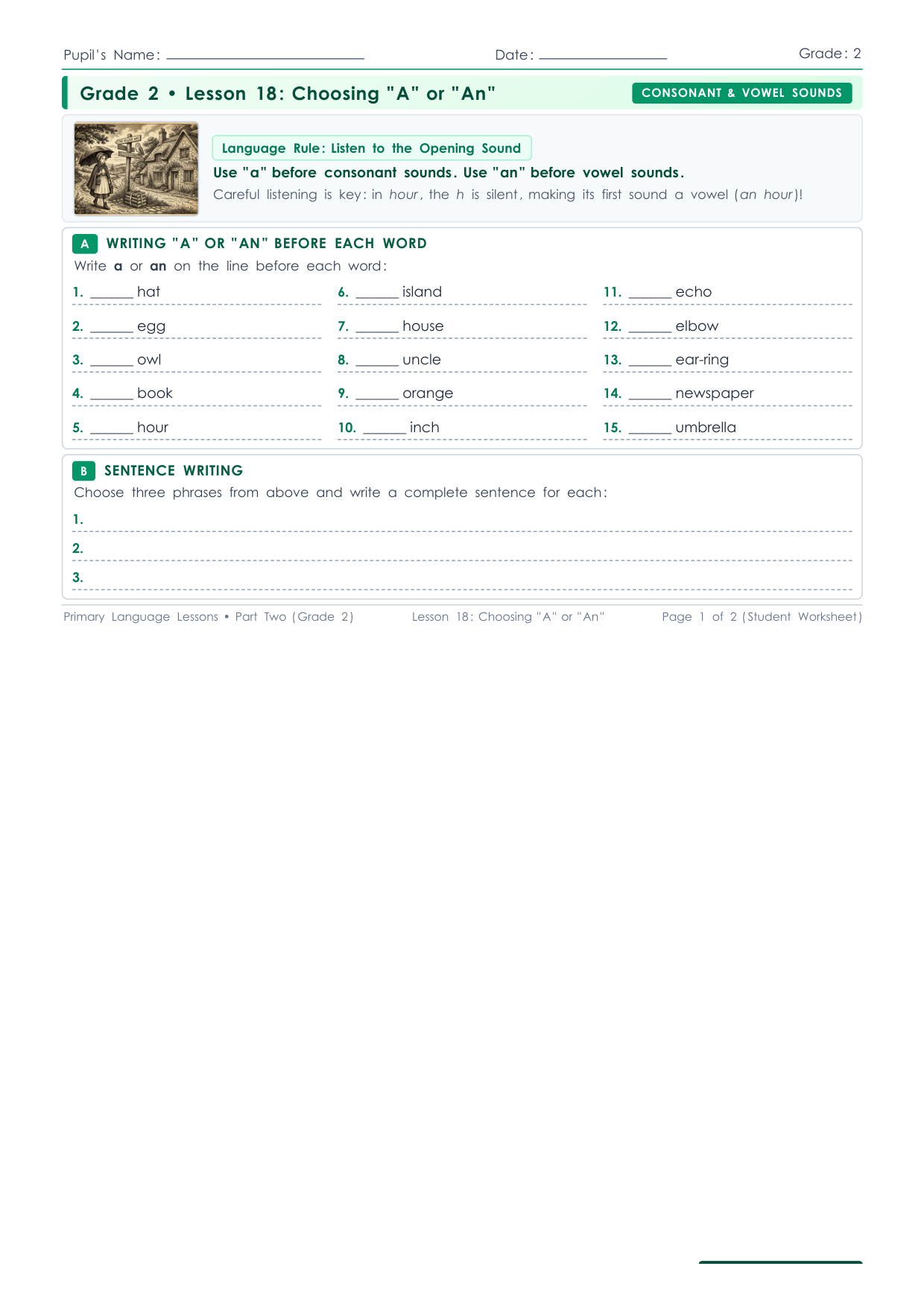
Grade 2 • Lesson 18: Choosing "A" or "An"
Sort 15 vocabulary words by initial consonant vs. vowel sound. Master phonetic exceptions such as silent "h" in "an hour" compared to "a hat" and "a house."
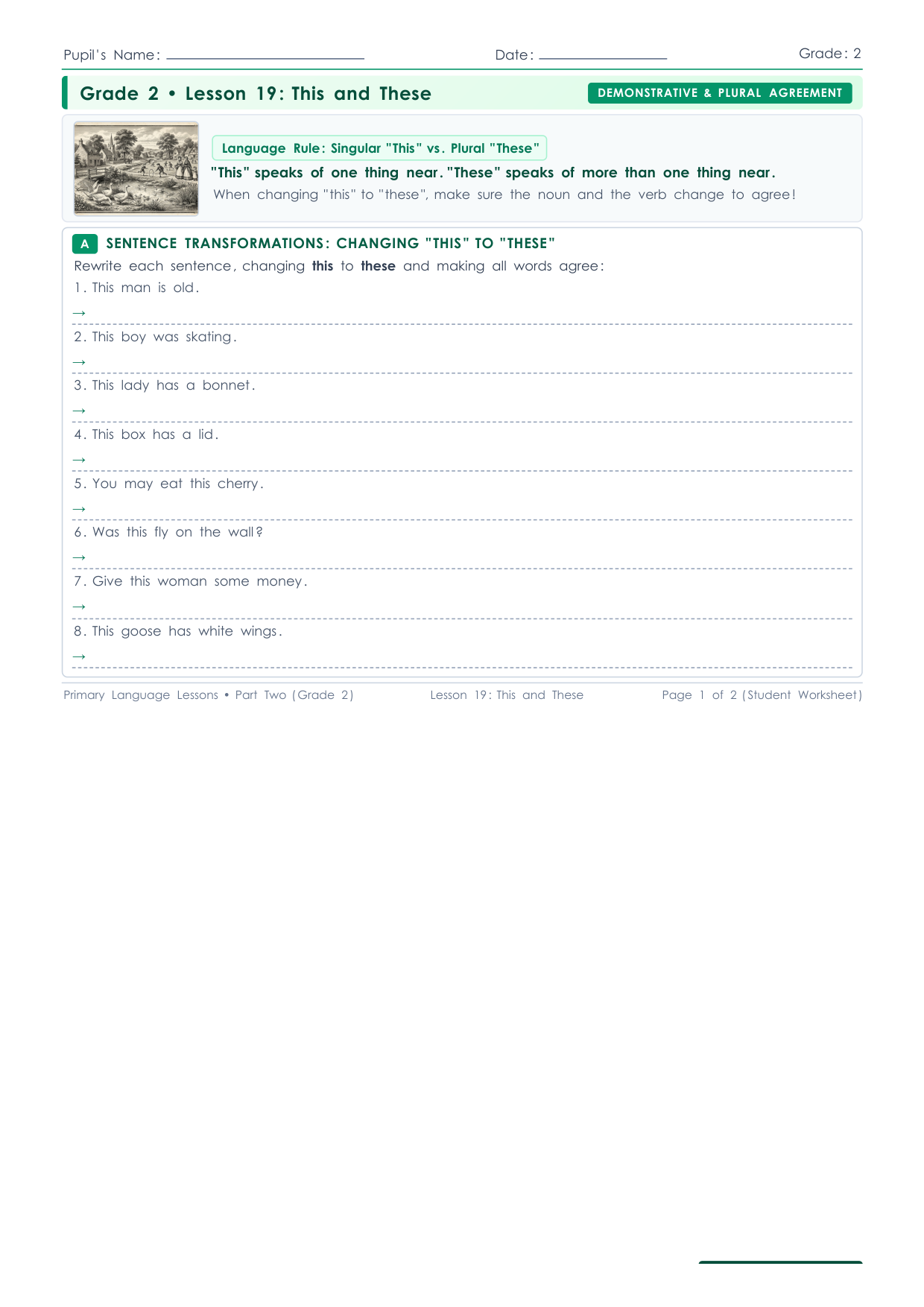
Grade 2 • Lesson 19: This and These
Transform singular sentences into plurals using "these." Master cascading grammatical concord: irregular nouns (men, women, geese), spelling rules (-ies, -es), and verbs.
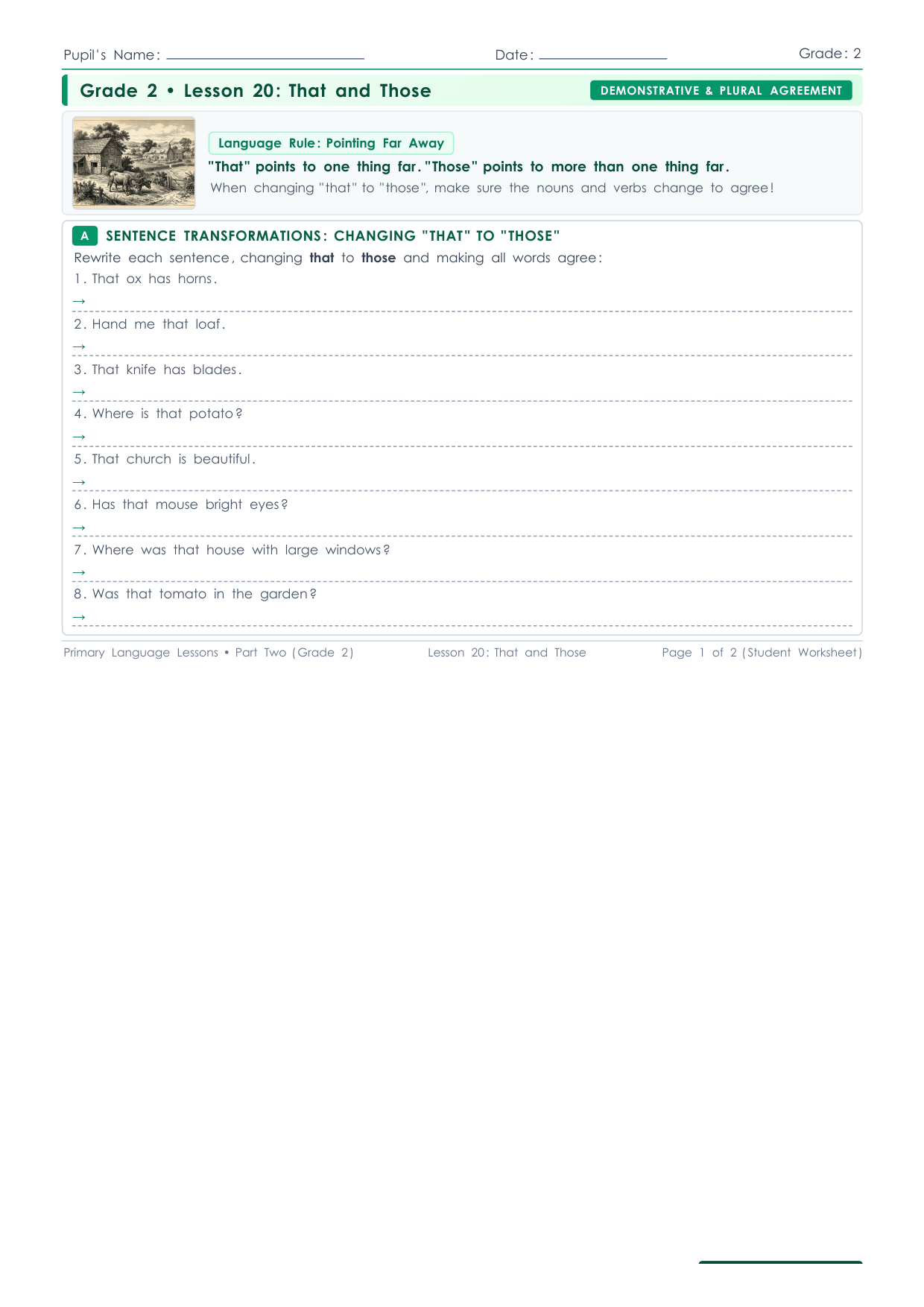
Grade 2 • Lesson 20: That and Those
Transform singular sentences with "that" to plural sentences with "those." Practice irregular plurals (oxen, loaves, knives, mice) and auxiliary verb inversion in questions.
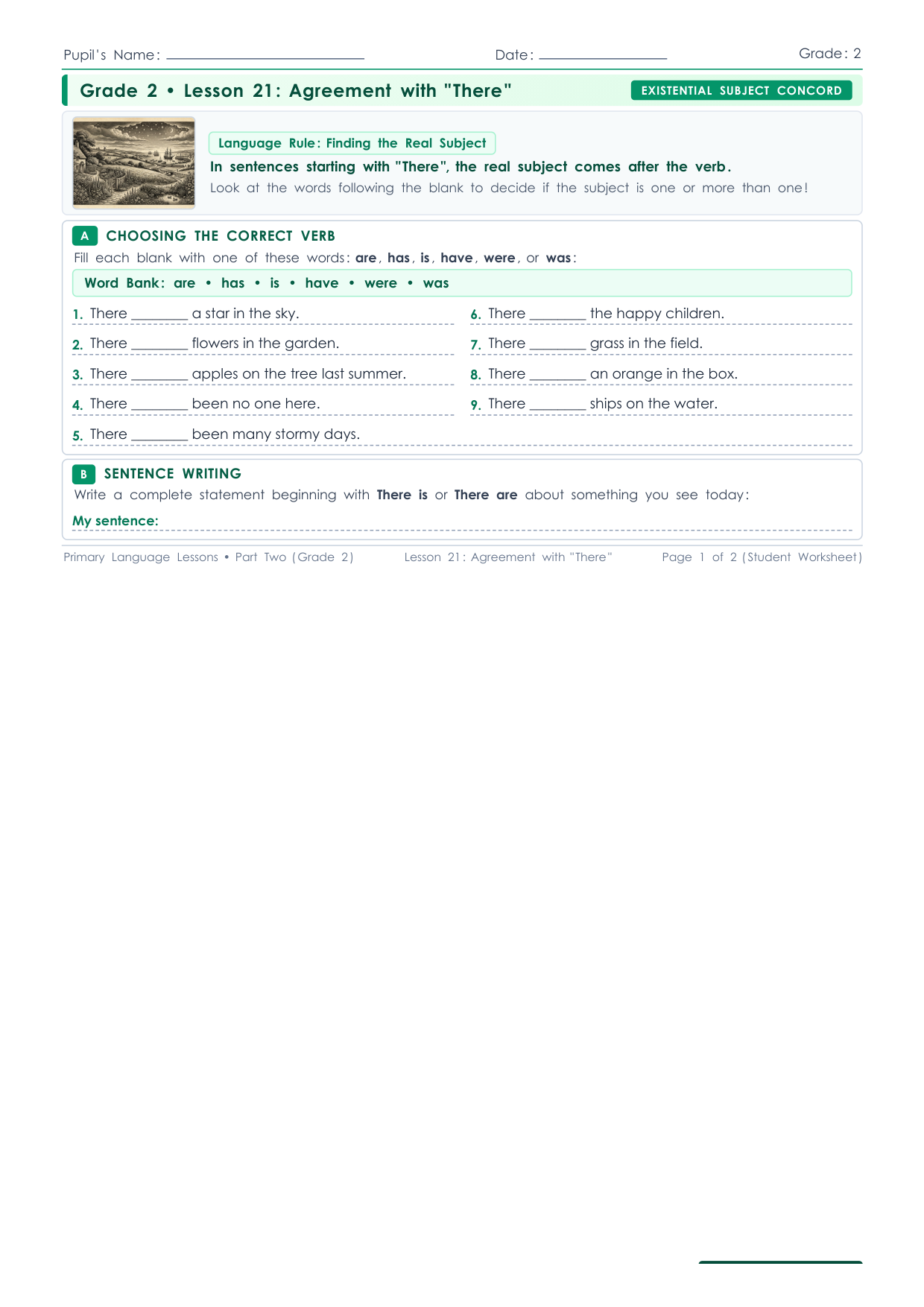
Grade 2 • Lesson 21: Agreement with "There"
Learn to locate delayed subjects following the verb in "There" clauses. Select correct verb forms (is, are, was, were, has, have) for count nouns, mass nouns, and past time cues.
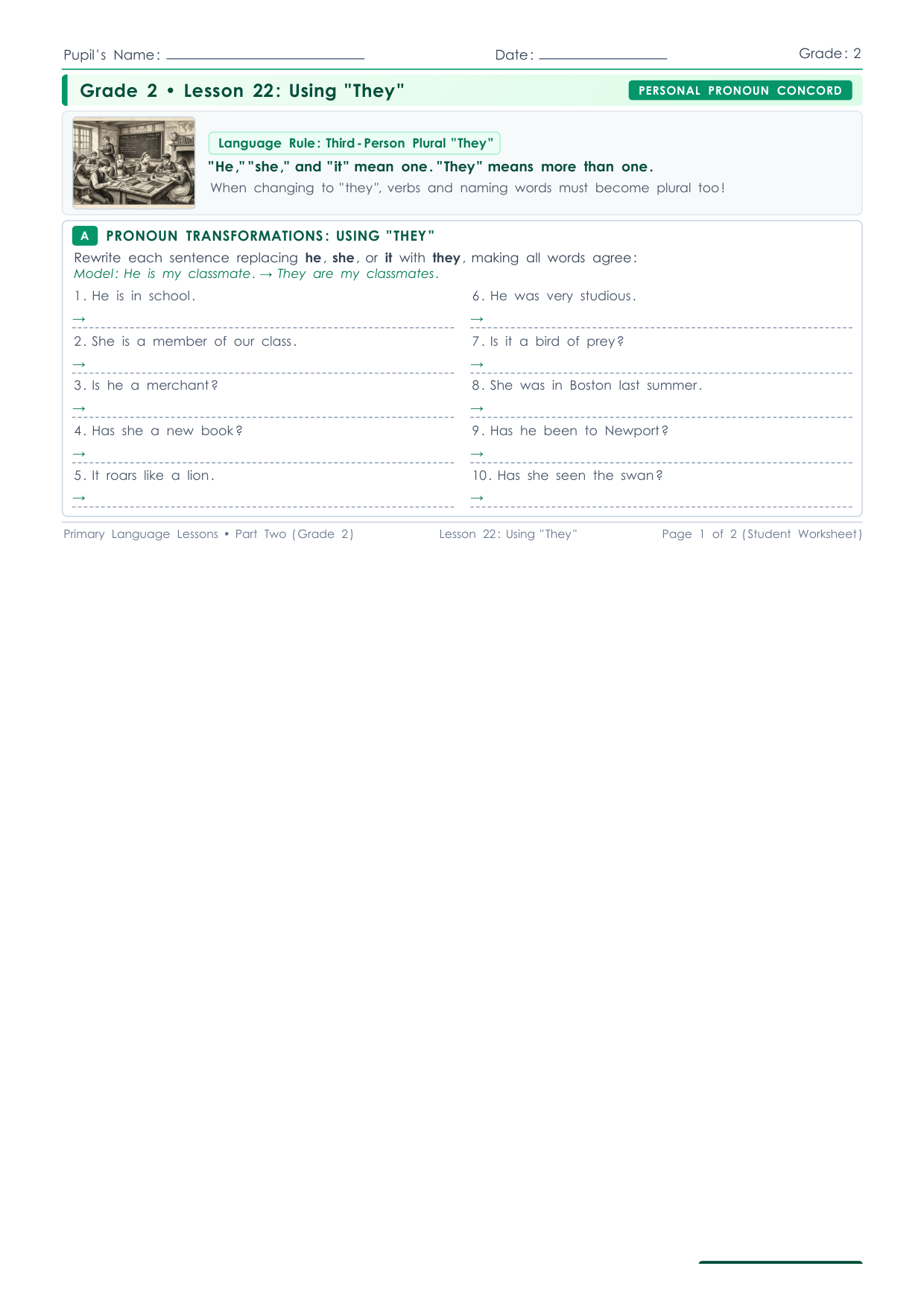
Grade 2 • Lesson 22: Using "They"
Substitute singular pronouns (he, she, it) with plural "they." Harmonize verbs (is/are, was/were, has/have, roars/roar) and predicate complements (merchants, birds of prey).
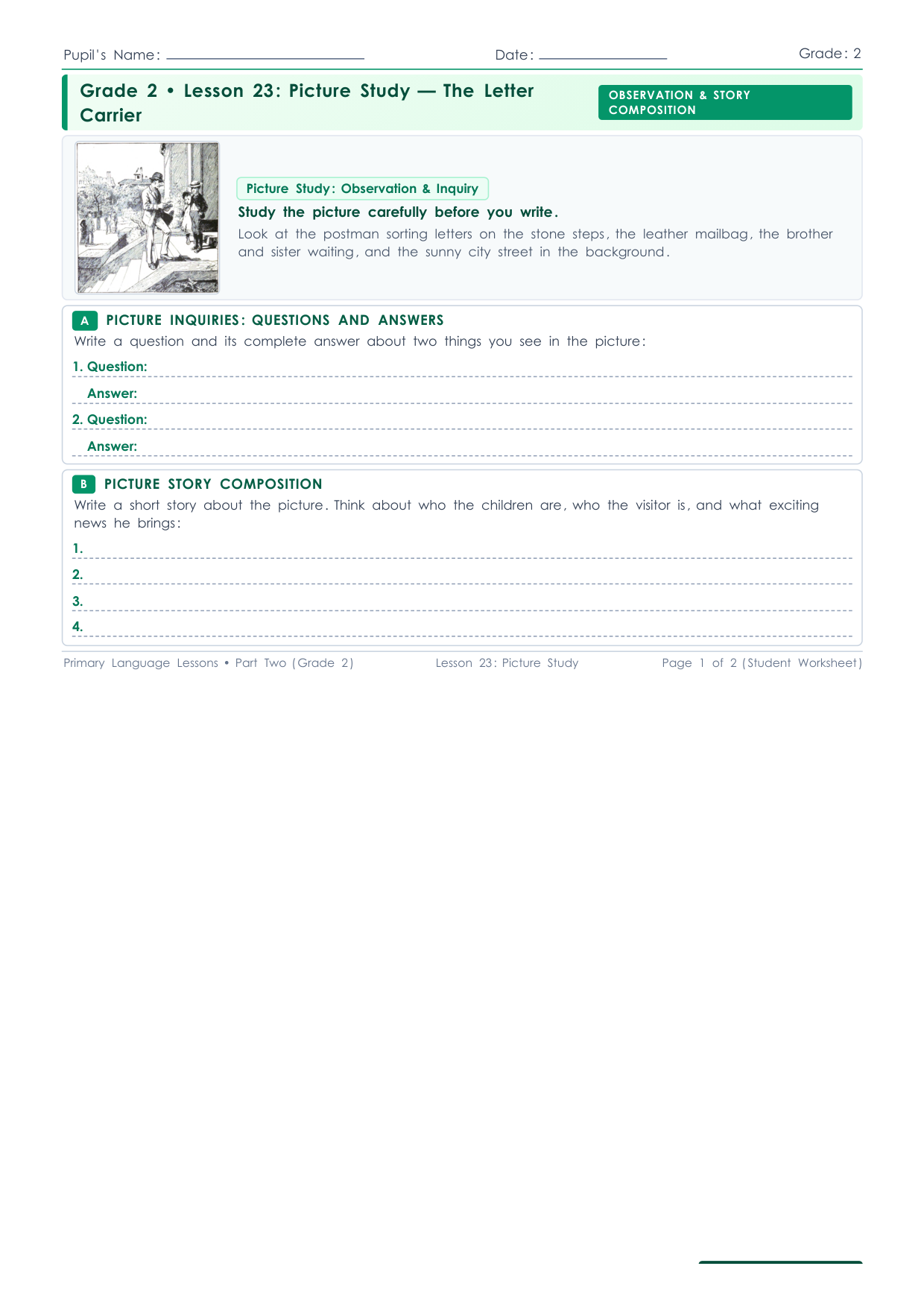
Grade 2 • Lesson 23: Picture Study — The Letter Carrier
Observe the authentic classical engraving of the visiting letter carrier. Compose question-and-answer pairs and write an original narrative story paragraph.
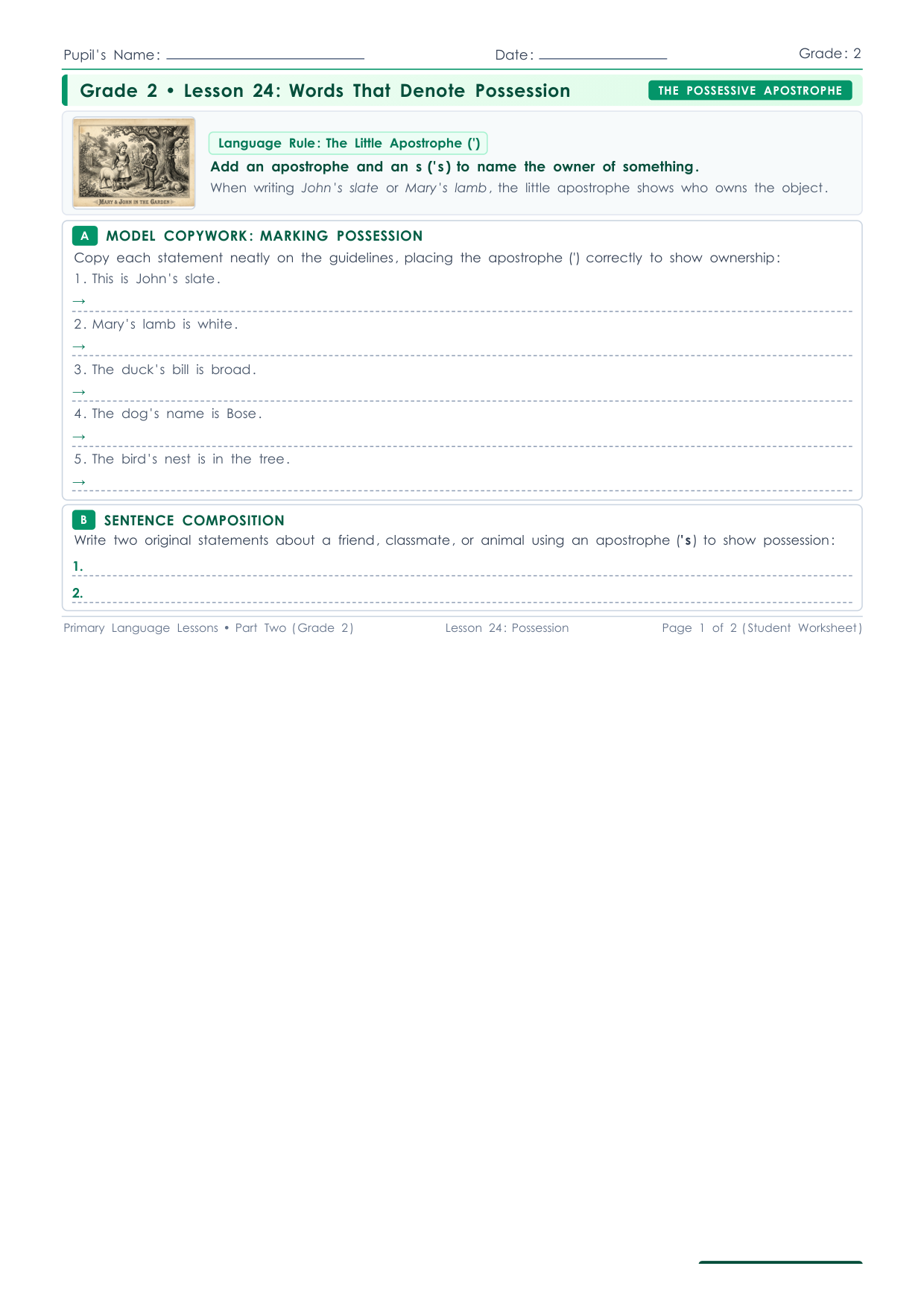
Grade 2 • Lesson 24: Words That Denote Possession
Learn to form singular possessives with the apostrophe and 's' ('s). Practice model copywork and compose original statements denoting ownership of animals and objects.
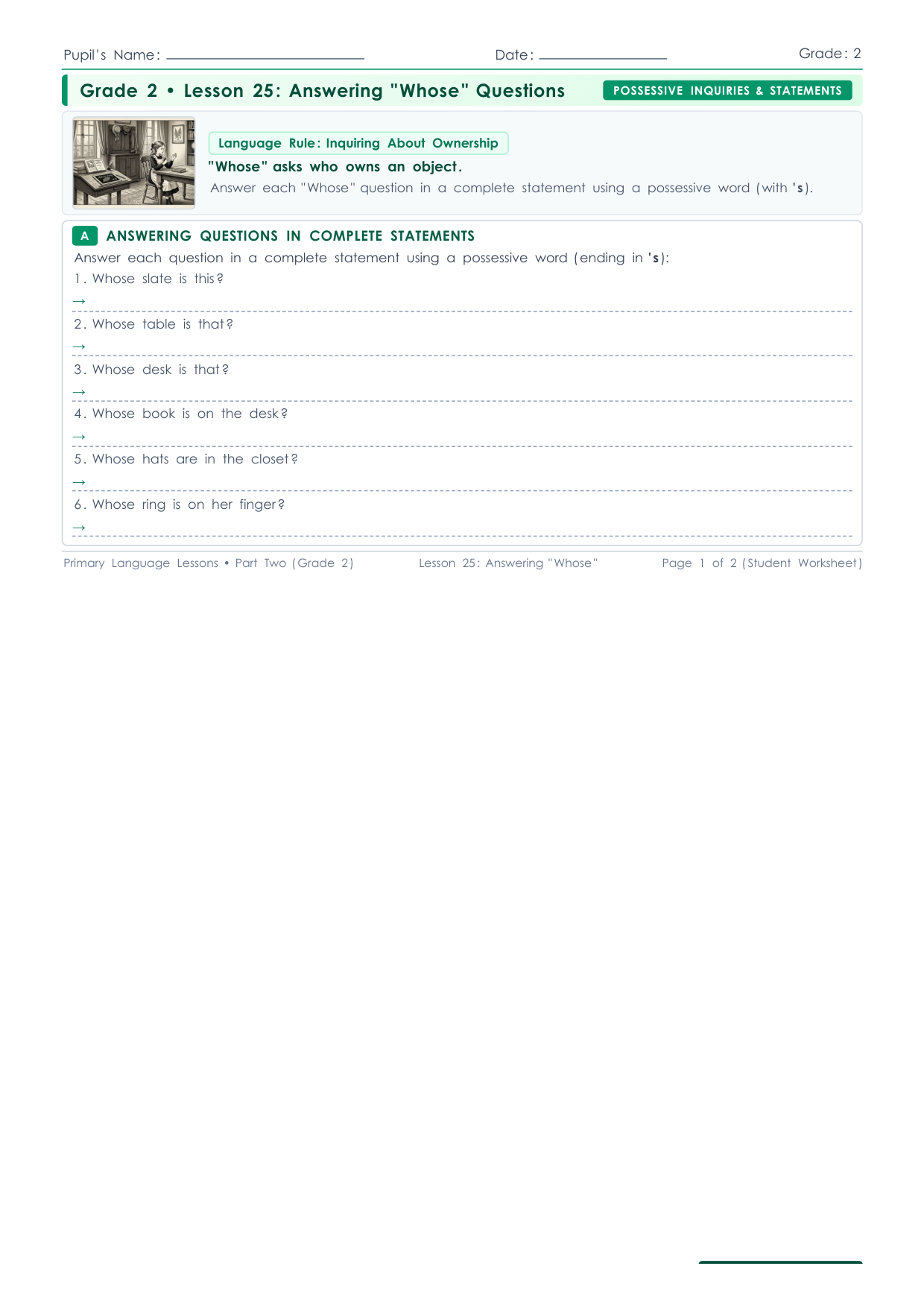
Grade 2 • Lesson 25: Answering "Whose" Questions
Convert "Whose" inquiries into complete declarative statements. Apply possessive nouns with ('s) and maintain subject-verb and demonstrative agreement.
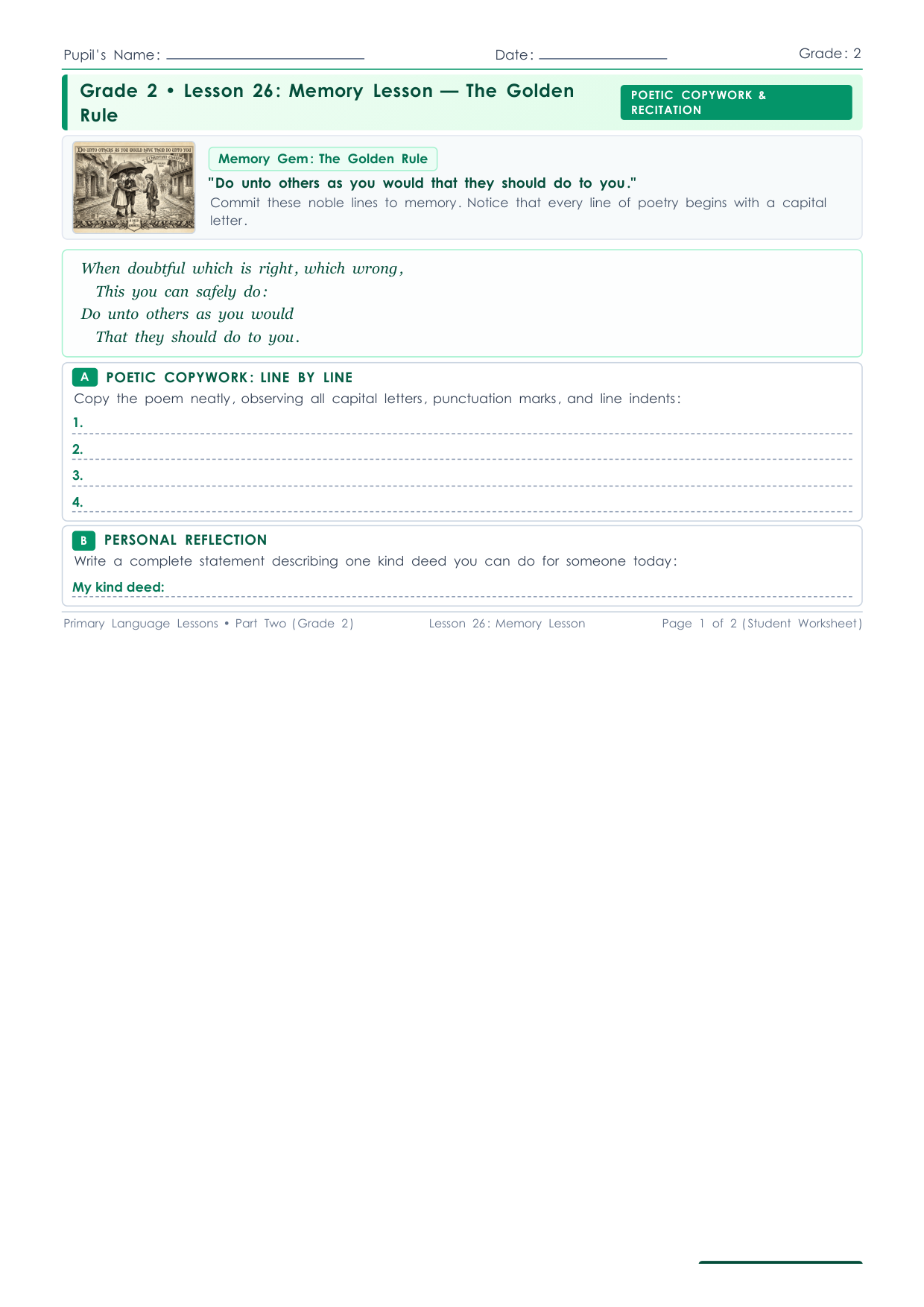
Grade 2 • Lesson 26: Memory Lesson — The Golden Rule
Commit the classic moral stanza to memory. Practice poetic line-by-line copywork with indentation, and compose a reflection on everyday kindness.
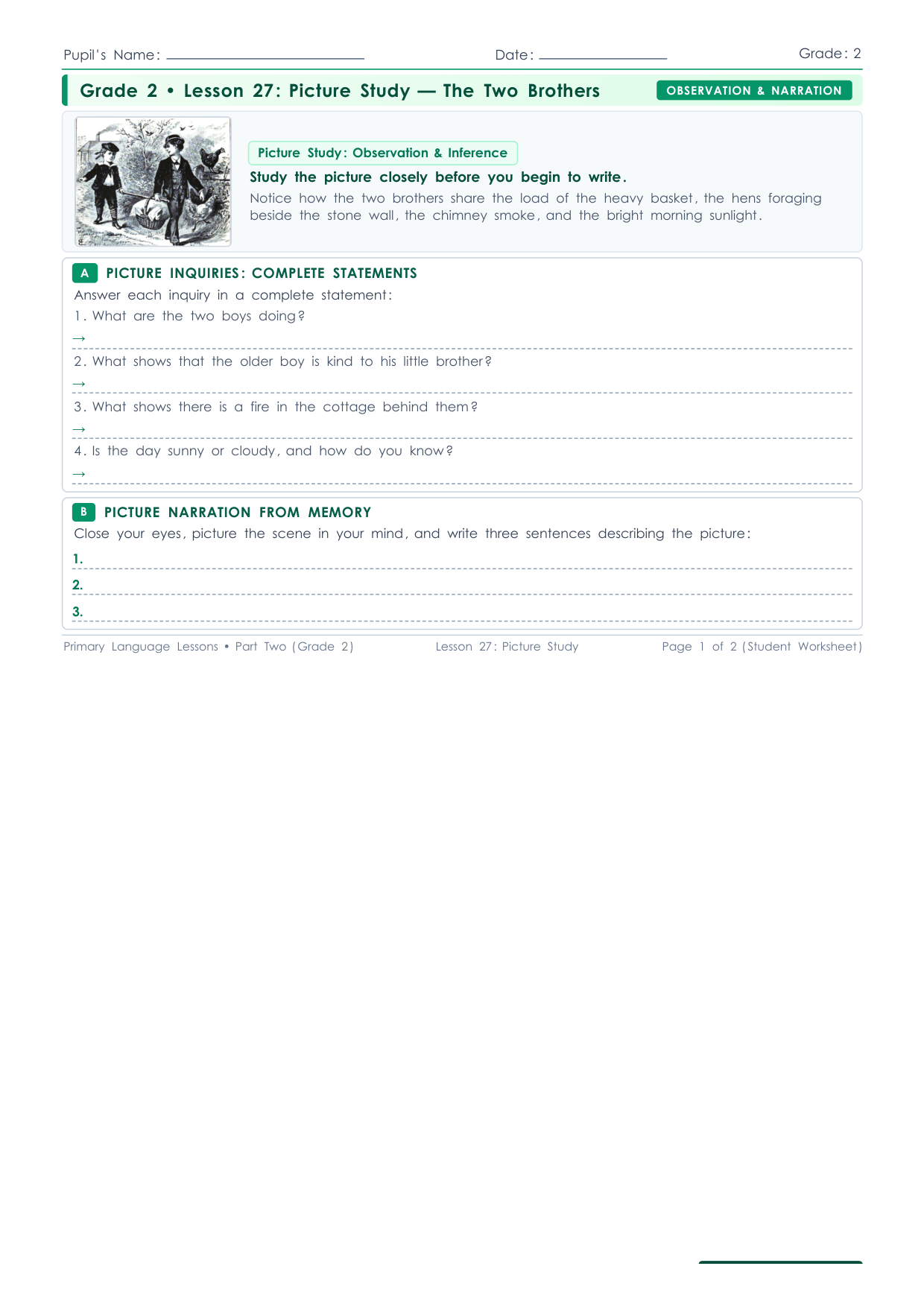
Grade 2 • Lesson 27: Picture Study — The Two Brothers
Observe the authentic classical engraving of two brothers carrying a basket. Deduce clues about weather, season, and brotherhood, and write a narration from memory.
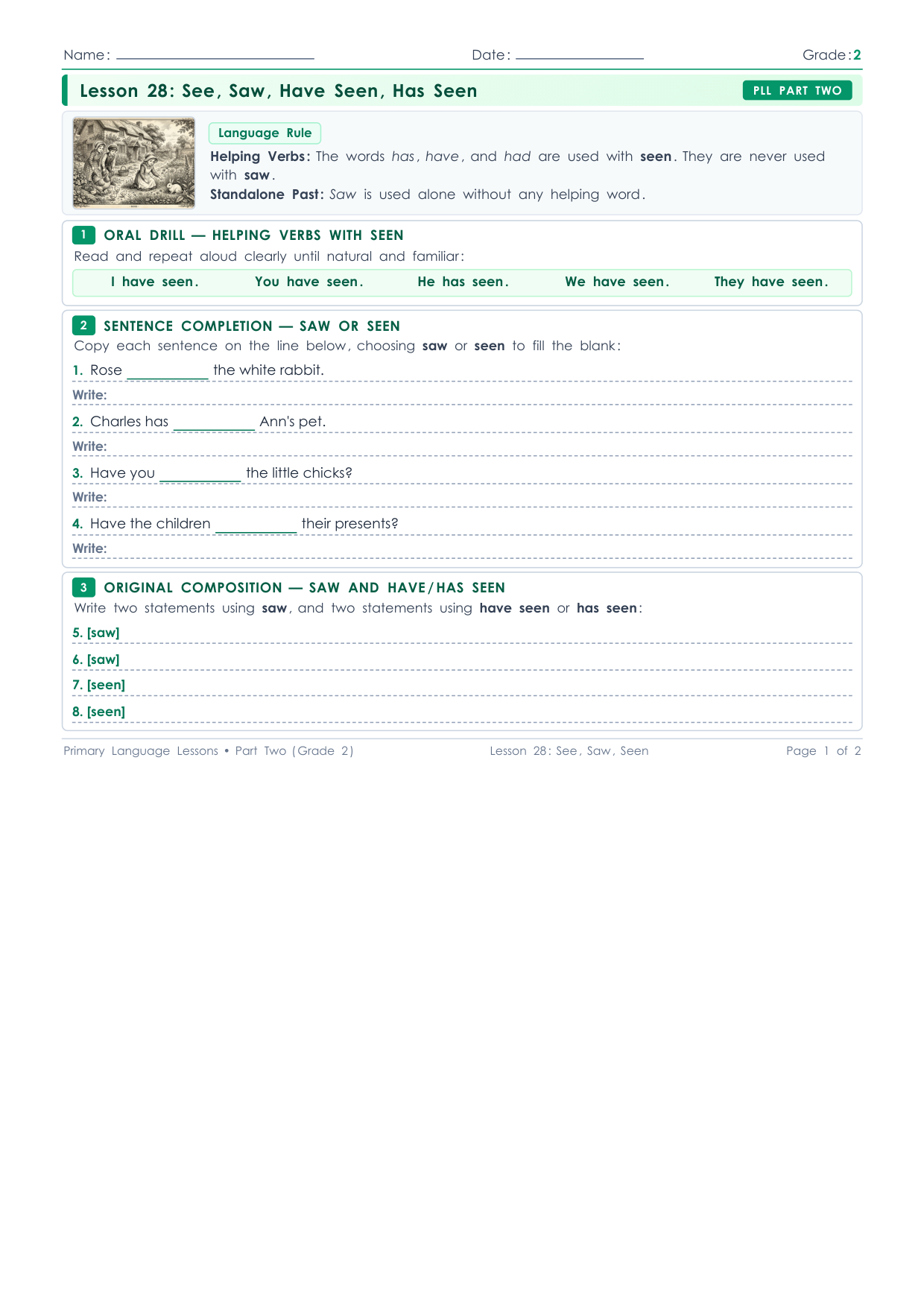
Grade 2 • Lesson 28: See, Saw, Have Seen, Has Seen
Master the usage of helping verbs (has, have, had) with seen versus standalone saw through oral drills, sentence completion, and original compositions.
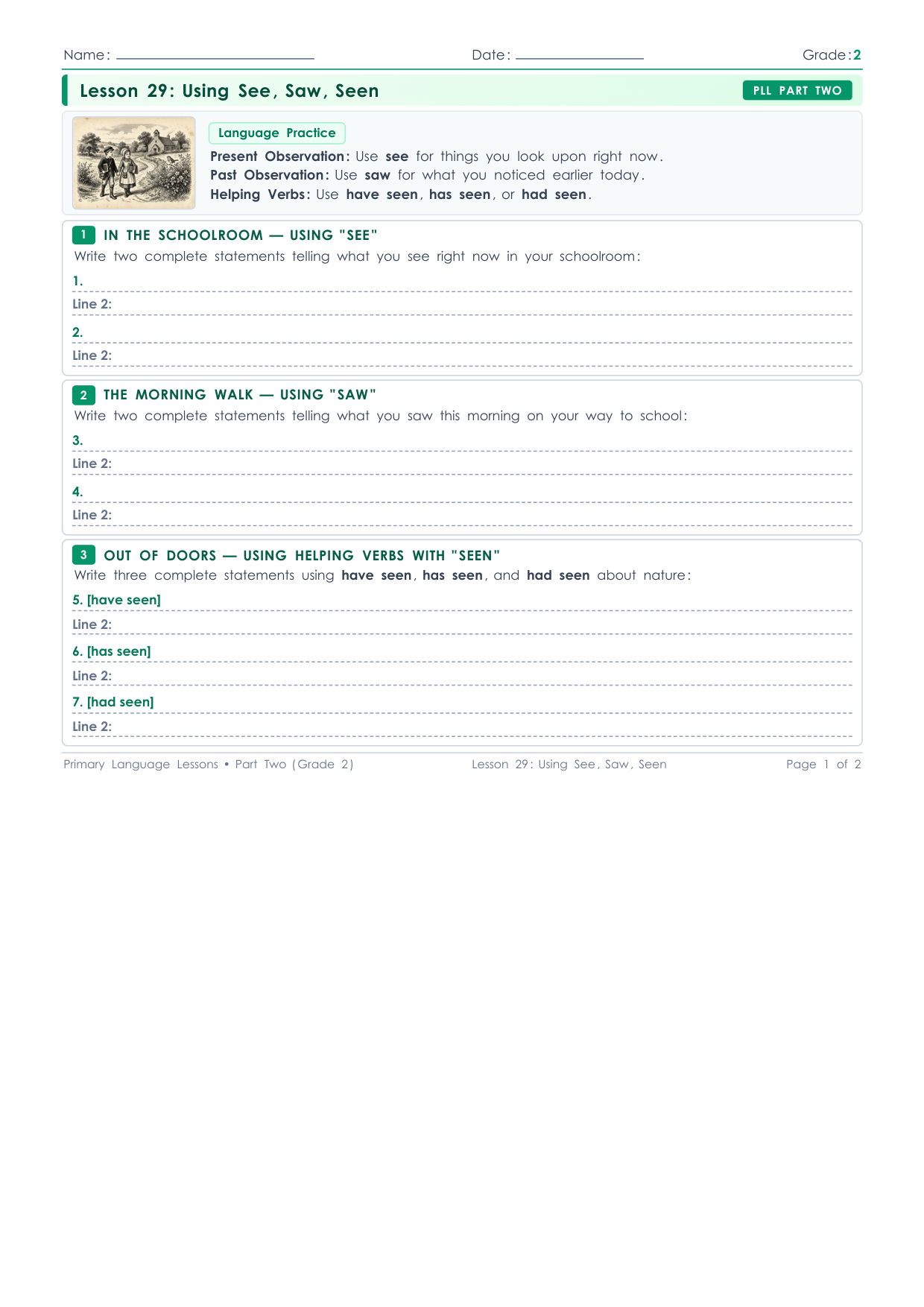
Grade 2 • Lesson 29: Using See, Saw, Seen
Connect real-life sensory observation with correct grammatical tense: describe classroom objects with see, morning sights with saw, and nature with have/has/had seen.
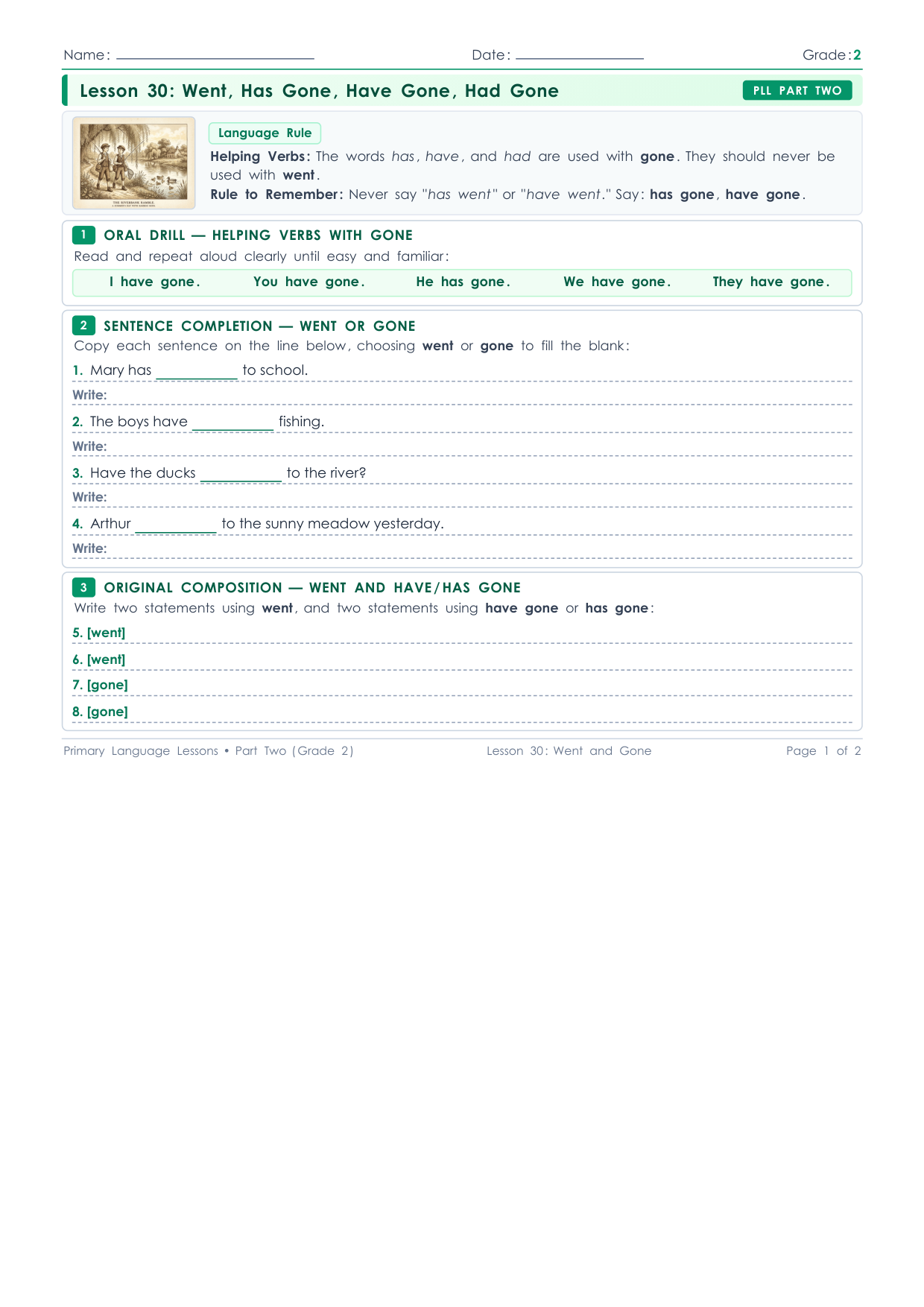
Grade 2 • Lesson 30: Went, Has Gone, Have Gone, Had Gone
Learn the principal parts of go, cementing the rule that helping verbs pair exclusively with gone, never with went, through recitation, fill-ins, and original writing.
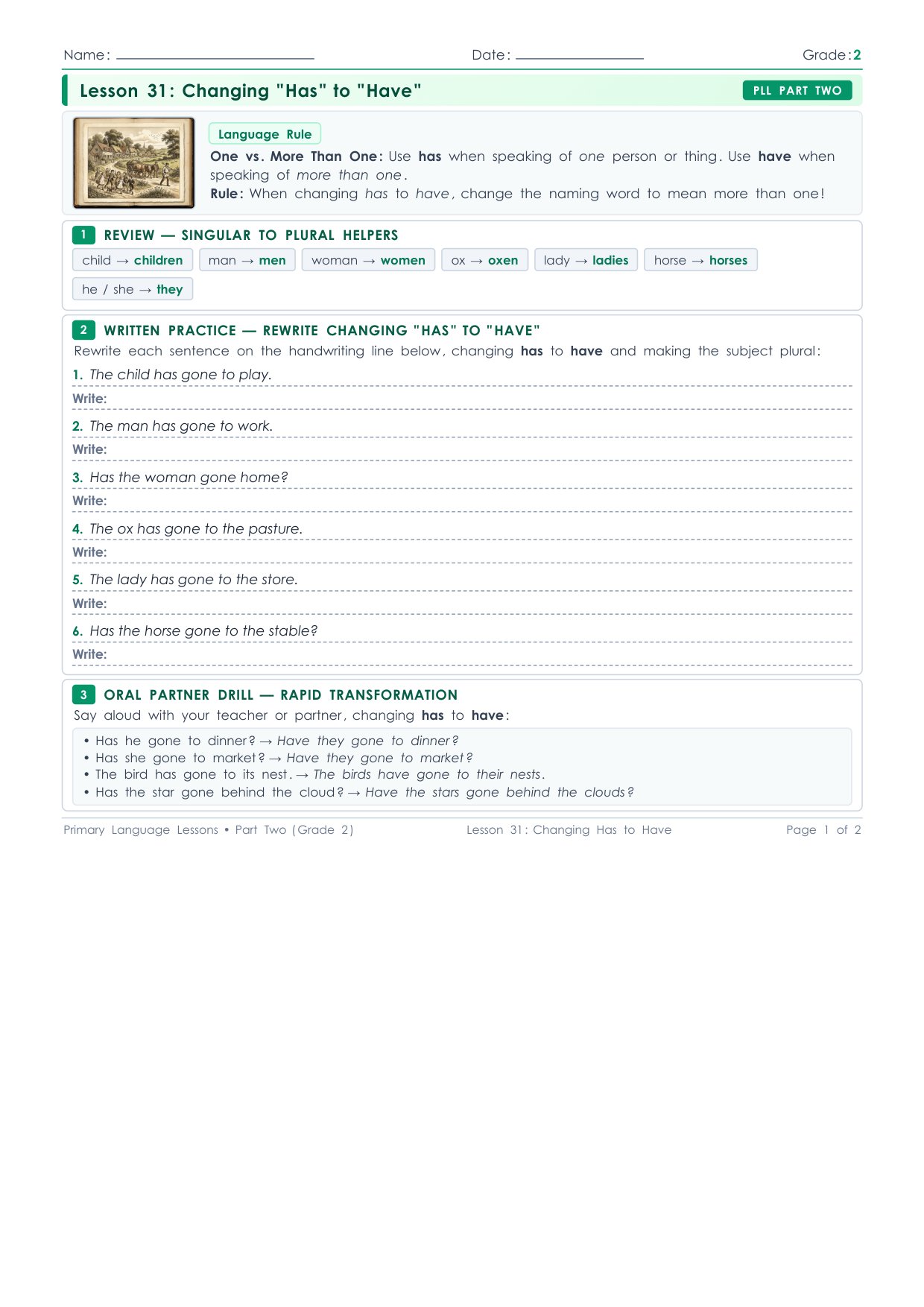
Grade 2 • Lesson 31: Changing "Has" to "Have"
Master subject-verb agreement by changing sentences from singular has to plural have, reviewing key irregular plurals (children, men, women, oxen, ladies).
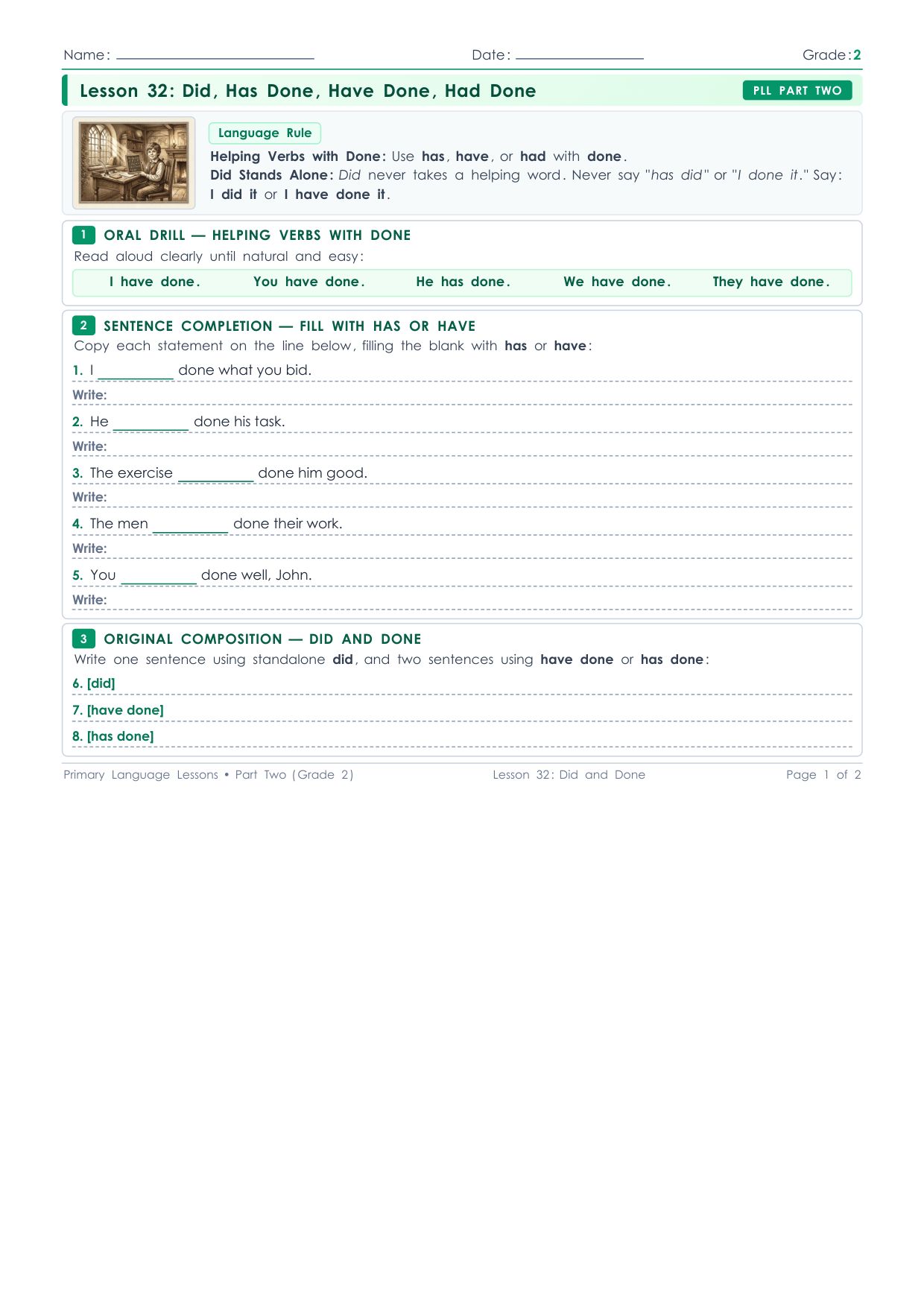
Grade 2 • Lesson 32: Did, Has Done, Have Done, Had Done
Understand the principal parts of do: practice standalone did versus done with helping verbs (has, have, had) through oral recitations, fill-ins, and original writing.
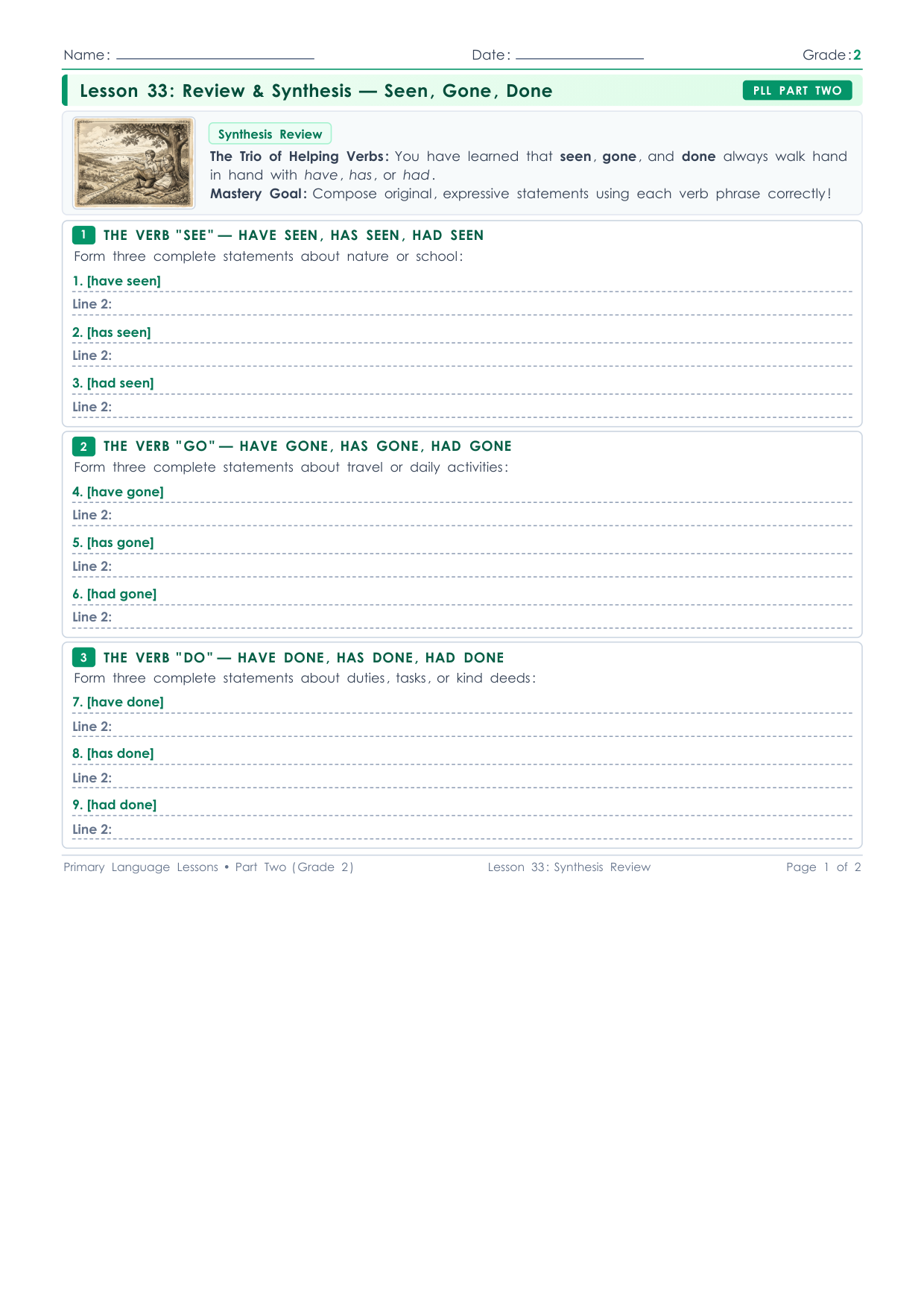
Grade 2 • Lesson 33: Review & Synthesis — Seen, Gone, Done
A grand synthesis of irregular past participles: compose nine original, descriptive statements using have/has/had seen, have/has/had gone, and have/has/had done.
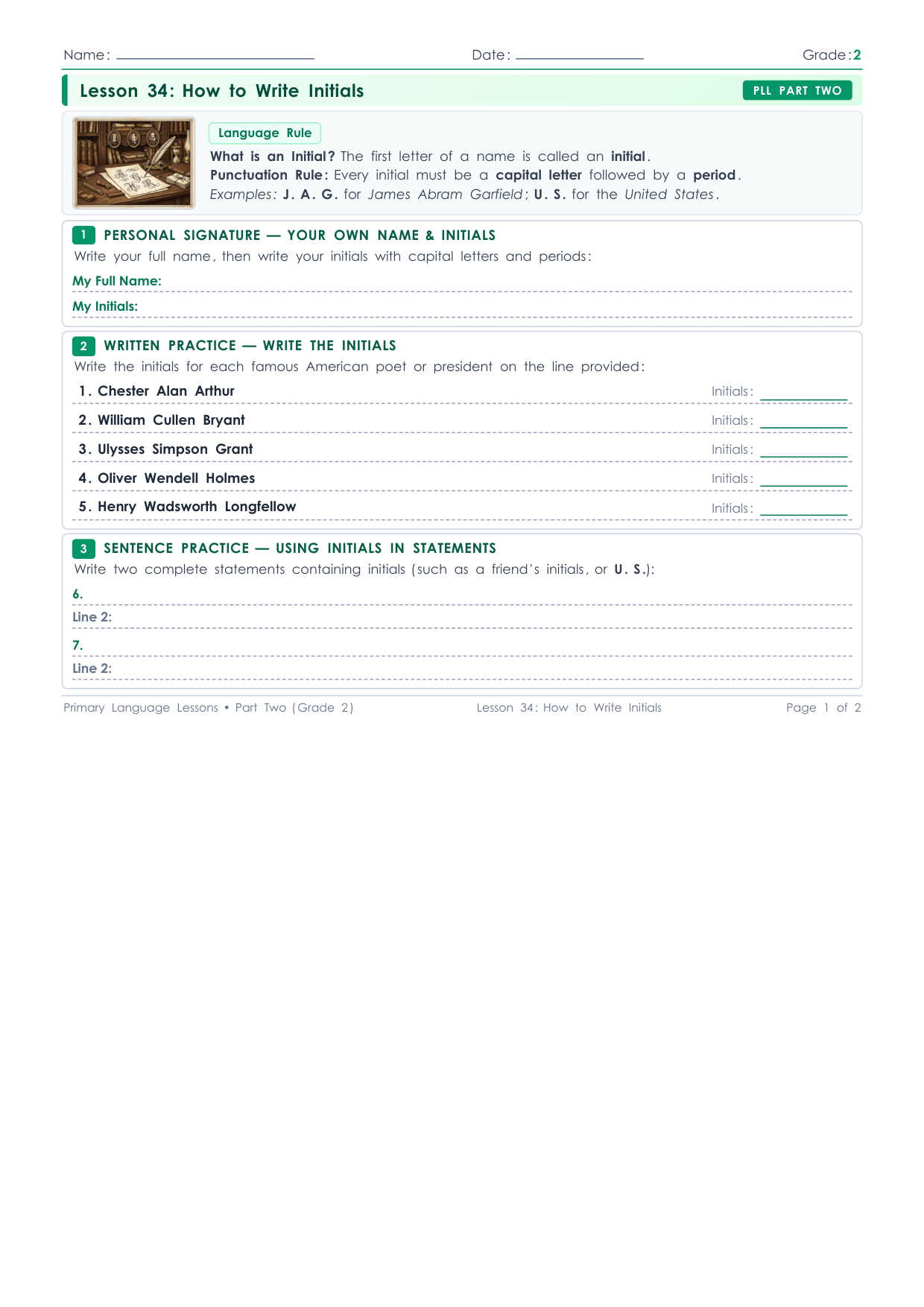
Grade 2 • Lesson 34: How to Write Initials
Learn the definition and mechanics of initials: practice writing personal initials and those of distinguished American figures (Garfield, Arthur, Bryant, Grant, Holmes, Longfellow).
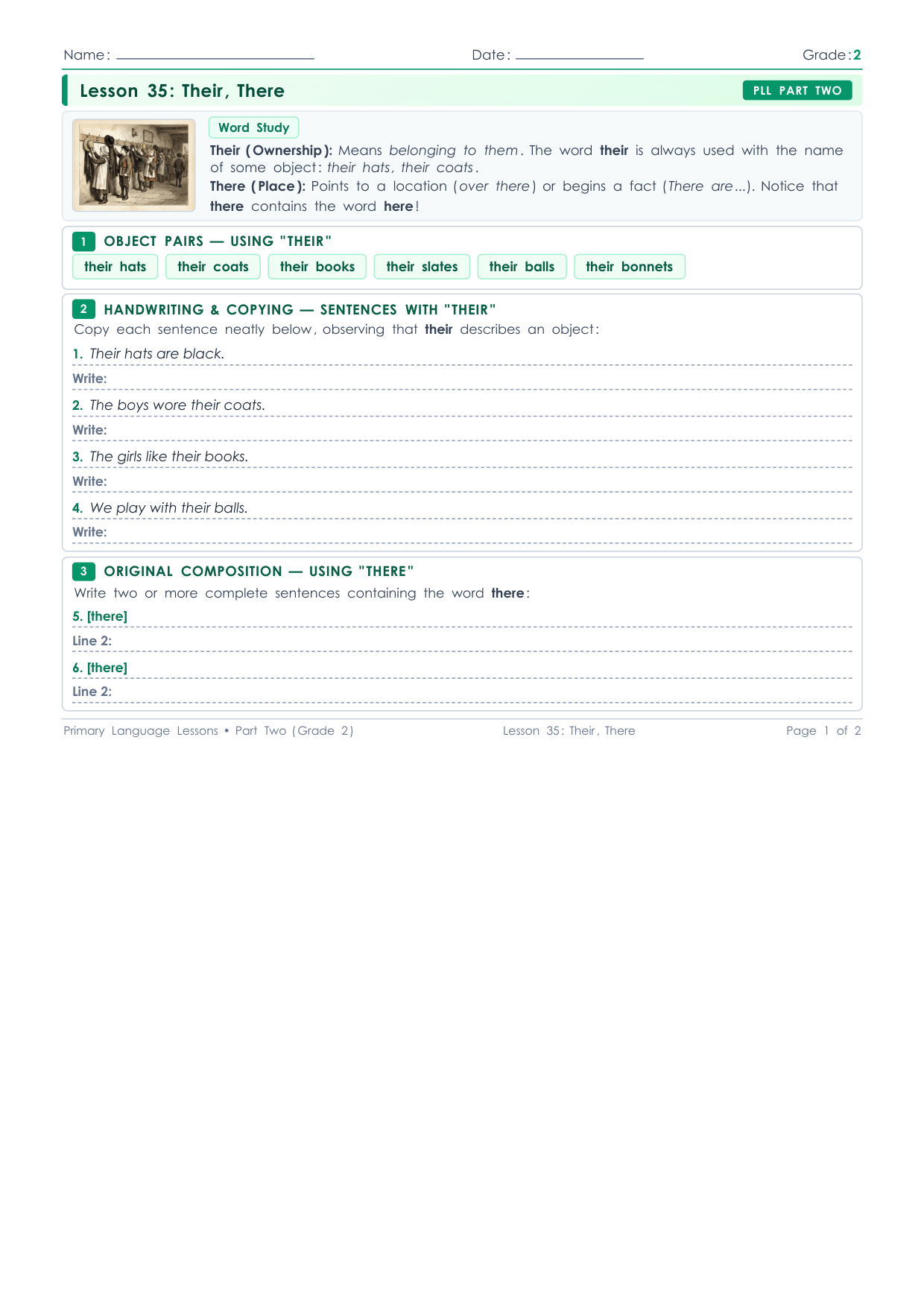
Grade 2 • Lesson 35: Their, There
Master the essential distinction between possessive their (belonging to them, with an object) and locative/introductory there through object pairing, copying, and original composition.
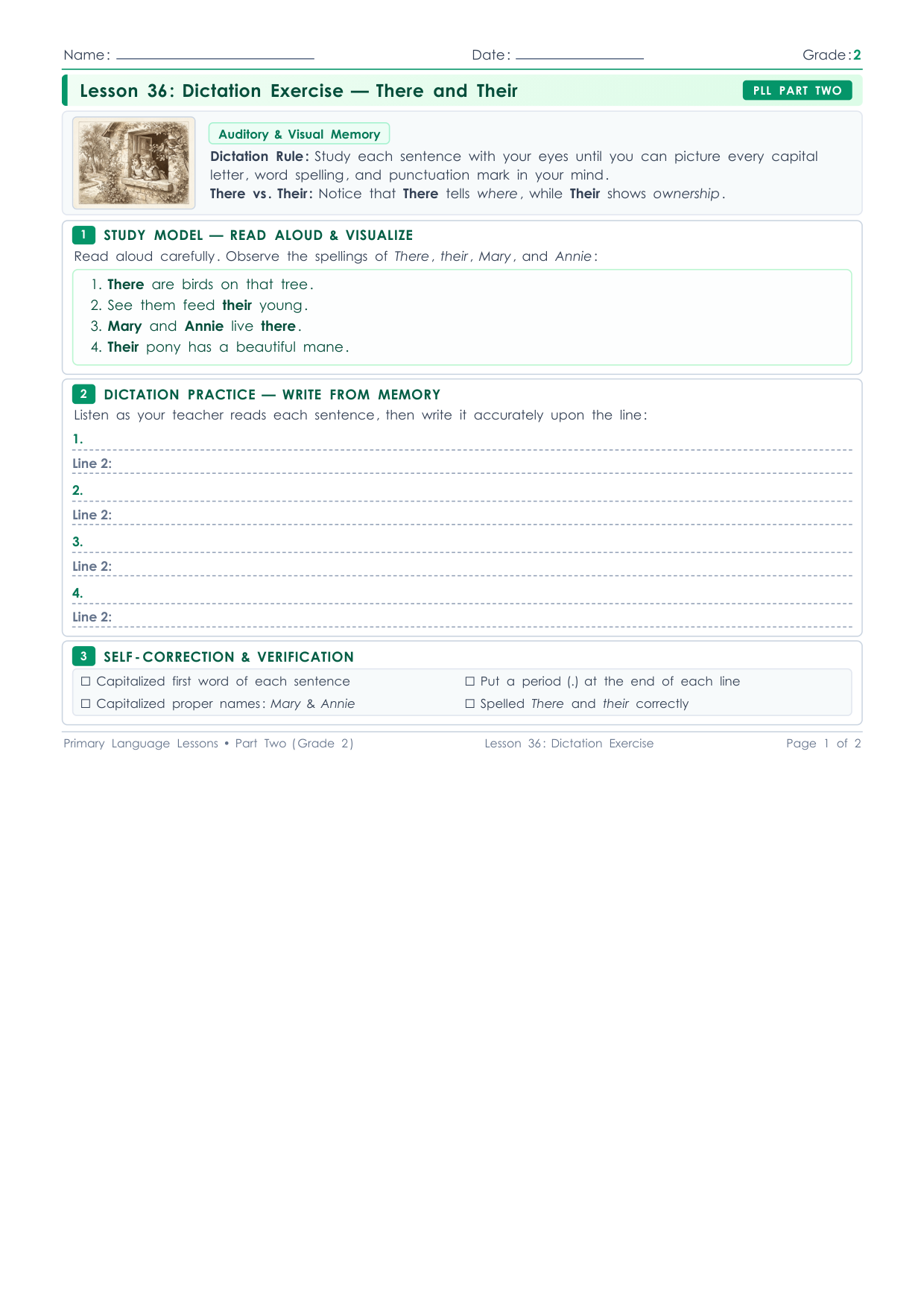
Grade 2 • Lesson 36: Dictation Exercise — There and Their
Practice Charlotte Mason-style auditory dictation: study four poetic sentences featuring Mary and Annie, birds feeding their young, and a beautiful pony, then transcribe accurately from auditory memory.
Grade 2 • Lesson 37: Homophones — Flour, Flower, Week, Weak, Threw, Through
Discriminate three essential sound-alike word pairs (flour/flower, week/weak, threw/through) through semantic matching, sentence completion, and original compositions.
Grade 2 • Lesson 38: Homophones — Cells/Sells, Seize/Sees, Buy/By, Scent/Sent/Cent
Master sound-alike word pairs and triplets through definition matching, context clues, sentence completion, and original sentence composition.
Grade 2 • Lesson 39: Quotation Marks — Direct Speech & Fruit Study
Discover quotation marks through Ida and Clara's dialogue about an orange (peel, pulp, seeds). Learn to enclose exact words and place internal punctuation.
Grade 2 • Lesson 40: Quotation Marks — Politeness & Daily Courtesy
Apply quotation marks to polite daily habits (“Good night.”, “Good morning.”, “Thank you.”, “If you please.”) with introductory commas and capitalization.
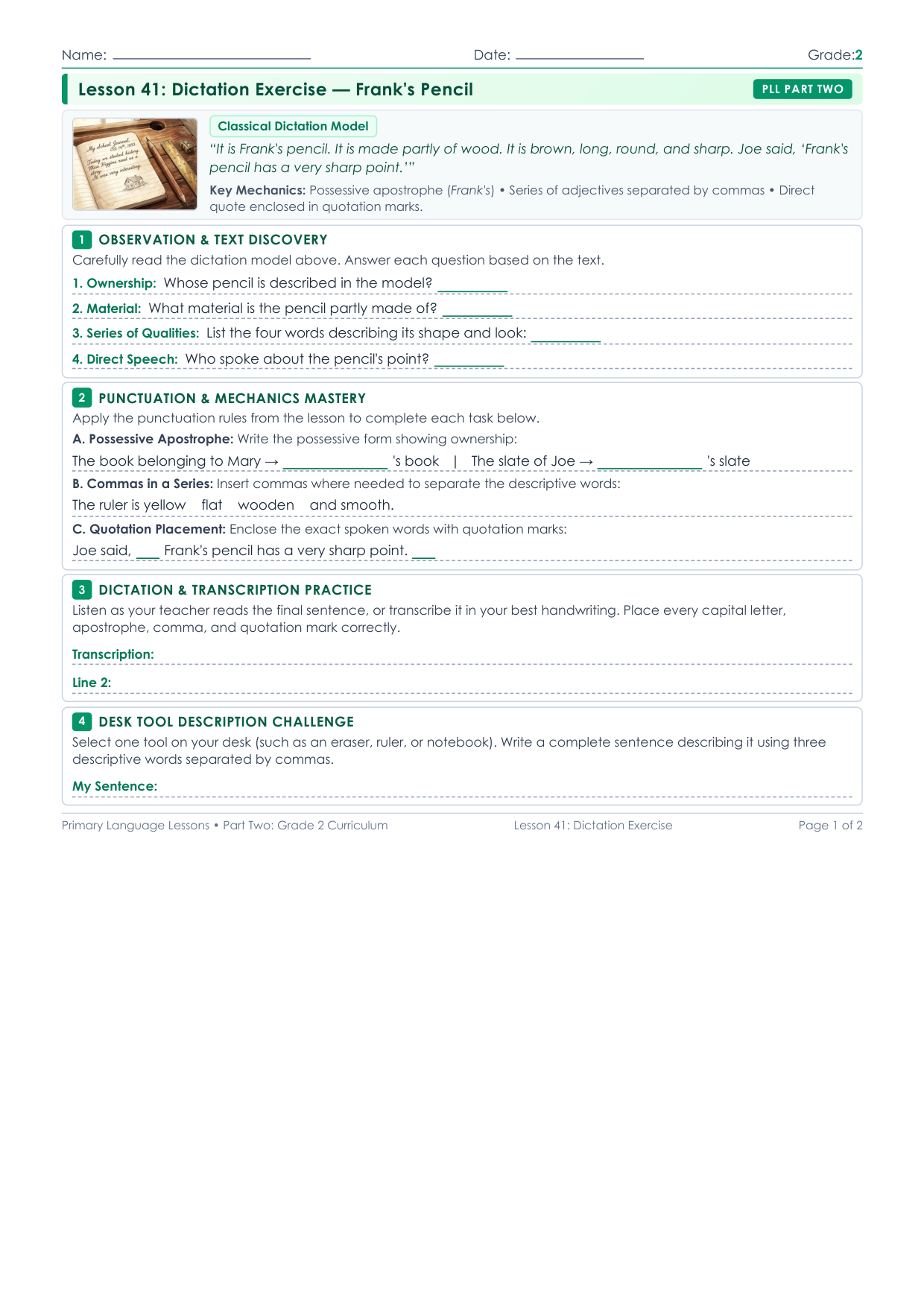
Grade 2 • Lesson 41: Dictation Exercise — Frank's Pencil
Sharpen auditory focus and penmanship through classical dictation. Master possessive apostrophes, commas in a series of adjectives, and direct speech quotation marks.
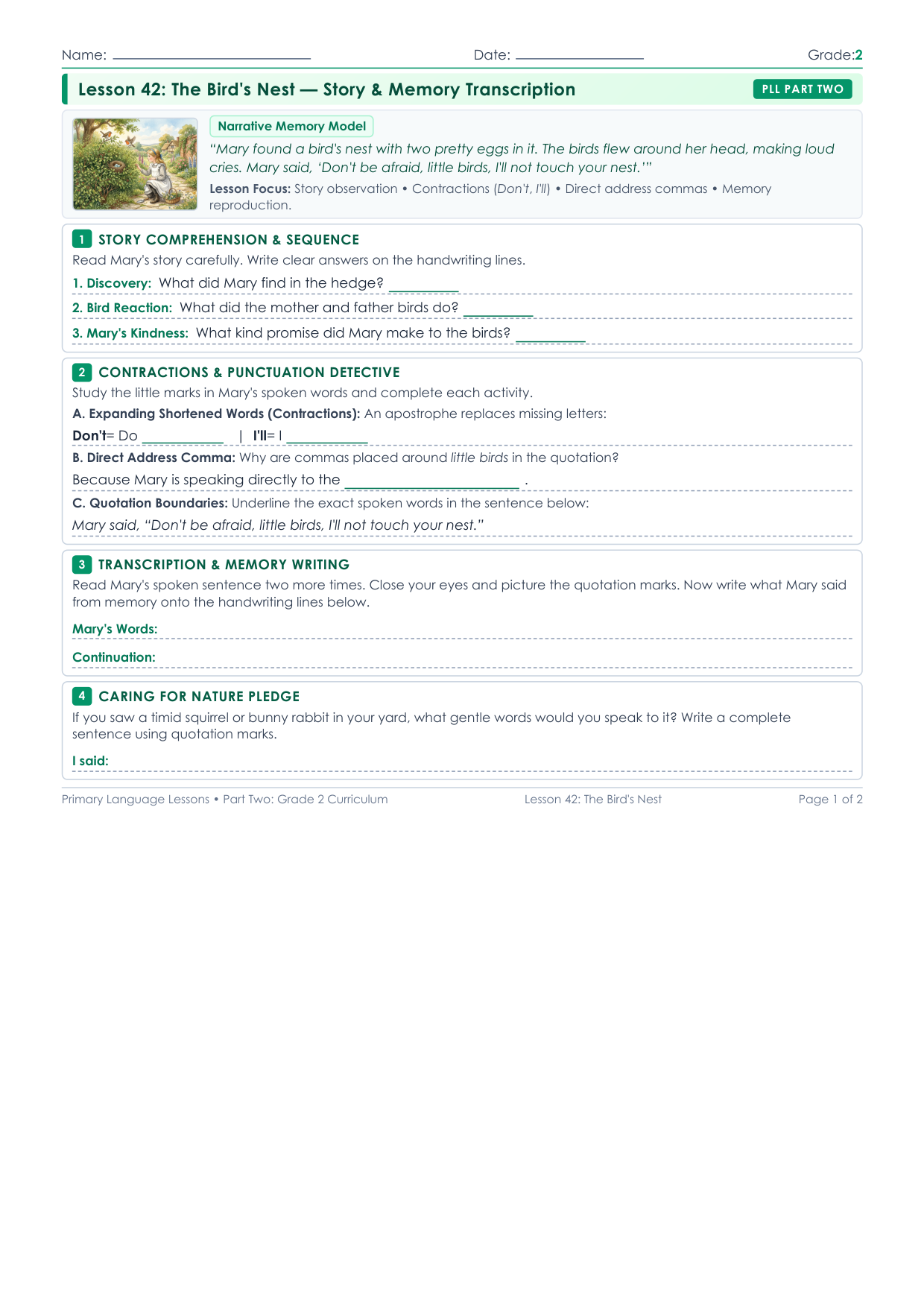
Grade 2 • Lesson 42: The Bird's Nest — Story & Direct Speech
Follow Mary's compassionate encounter with nesting birds. Practice story transcription from memory, expand contractions (Don't, I'll), and frame direct address dialogue.
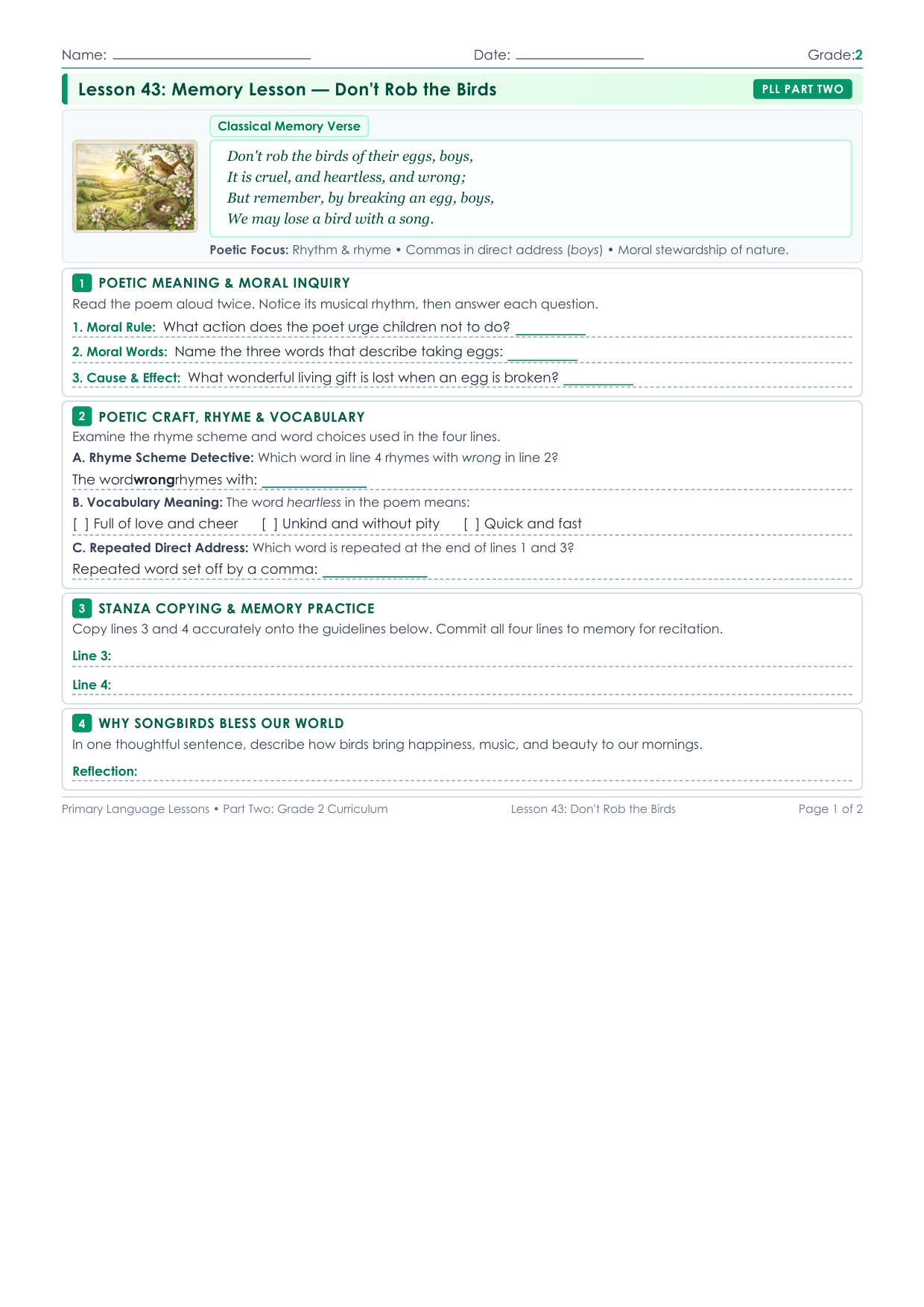
Grade 2 • Lesson 43: Memory Lesson — Don't Rob the Birds
Commit classical rhyming verse to heart. Explore rhythm and rhyme (wrong/song), understand moral stewardship of living creatures, and write nature reflections.
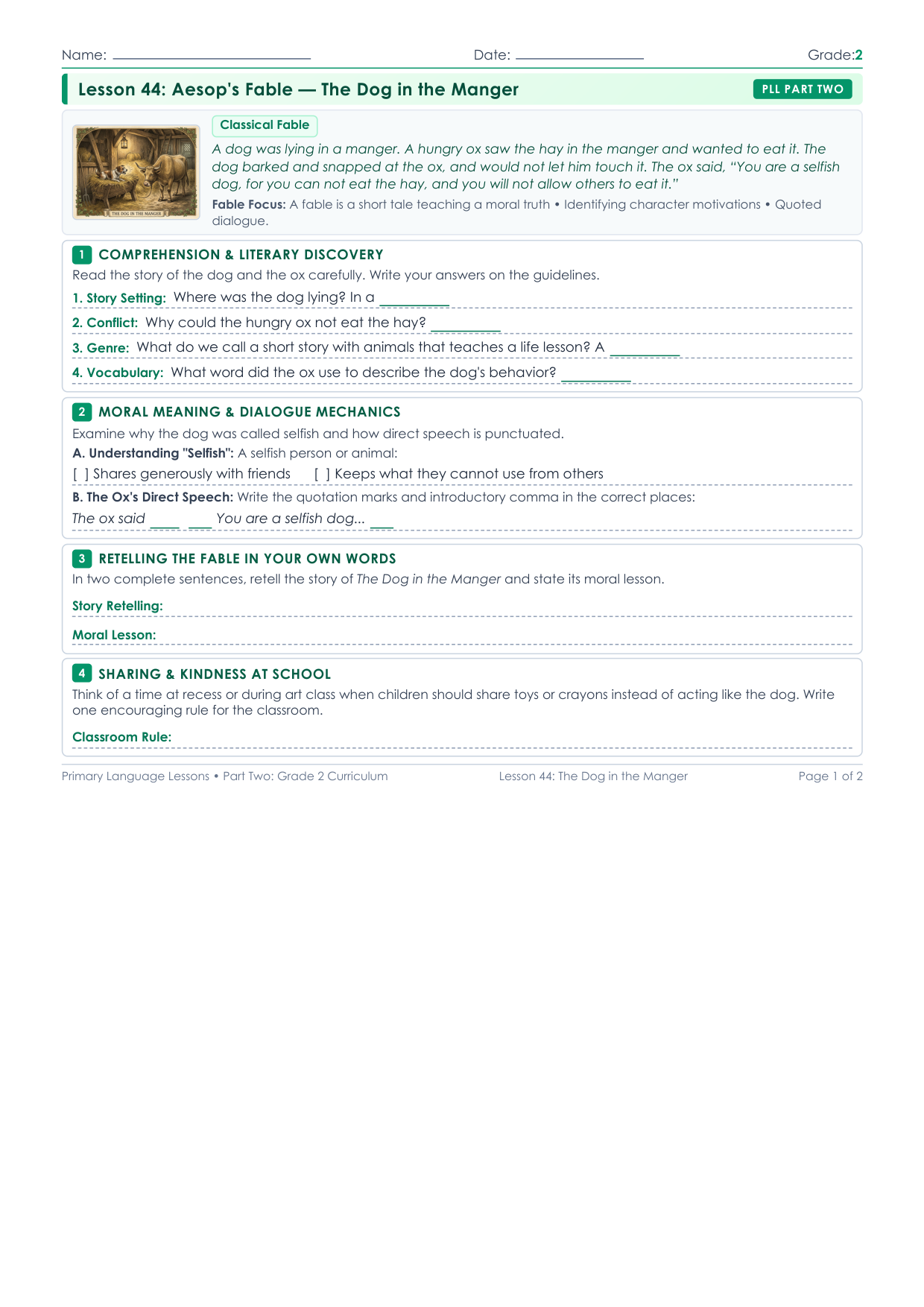
Grade 2 • Lesson 44: Aesop's Fable — The Dog in the Manger
Discover the literary genre of the fable. Analyze the conflict between the selfish dog and the hungry ox, master quoted dialogue, and retell the moral in original prose.
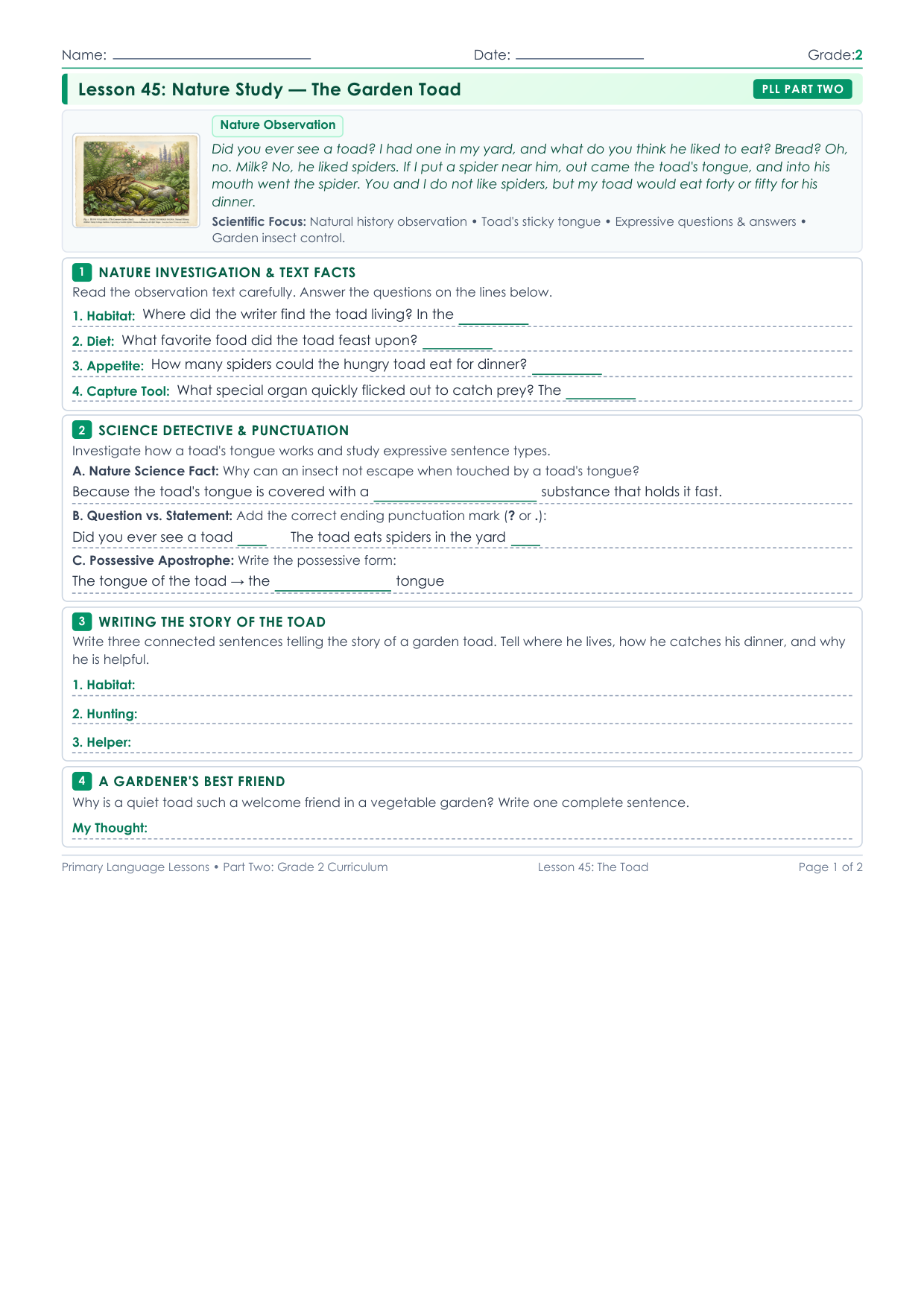
Grade 2 • Lesson 45: Nature Study — The Garden Toad
Investigate the anatomy and behavior of the common garden toad. Discover its lightning-fast sticky tongue, practice expressive question marks, and compose a 3-part nature story.
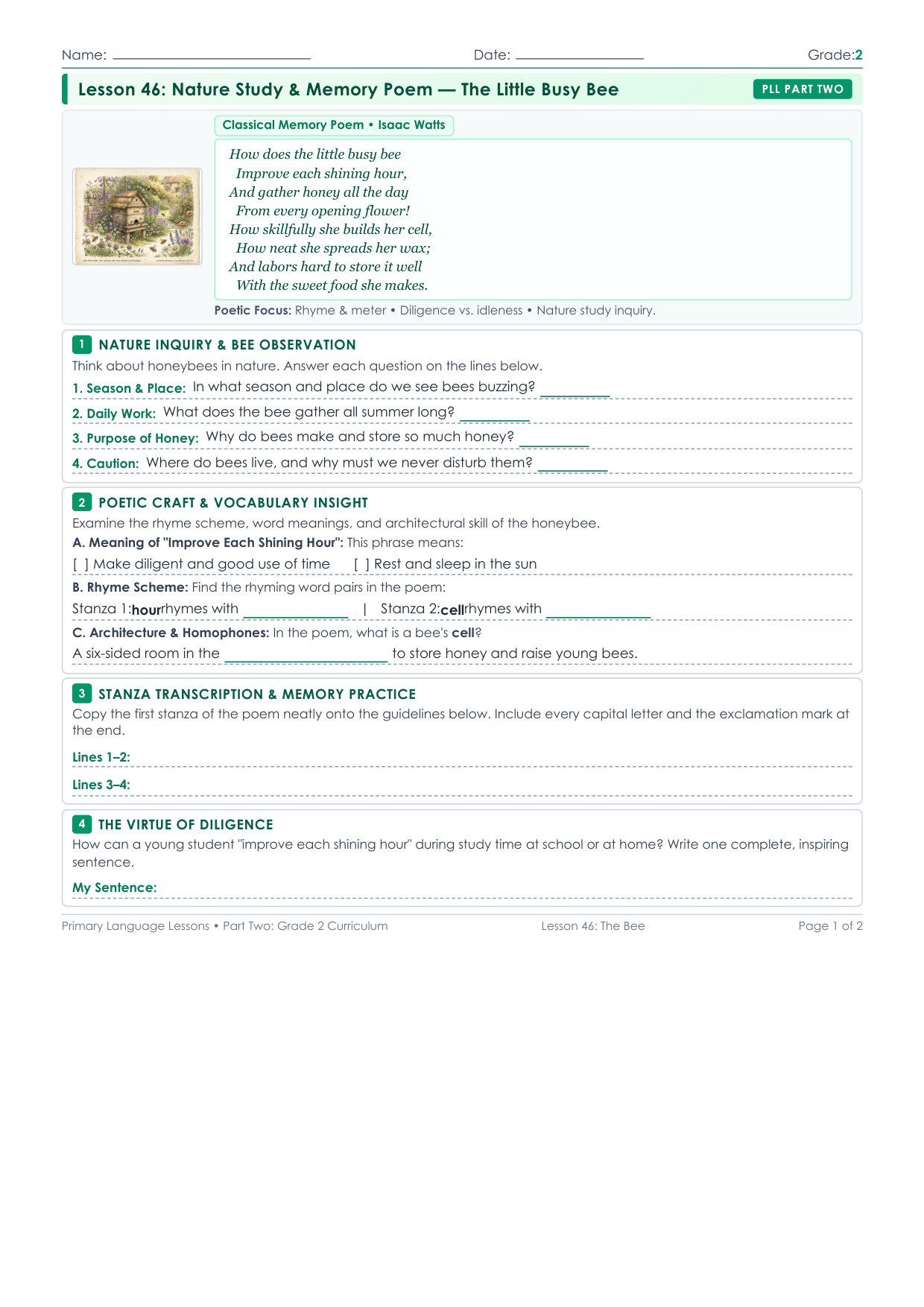
Grade 2 • Lesson 46: Nature Study & Memory Poem — The Little Busy Bee
Explore the industry of the honeybee through Isaac Watts' classical verse. Investigate hives, honeycomb cells, and summer pollination, and master rhyming craft and diligence.
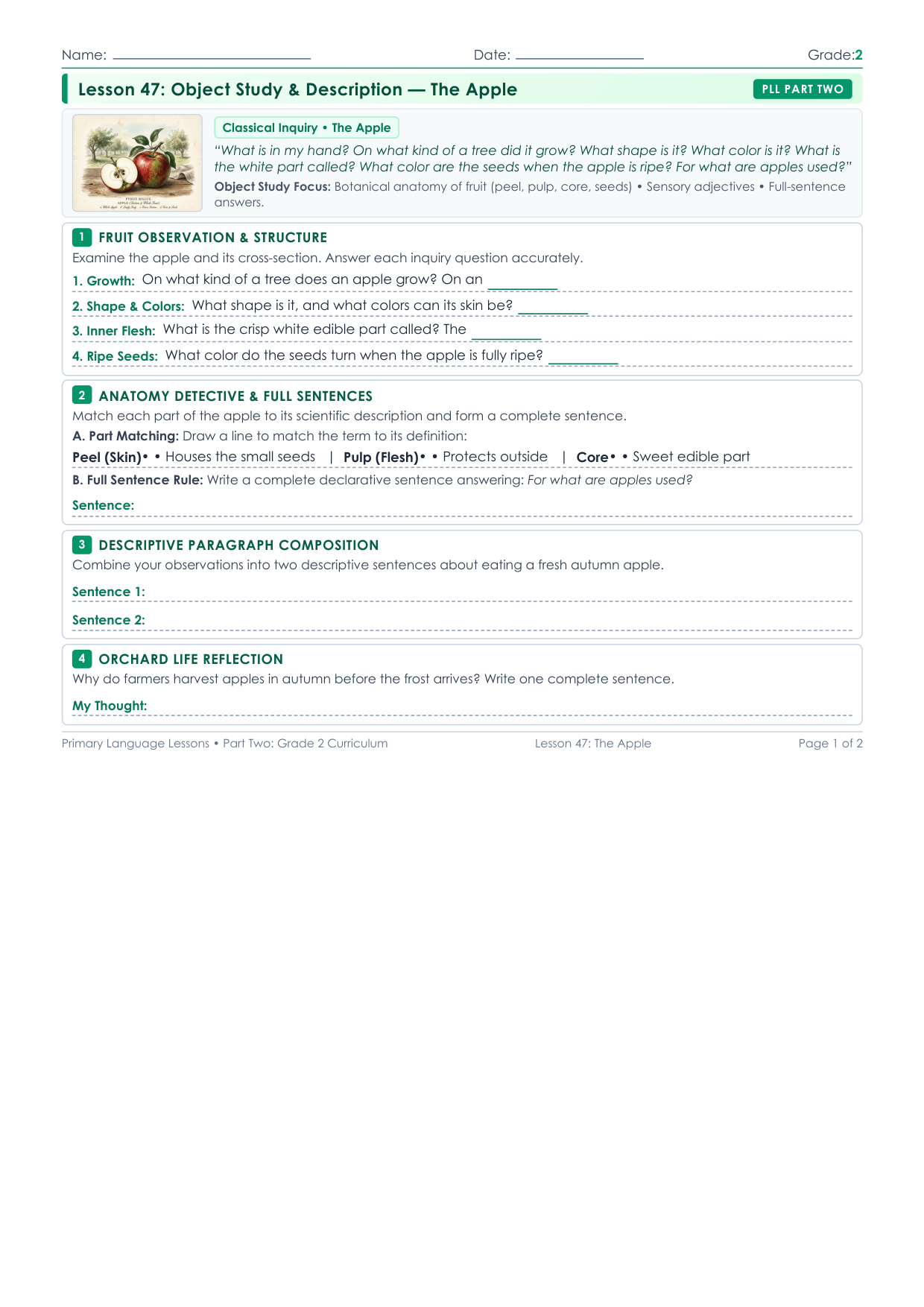
Grade 2 • Lesson 47: Object Study & Description — The Apple
Investigate fruit anatomy (skin, pulp, core, seeds) through concrete sensory inquiry. Master botanical vocabulary and write complete declarative sentences.
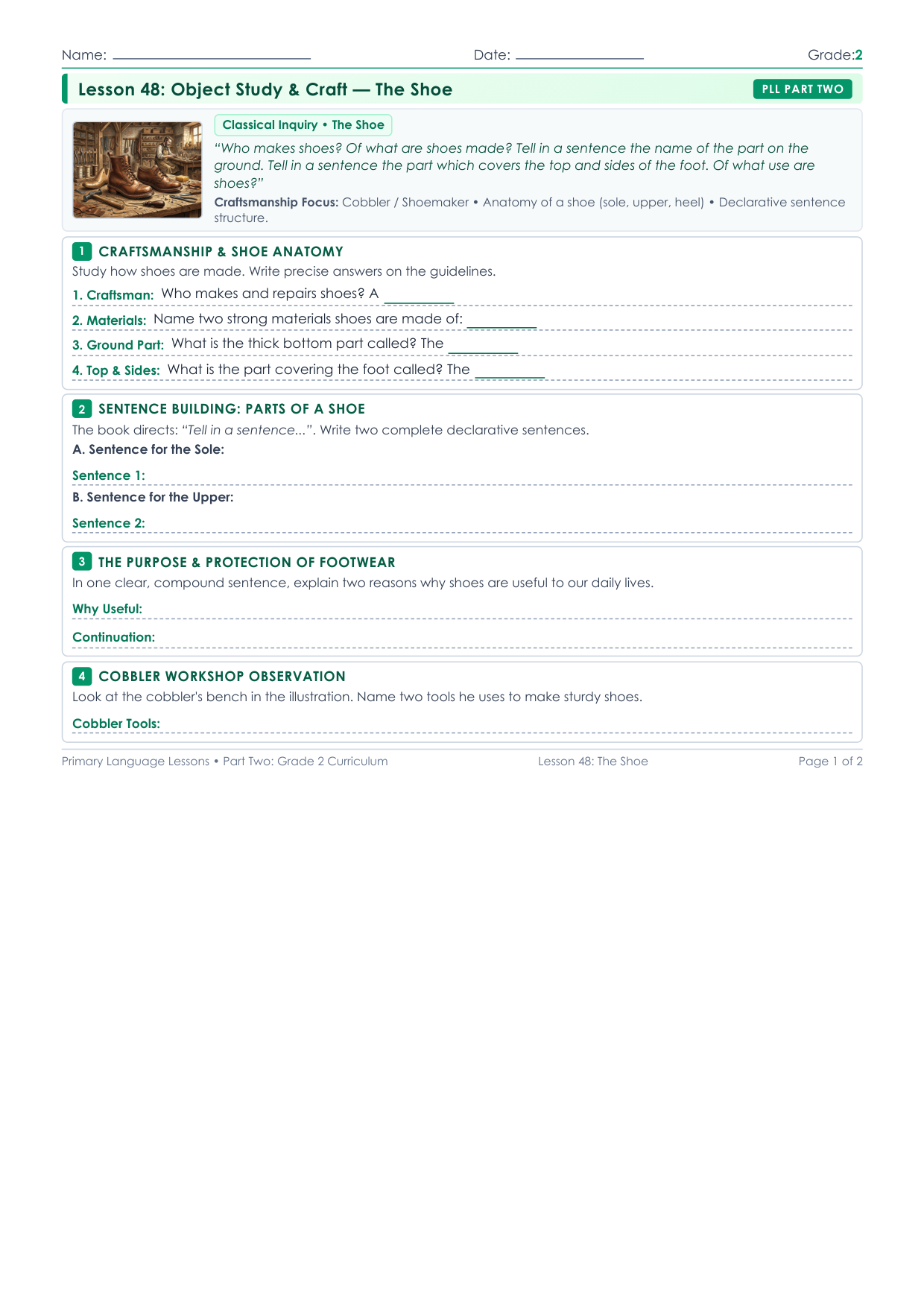
Grade 2 • Lesson 48: Object Study & Craft — The Shoe
Examine everyday footwear craftsmanship. Define the cobbler's tools, identify the sole and upper, and compose full-sentence structural definitions.
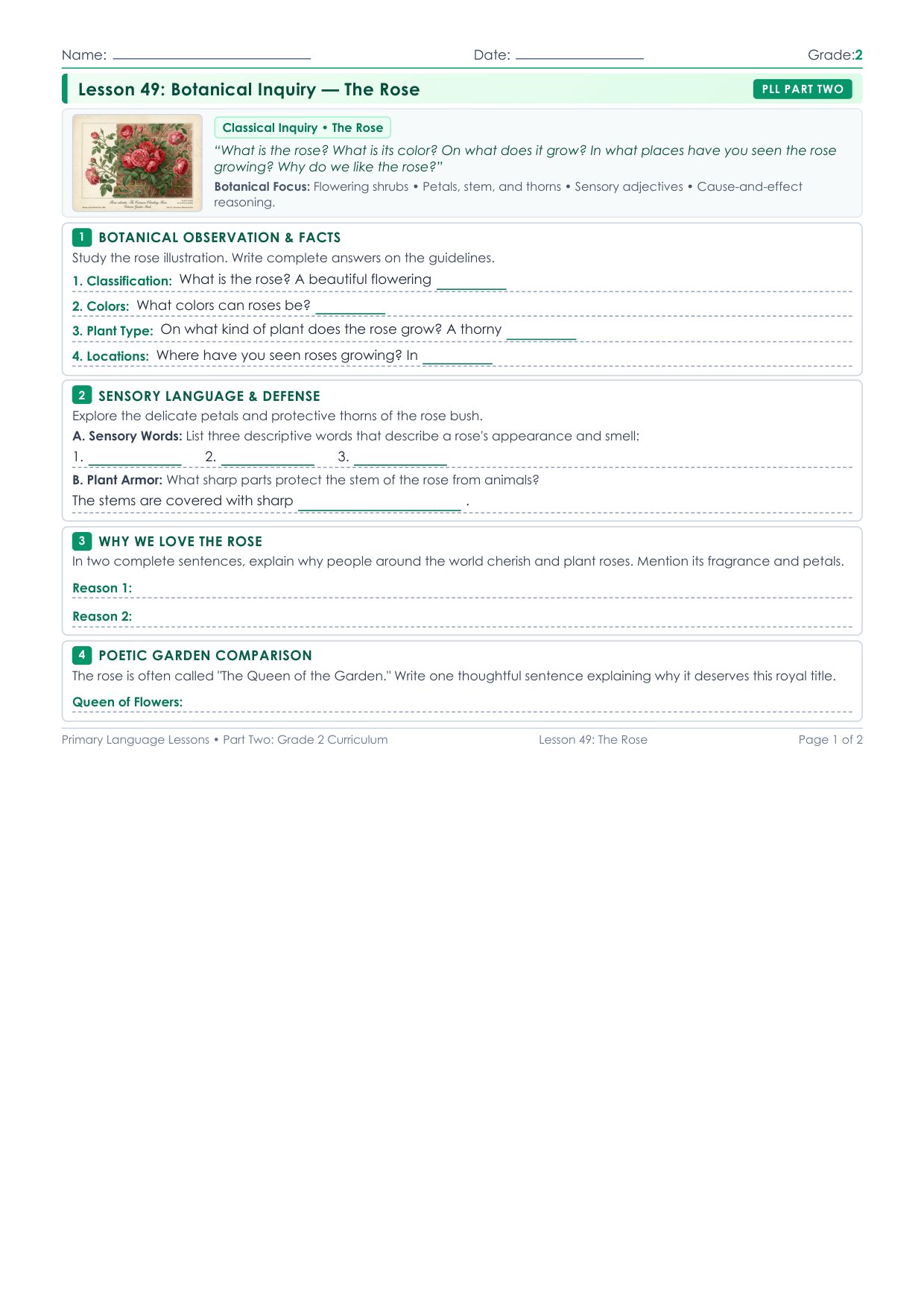
Grade 2 • Lesson 49: Botanical Inquiry — The Rose
Explore the Queen of Flowers. Observe vibrant petals, sweet fragrance, and protective stem thorns, practicing sensory adjectives and aesthetic appreciation.
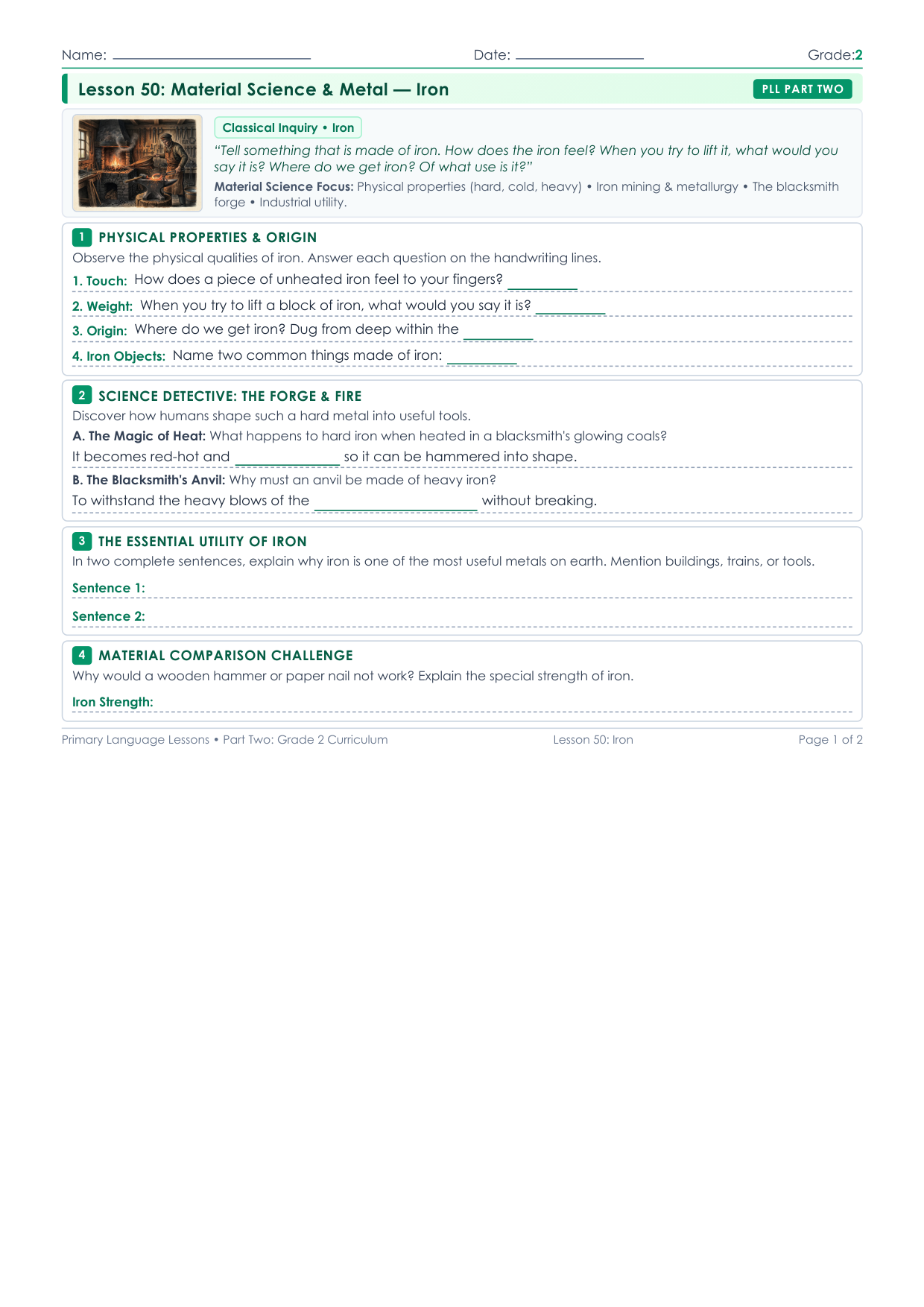
Grade 2 • Lesson 50: Material Science & Metal — Iron
Discover the strength of iron: hard, cold, and heavy. Learn about mining iron ore from the earth, the blacksmith's forge, and industrial structural utility.
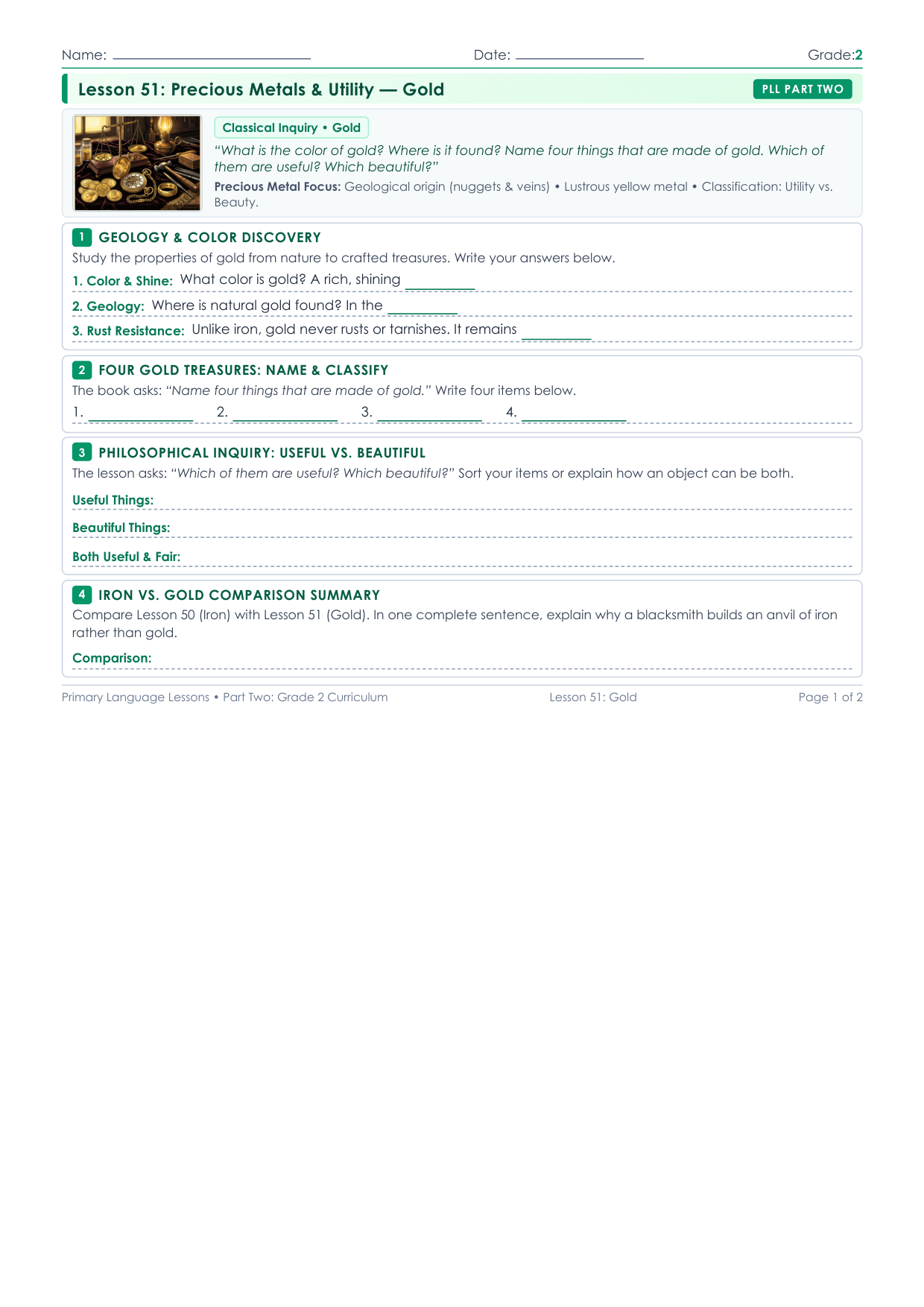
Grade 2 • Lesson 51: Precious Metals & Utility — Gold
Investigate lustrous gold from river sands to royal treasures. Classify objects by utility versus beauty, and compare the distinct roles of iron and gold.
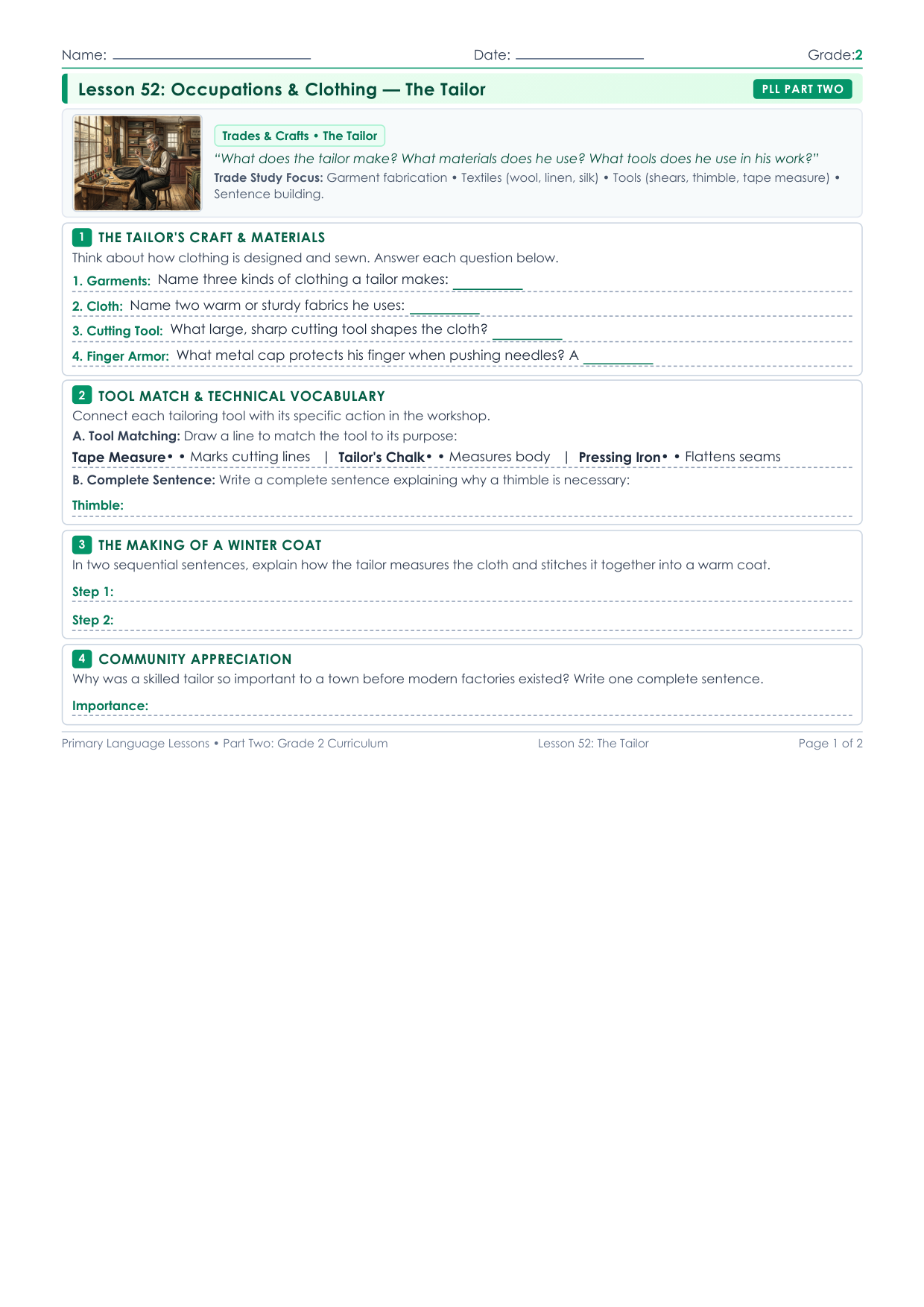
Grade 2 • Lesson 52: Occupations & Clothing — The Tailor
Explore the craft of garment making. Investigate fabrics (wool, tweed, linen, silk) and master trade tools (shears, needle, thimble, chalk) in structured sentences.
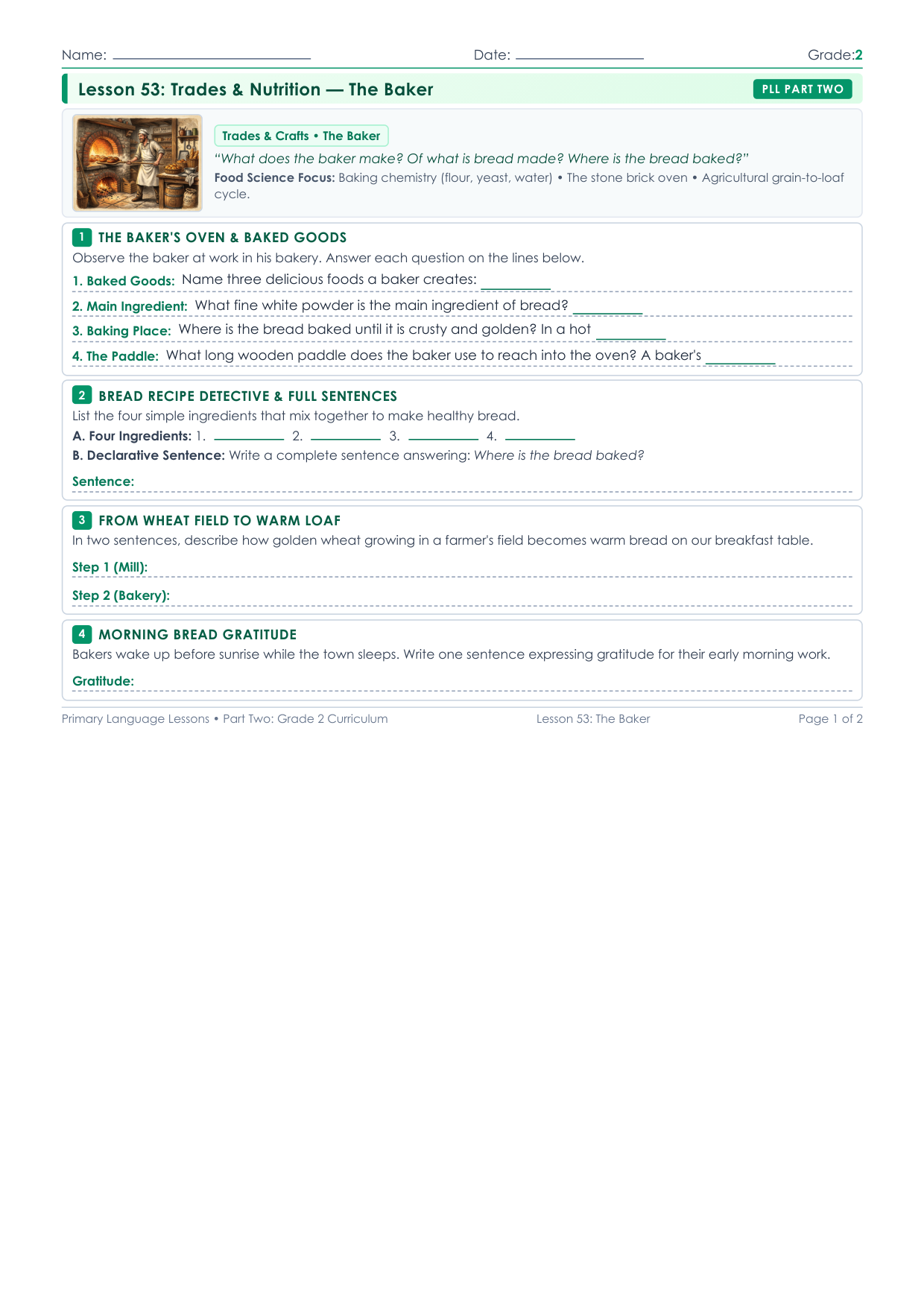
Grade 2 • Lesson 53: Trades & Nutrition — The Baker
Follow the journey of bread from golden wheat in the field to crusty loaves in the brick oven. Learn the role of flour, water, and yeast in narrative prose.
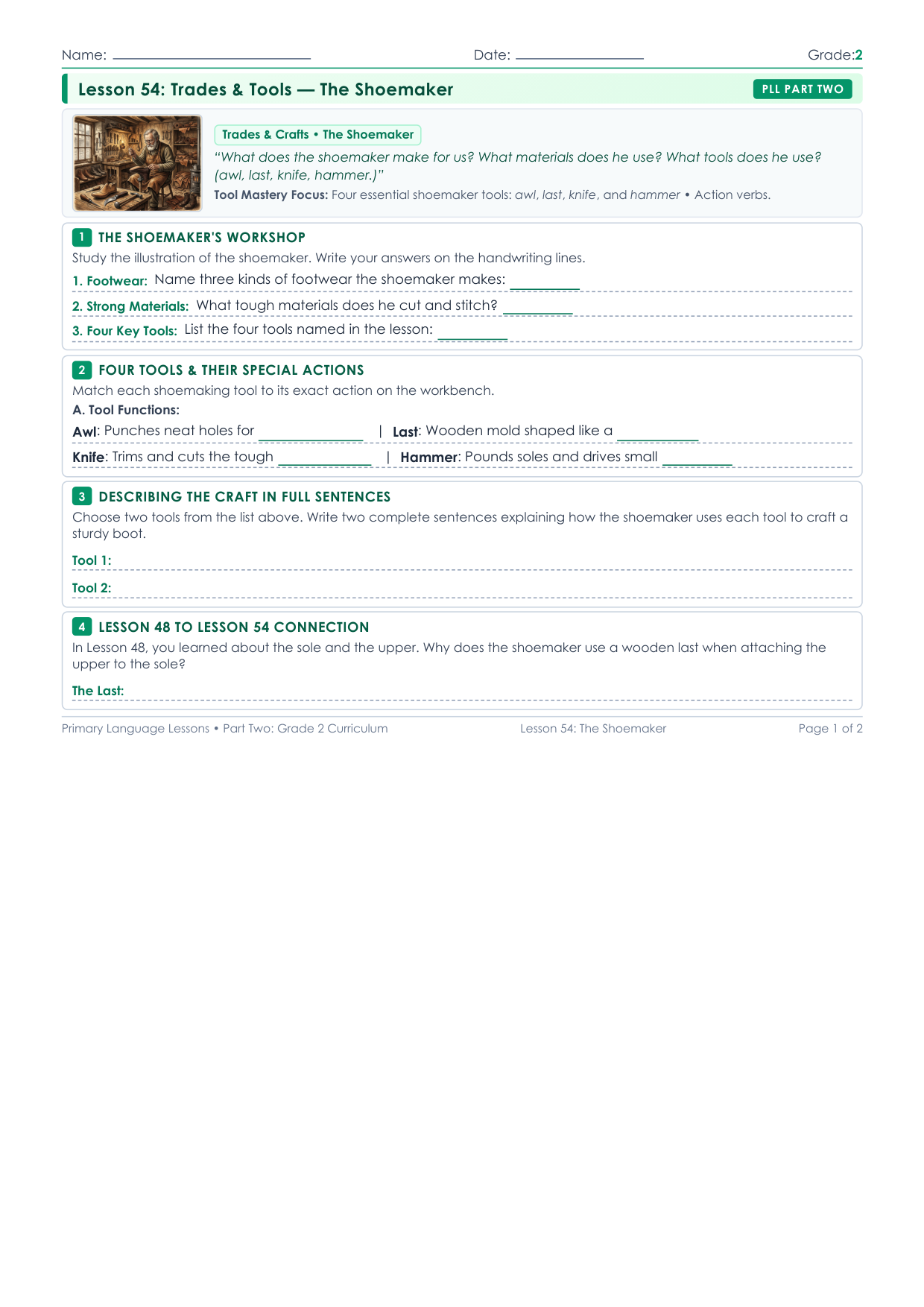
Grade 2 • Lesson 54: Trades & Tools — The Shoemaker
Examine the four classical instruments of the cordwainer: the awl, last, knife, and hammer. Connect precise action verbs to durable footwear craftsmanship.
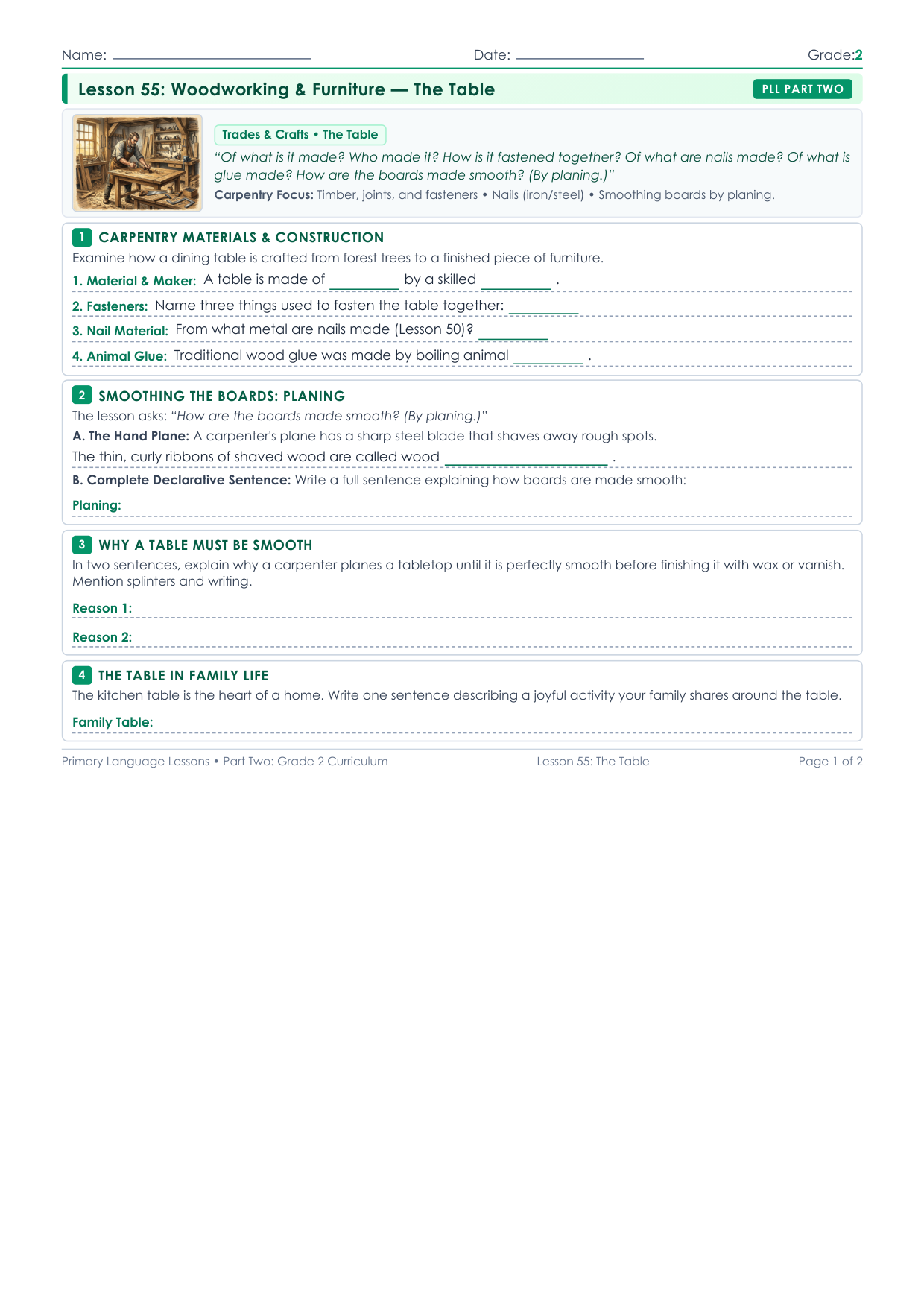
Grade 2 • Lesson 55: Woodworking & Furniture — The Table
Discover the carpenter's art: fastening timber with iron nails and hide glue, and shaving boards mirror-smooth with the hand plane. Practice procedural descriptions.
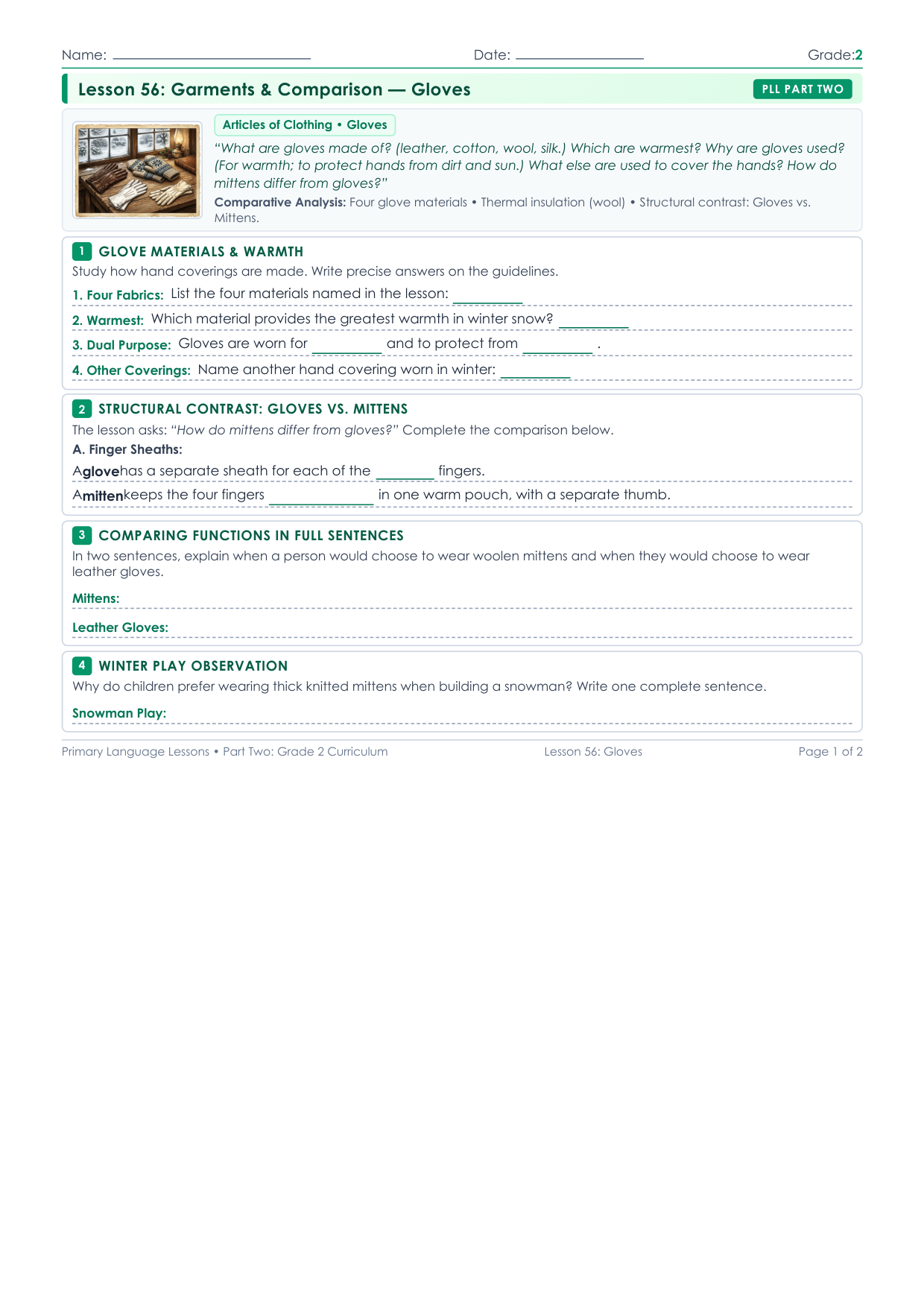
Grade 2 • Lesson 56: Garments & Comparison — Gloves
Compare hand coverings across materials (wool, leather, cotton, silk). Discriminate the physical structure of gloves (individual stalls) vs. mittens (warm pouch).
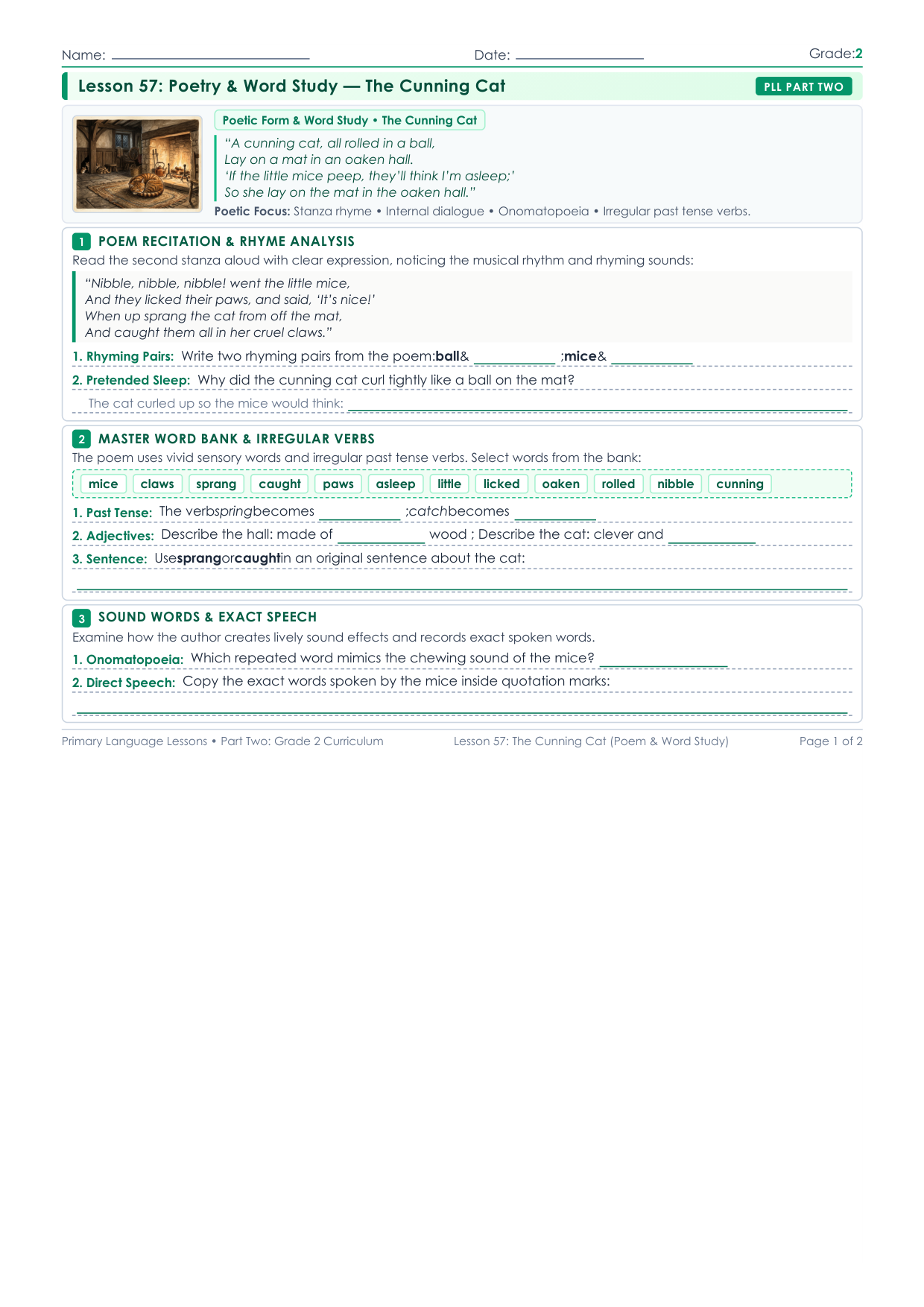
Grade 2 • Lesson 57: Poetry & Word Study — The Cunning Cat
Recite rhyming verses, analyze AABB meter, onomatopoeia (“Nibble, nibble, nibble!”), and apply irregular verbs (sprang, caught) and sensory words from the oaken hall.
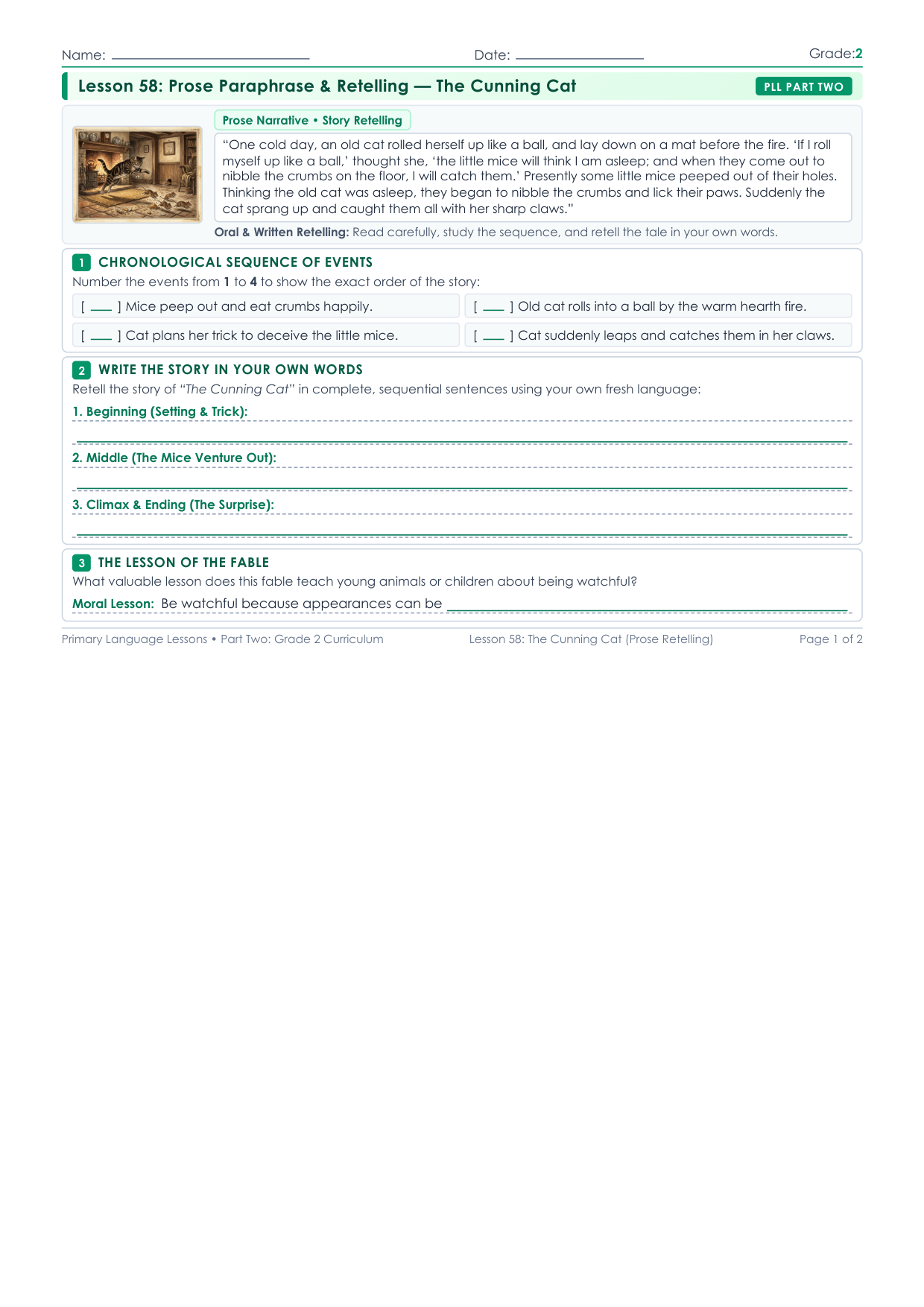
Grade 2 • Lesson 58: Prose Paraphrase & Retelling — The Cunning Cat
Transpose poetic verse into sequential narrative prose. Master chronological story structure (1 to 4), retell the fable in original words, and deduce the moral of deception.
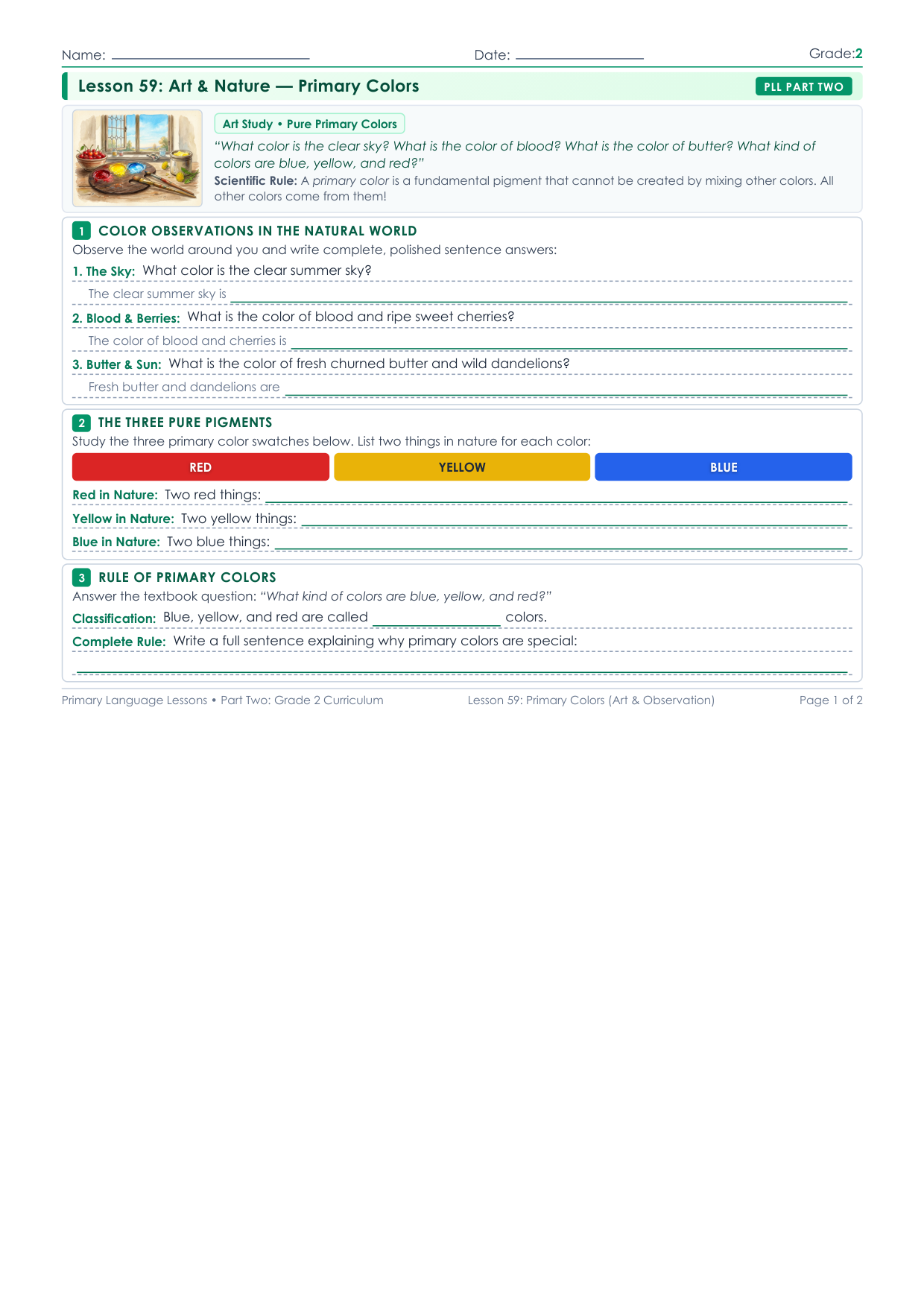
Grade 2 • Lesson 59: Art & Nature — Primary Colors
Identify the three pure primary colors (Red, Yellow, Blue). Observe foundational color sources in nature (sky, blood, butter) and write complete declarative definition sentences.
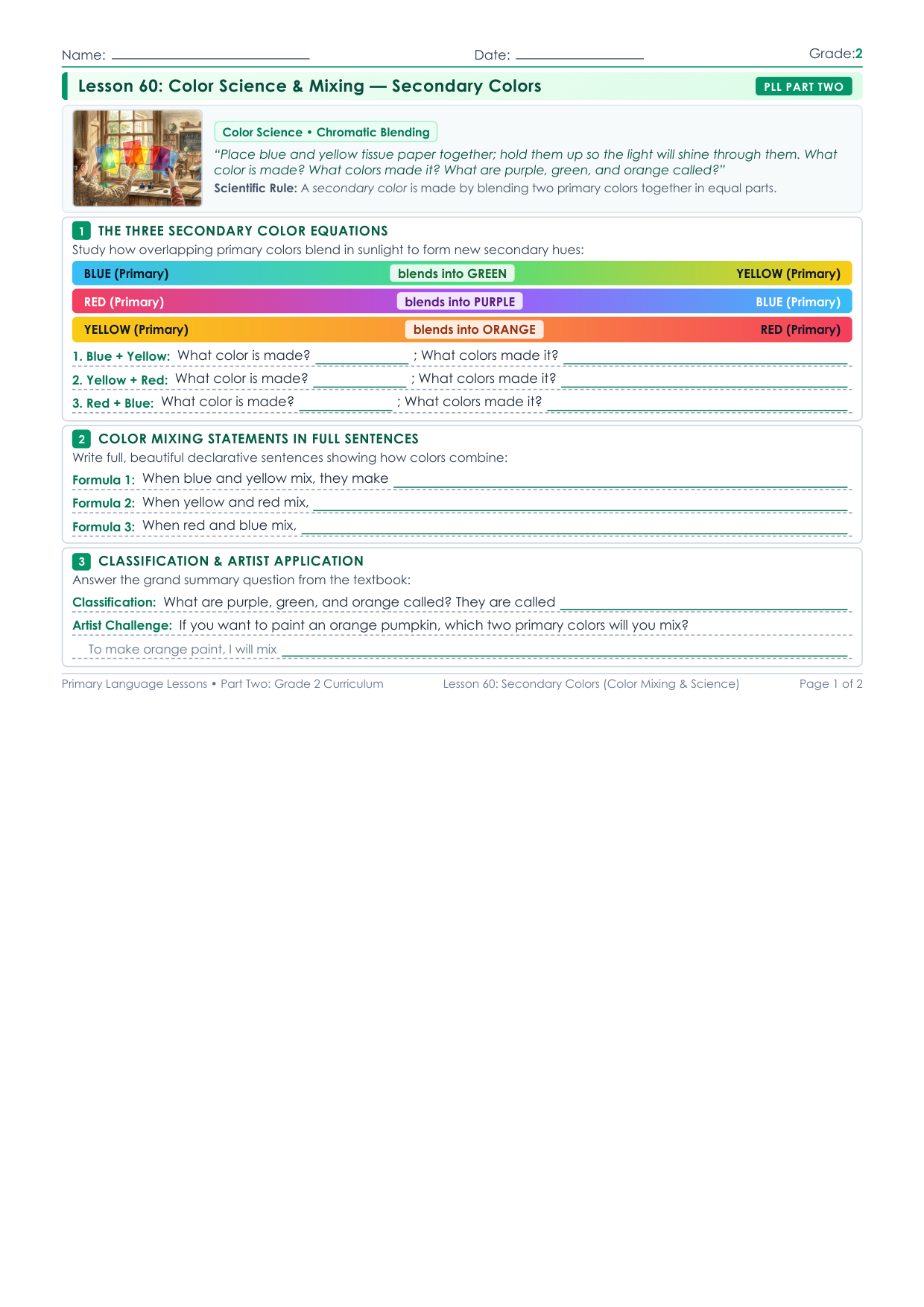
Grade 2 • Lesson 60: Color Science & Mixing — Secondary Colors
Investigate optical color blending through overlapping colored tissues in sunlight. Master the three secondary color equations (Green, Orange, Purple) and construct cause-and-effect sentences.
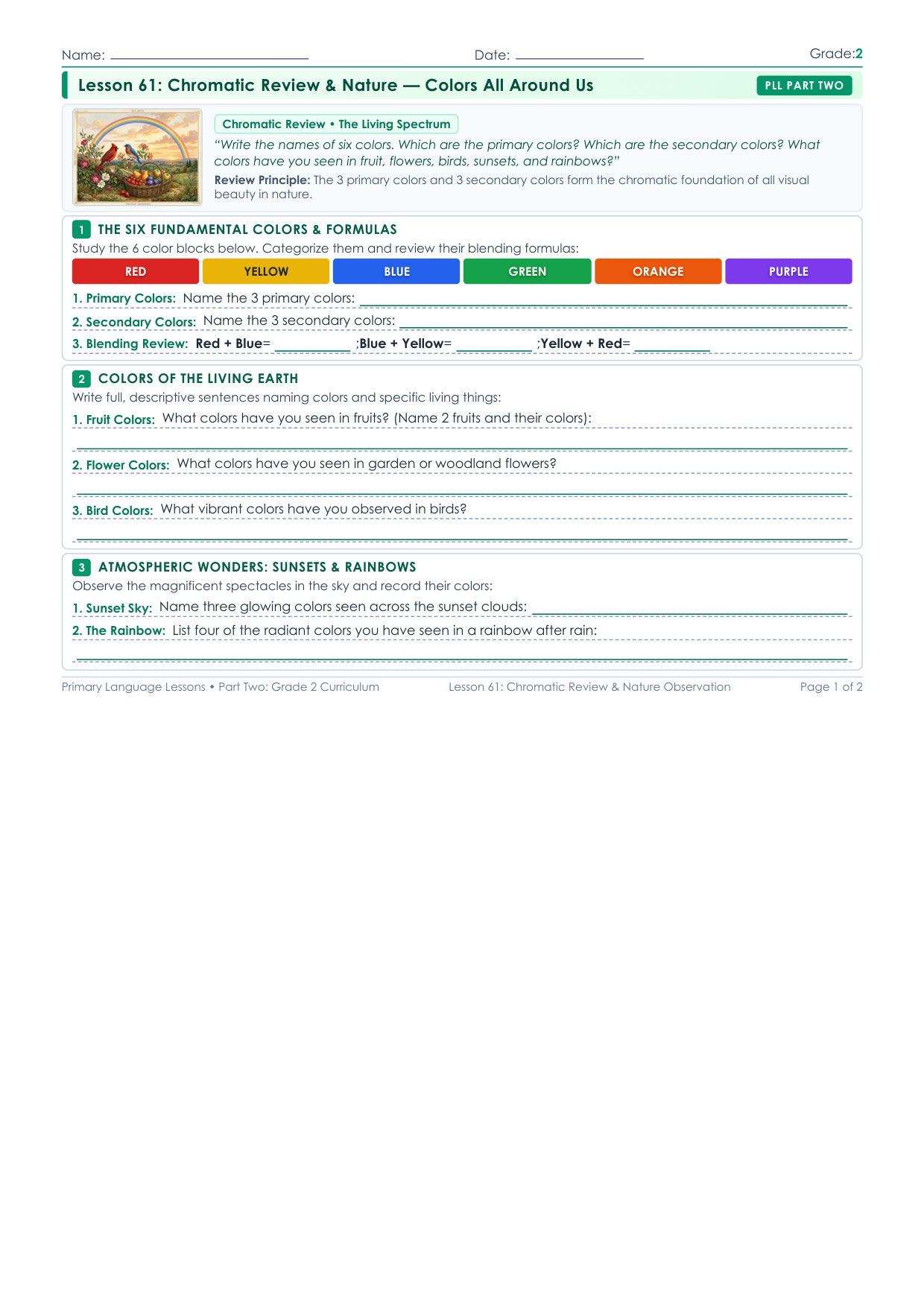
Grade 2 • Lesson 61: Chromatic Review & Nature — Colors All Around Us
Review the six core colors, primary and secondary formulas, and discover brilliant chromatic palettes in living nature: fruits, flowers, songbirds, sunsets, and rainbows.
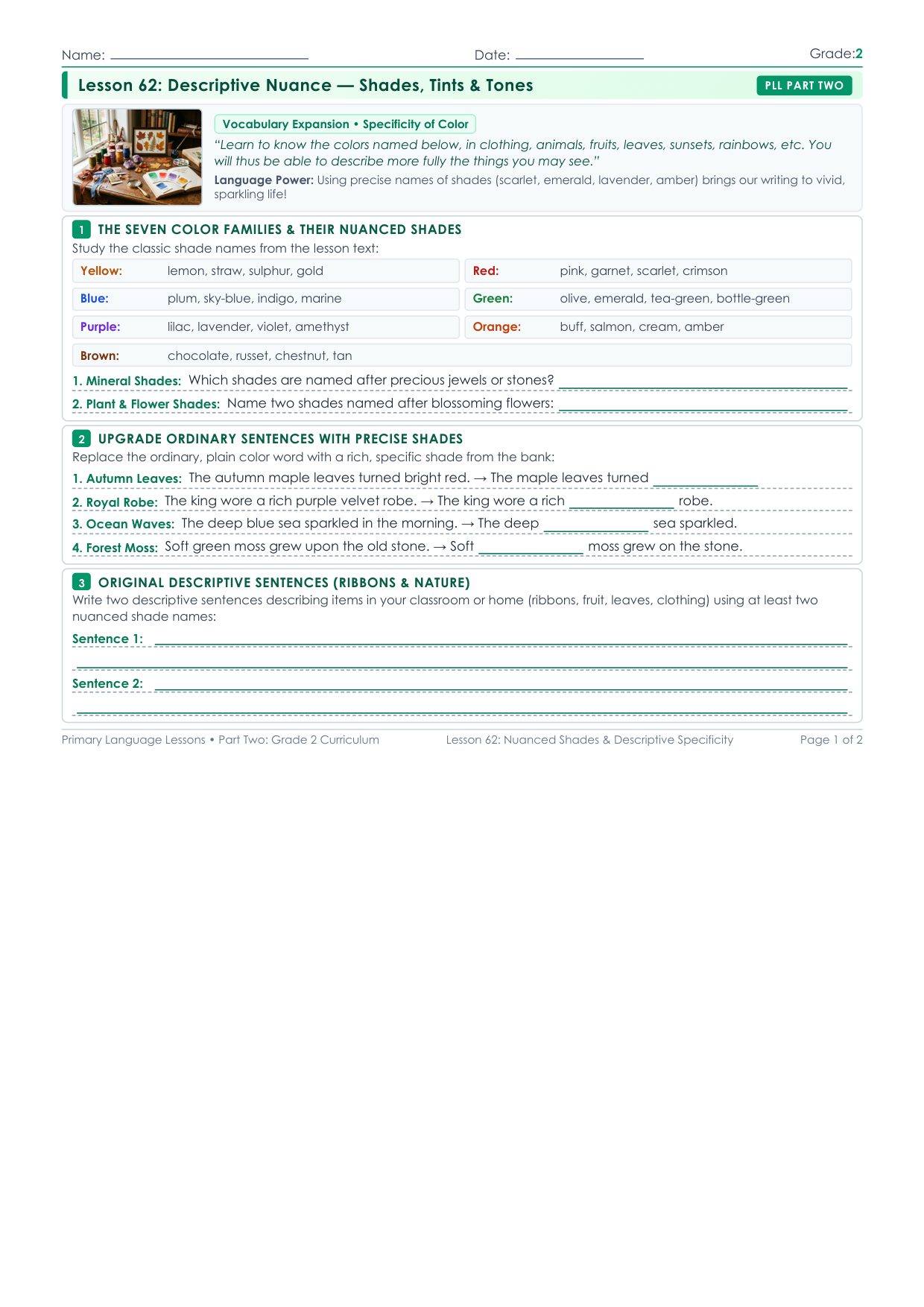
Grade 2 • Lesson 62: Descriptive Nuance — Shades, Tints & Tones
Enrich descriptive writing through 28 specific shade names across 7 color families (scarlet, emerald, indigo, lavender, amber, chestnut). Upgrade sentences with precise sensory adjectives.
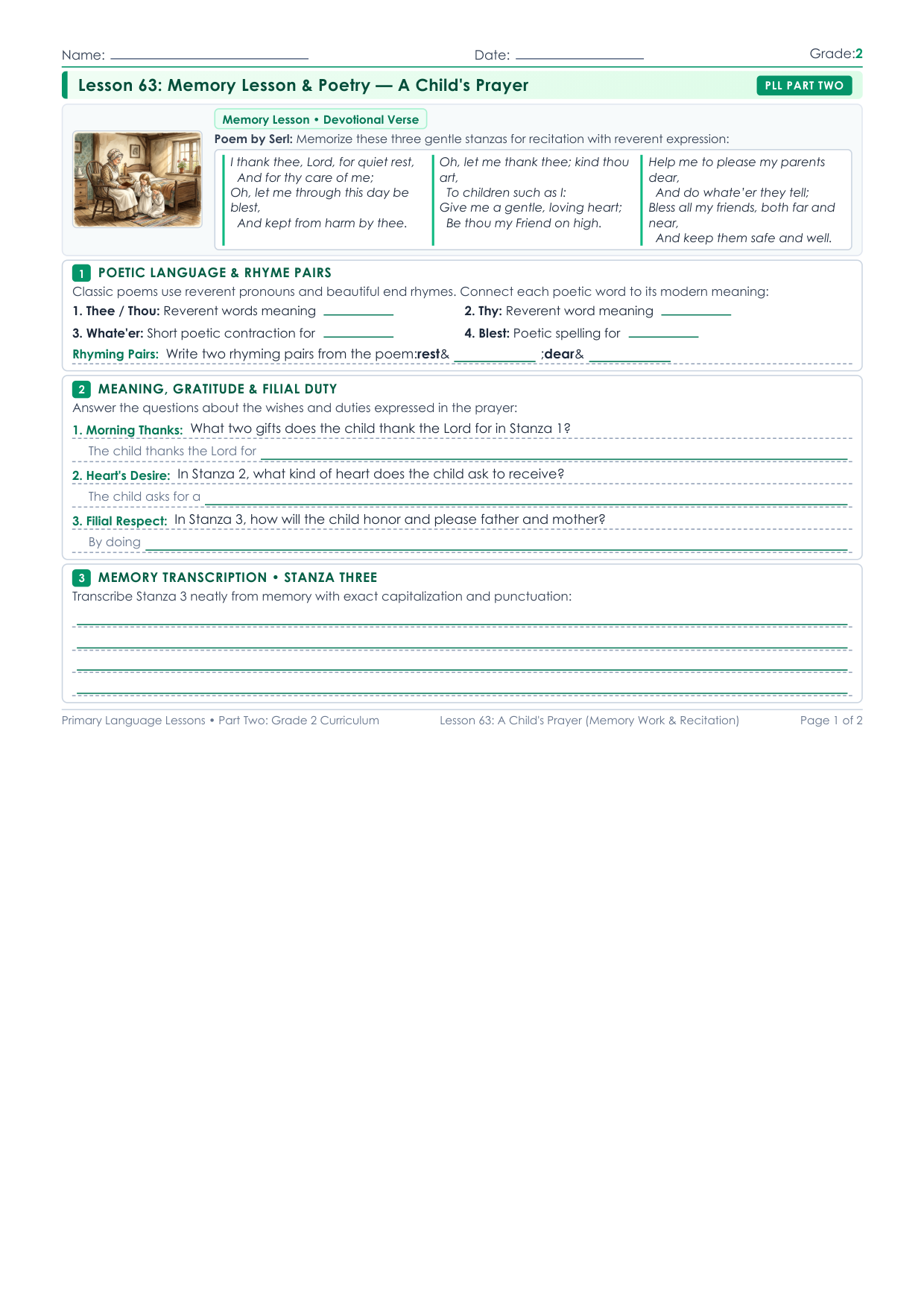
Grade 2 • Lesson 63: Memory Lesson & Poetry — A Child's Prayer
Memorize and recite three reverent stanzas, master archaic poetic pronouns (thee, thy, thou), and explore themes of morning gratitude, a gentle heart, and filial obedience.
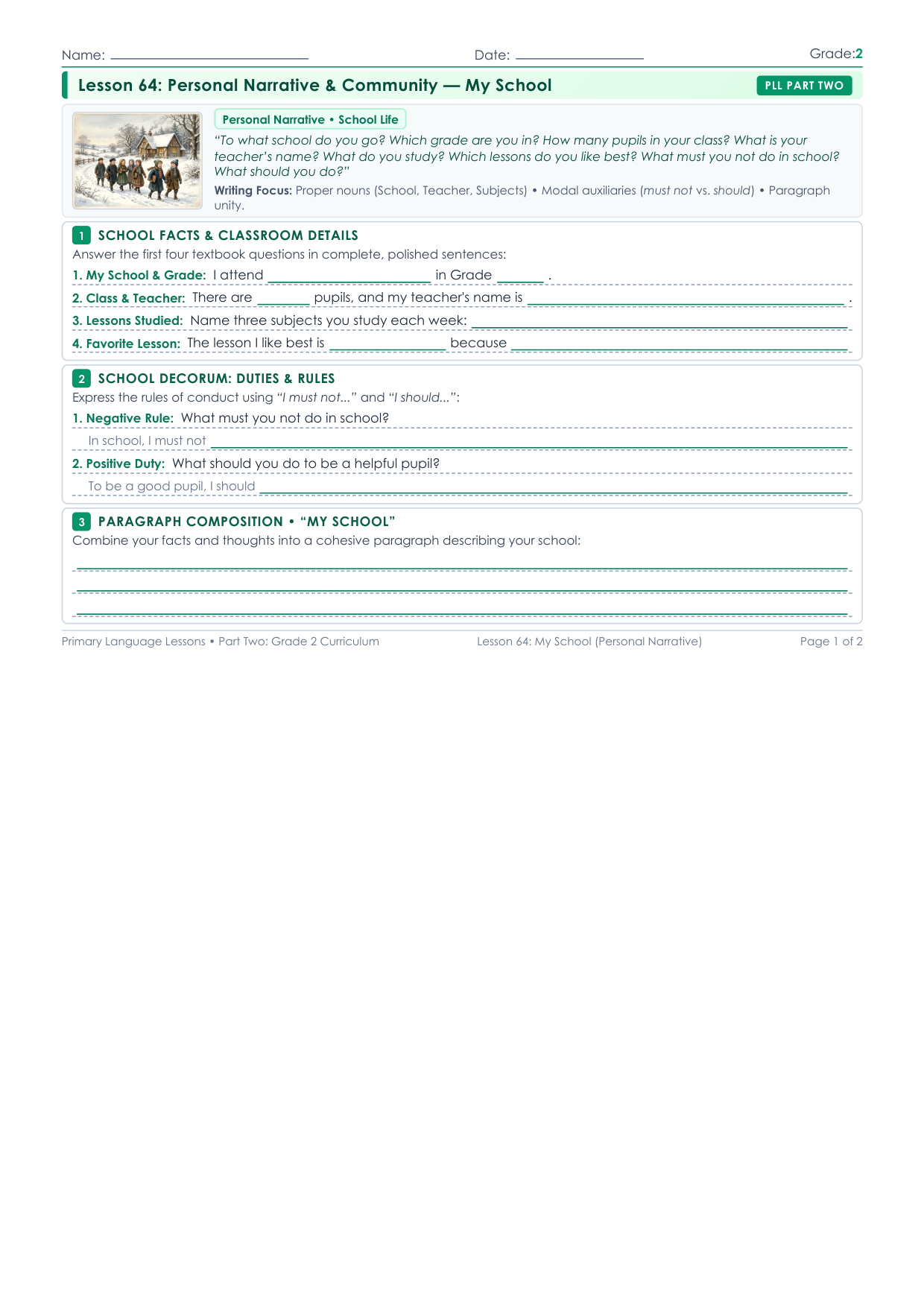
Grade 2 • Lesson 64: Personal Narrative & Community — My School
Write factual statements about your school, teacher, and favorite lessons. Master proper noun capitalization, modal rules of decorum (must not / should), and paragraph synthesis.
Grade 2 • Lesson 65: Object Study & Description — My Penknife
Examine an everyday tool's anatomy (handle and blade), tactile materials (horn, bone, steel), utility (sharpening pencils, carving cedar), and essential safety rules in a descriptive paragraph.
Grade 2 • Lesson 66: Domestic Animals & Companionship — My Pet
Describe a pet bird's species, daily care routine, favorite foods, singing habits, cage safety rules, and unique playful quirks in a vivid narrative paragraph.
Grade 2 • Lesson 67: Canine Companionship & Work — My Dog
Explore canine traits (size, color, smooth vs. shaggy coat), swimming and retrieving skills, tricks, and practical farm or home guardianship in an expressive paragraph.
Grade 2 • Lesson 68: Feline Habits & Anatomy — The Cat
Investigate feline anatomy: tame vs. wild classification, velvet-padded paws for stealth locomotion, retractable claws, self-grooming with barbed tongue, and pantry mousing service.
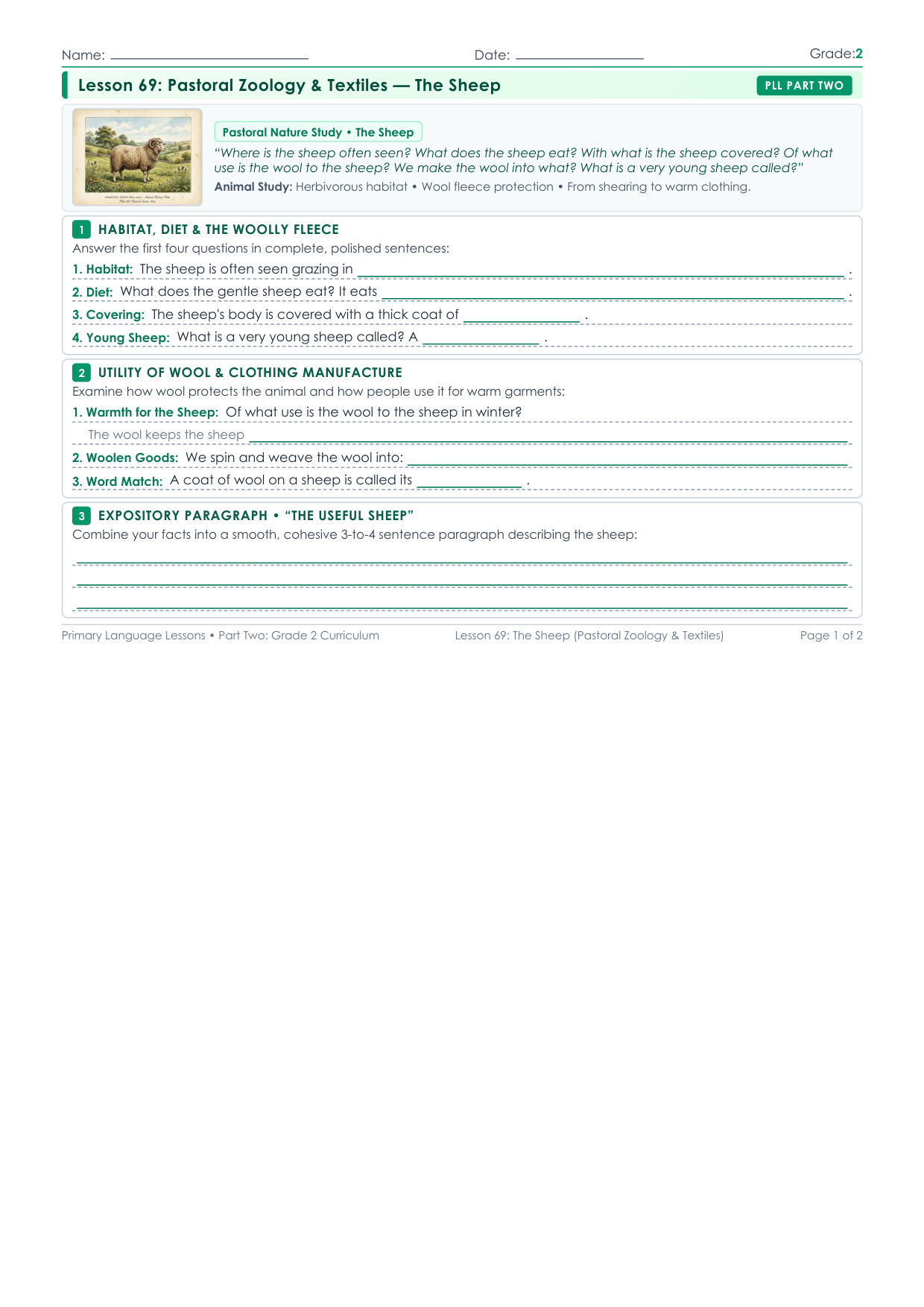
Grade 2 • Lesson 69: Pastoral Zoology & Textiles — The Sheep
Examine the gentle sheep: habitat in rolling grassy pastures, herbivorous grazing diet, warm insulating fleece, the lifecycle of wool sheared and spun into cloth, and identifying young lambs.
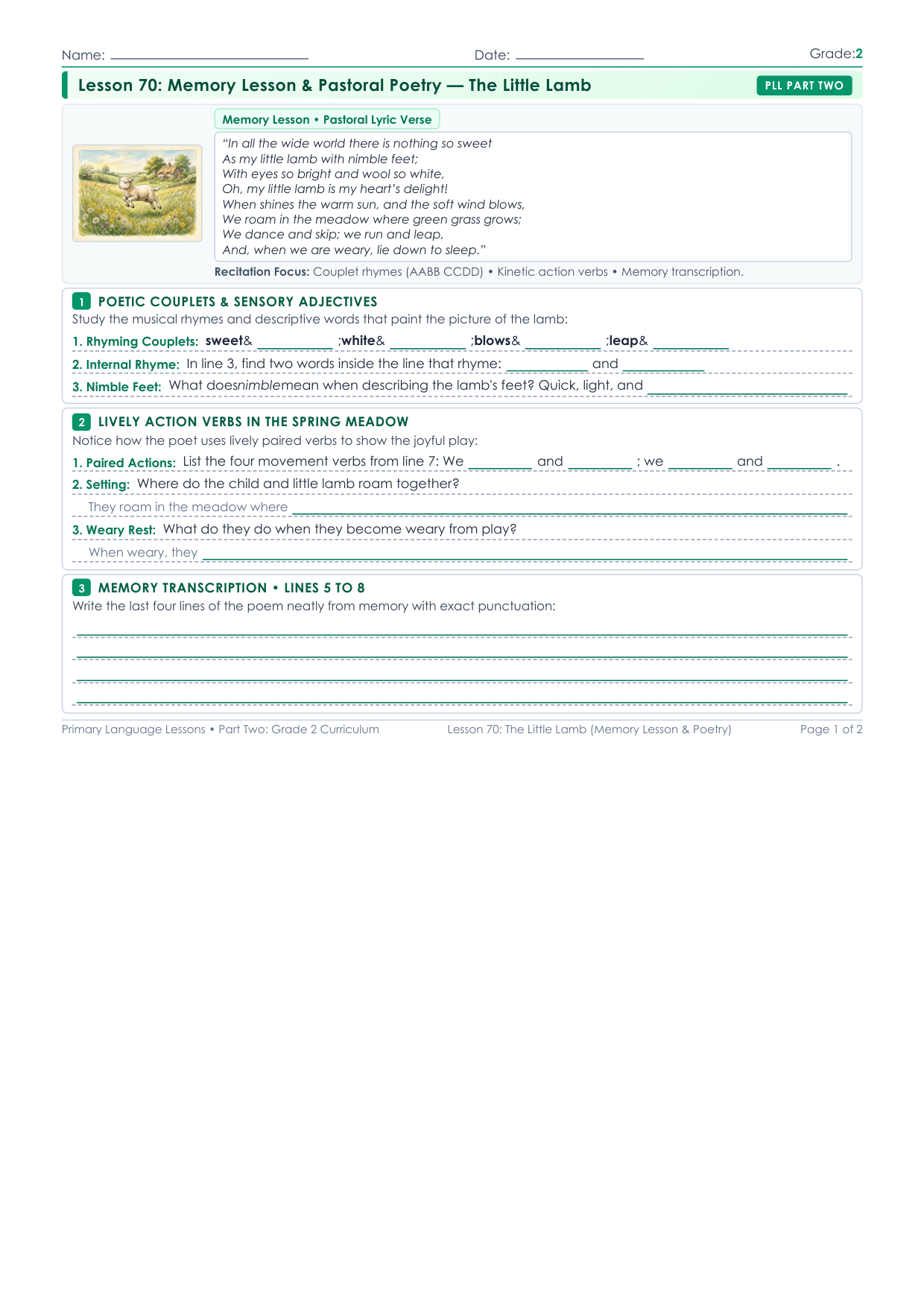
Grade 2 • Lesson 70: Pastoral Poetry & Recitation — The Little Lamb
Memorize and recite the classic lyrical poem: analyze AABB CCDD couplets, internal rhymes, nimble action verbs, and transcribe lines from memory with flawless punctuation.
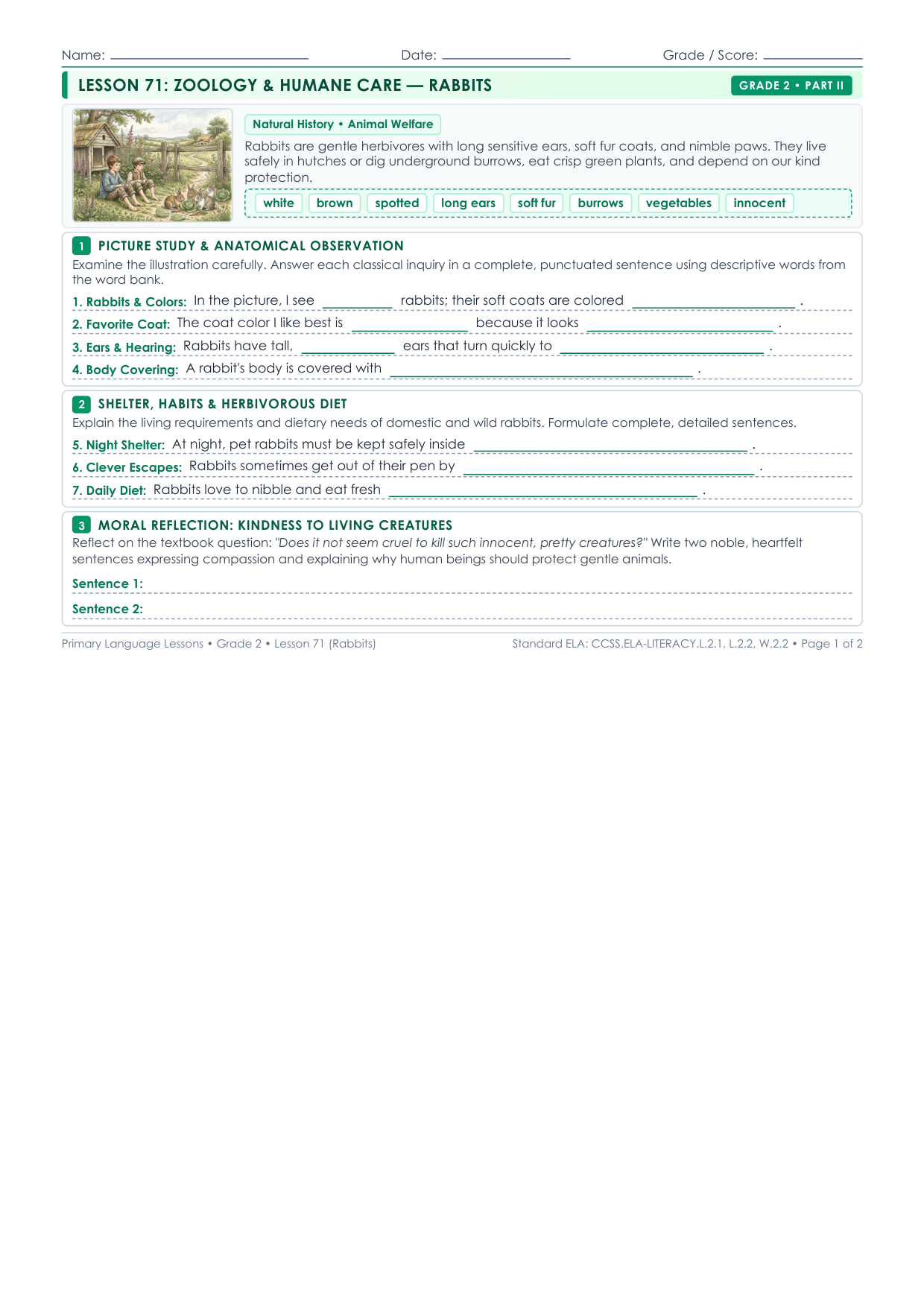
Grade 2 • Lesson 71: Zoology & Humane Care — Rabbits
Study gentle domestic rabbits: observe coat color variations, tall sound-sensitive ears, soft fur, underground burrows and night hutches, fresh vegetable diets, and cultivate compassionate care for innocent creatures.
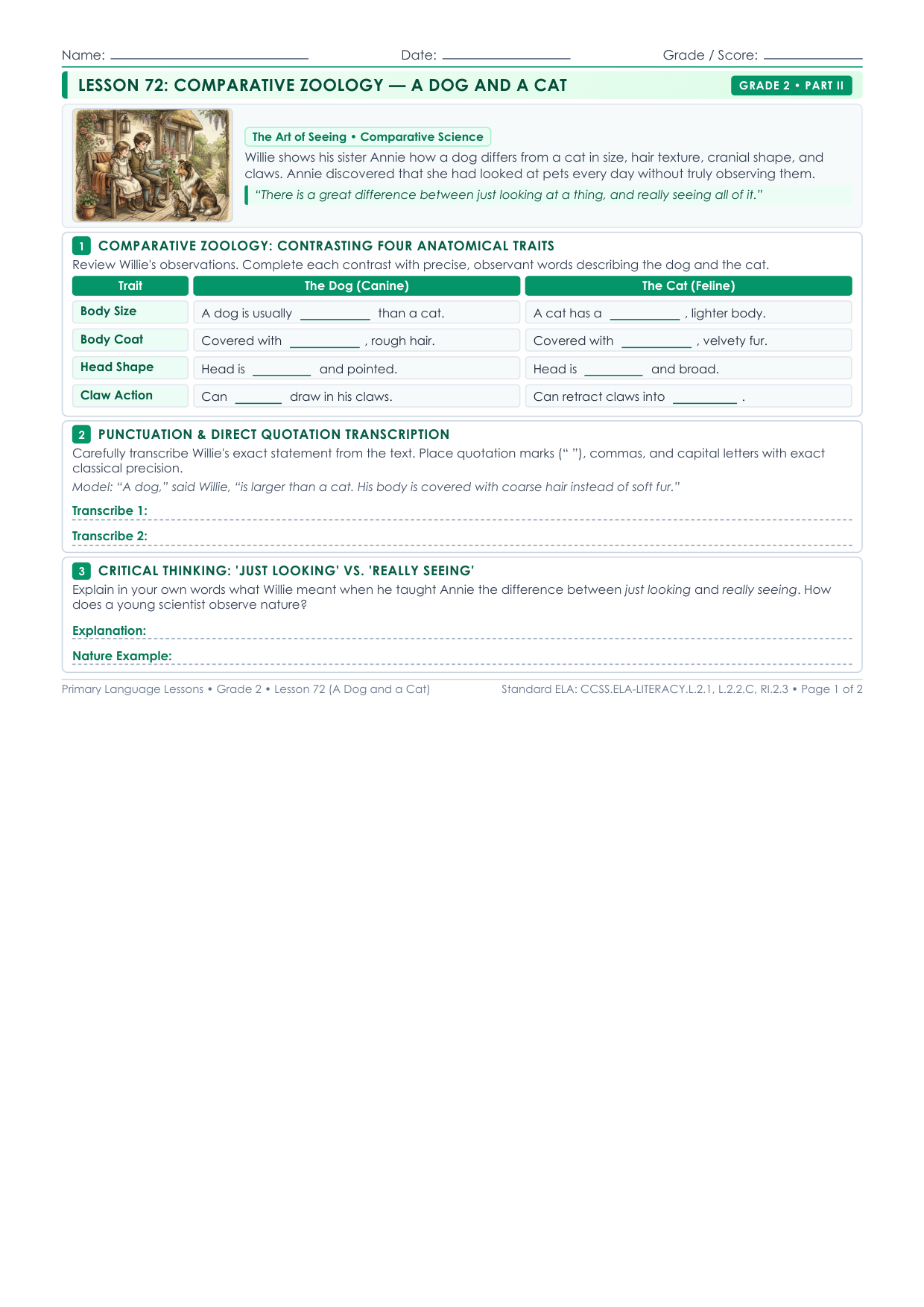
Grade 2 • Lesson 72: Comparative Zoology & Observation — A Dog and a Cat
Explore comparative anatomy with Willie and Annie: contrast dog vs. cat in body size, coarse hair vs. soft fur, head shape, and retractile claws; transcribe divided speech quotations, and understand the difference between just looking and really seeing.
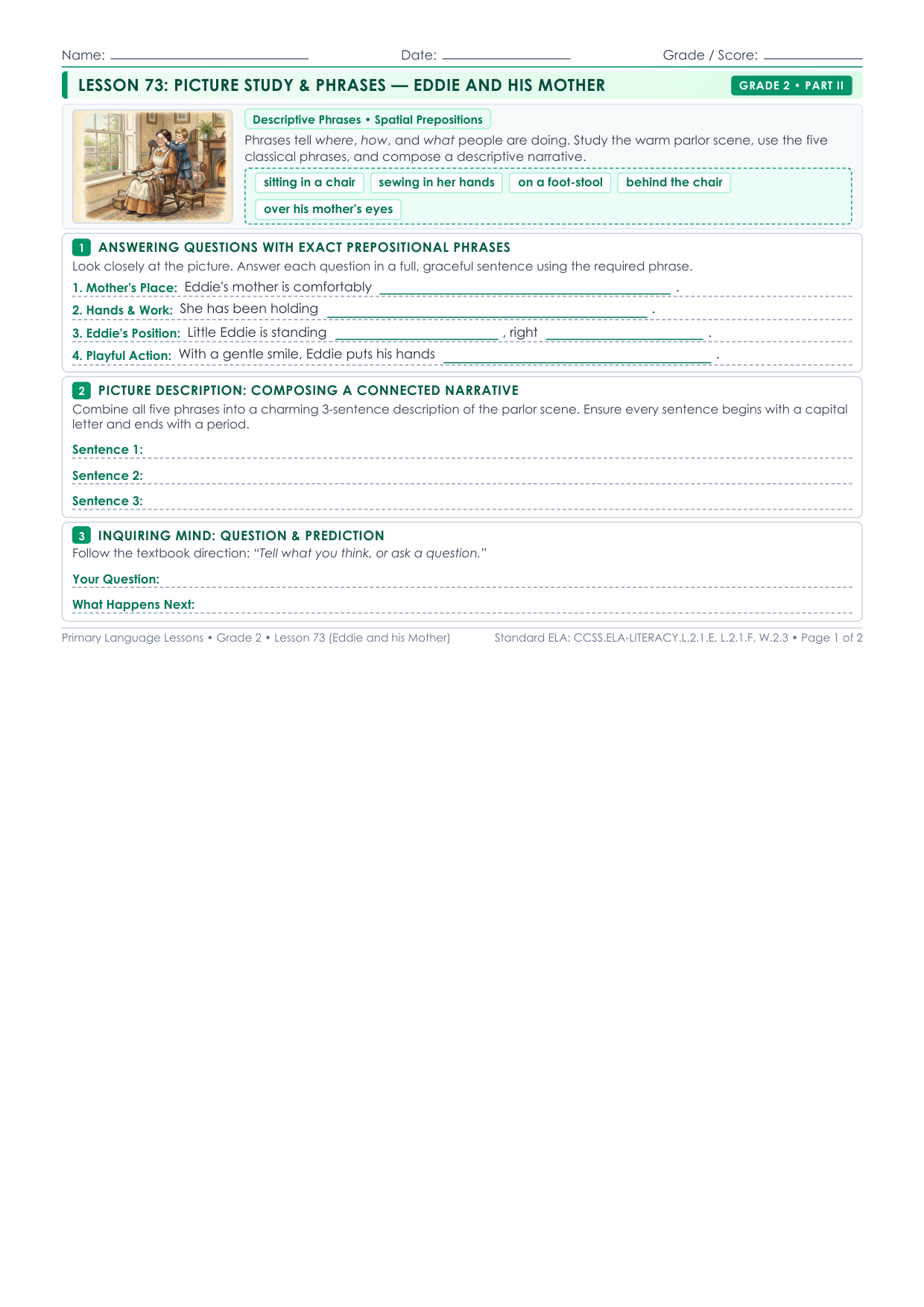
Grade 2 • Lesson 73: Picture Study & Phrases — Eddie and his Mother
Analyze a warm Victorian parlor scene: master spatial prepositional phrases (in a chair, on a foot-stool, behind the chair, over his mother's eyes) and compose a flowing descriptive narrative.
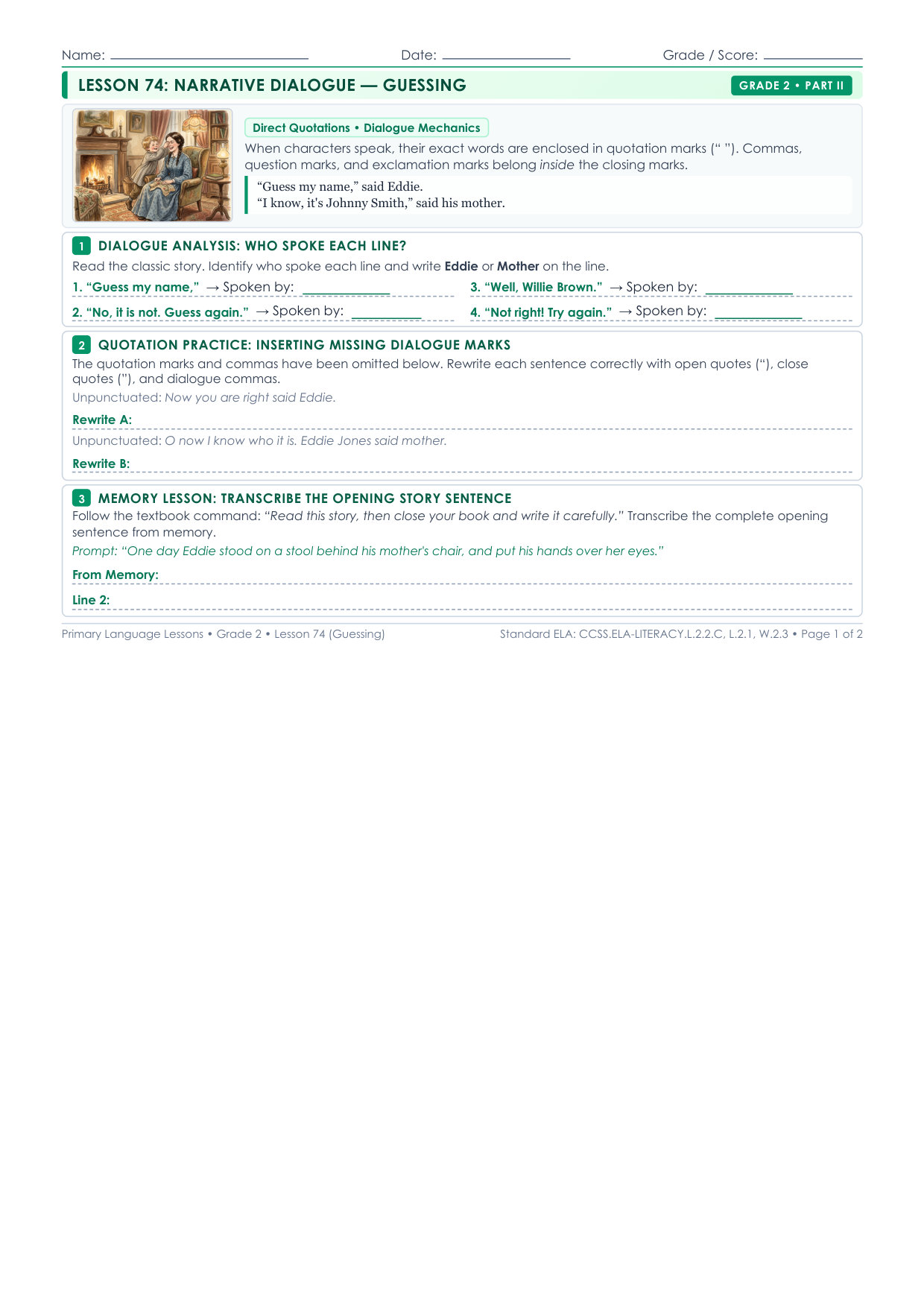
Grade 2 • Lesson 74: Narrative Dialogue & Quotation Marks — Guessing
Master the rules of spoken dialogue: enclose exact utterances in quotation marks, punctuate speech tags and interjections, identify speakers, and transcribe story lines from memory.
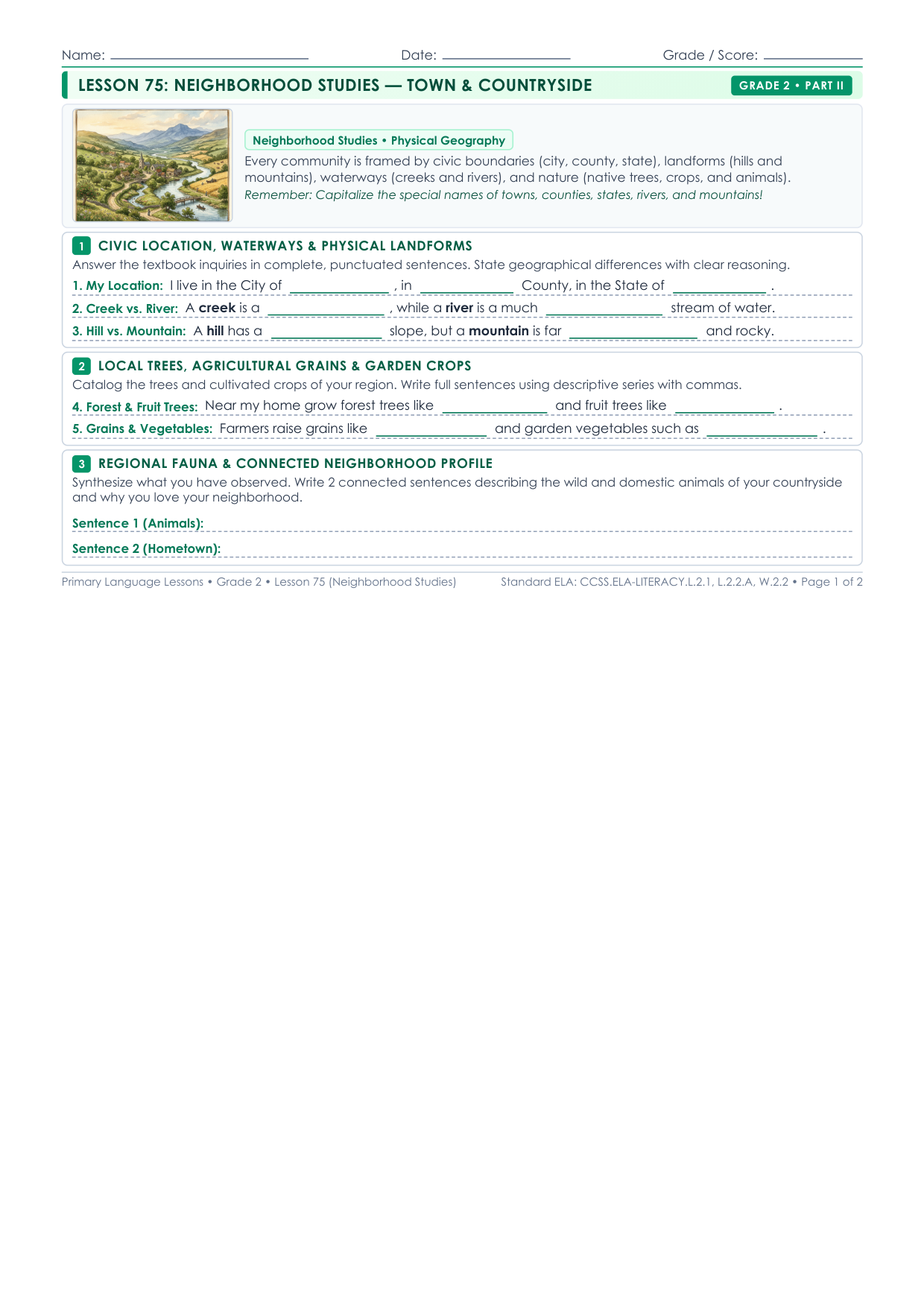
Grade 2 • Lesson 75: Neighborhood Studies — Town & Countryside
Survey your home environment: record civic coordinates (city, county, state), contrast creeks vs. rivers and hills vs. mountains, catalog native trees and crops, and describe local wildlife.
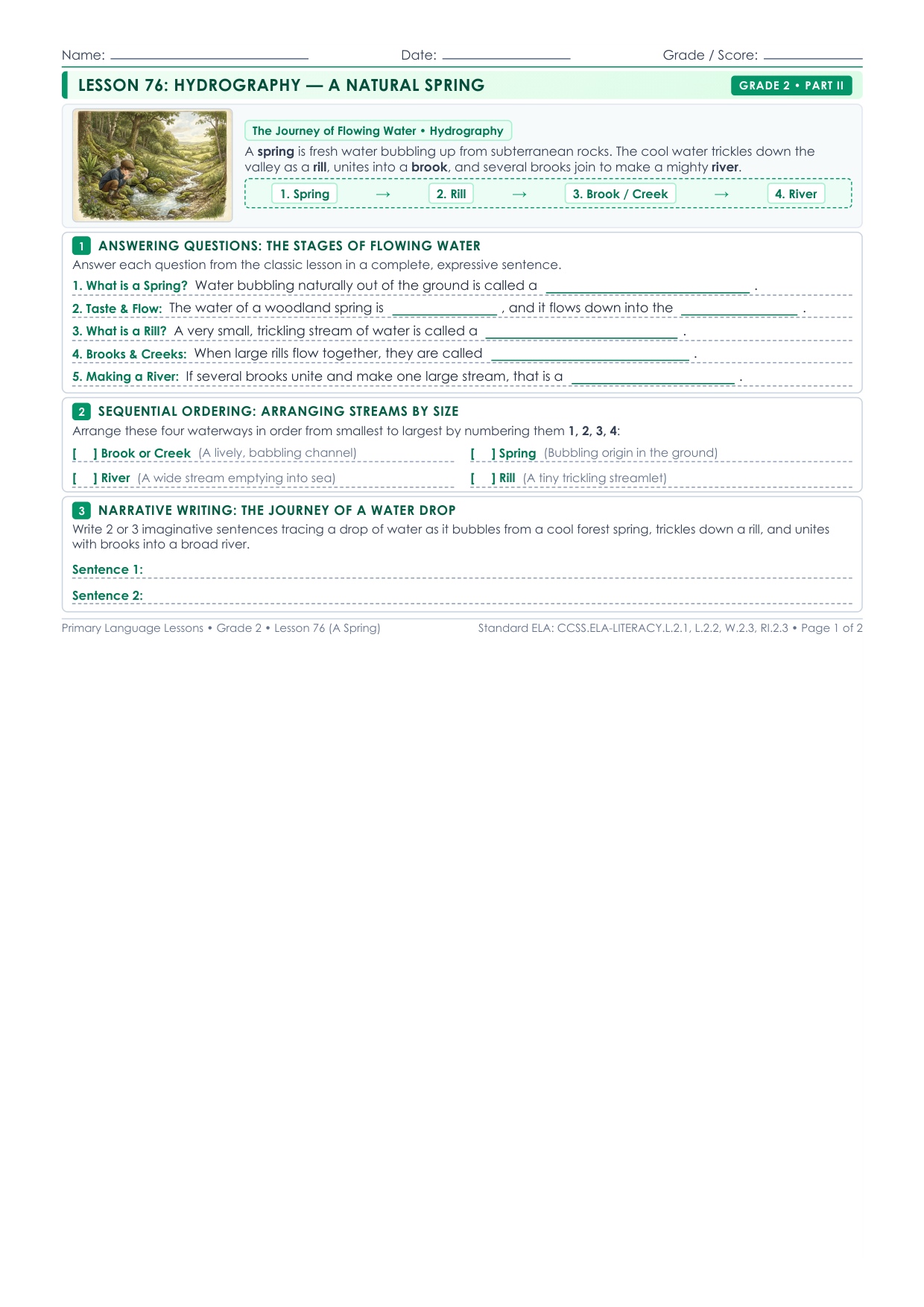
Grade 2 • Lesson 76: Physical Geography & Hydrography — A Natural Spring
Trace the journey of flowing freshwater: define a bubbling spring, trickling rill, babbling brook/creek, and mighty river; sequence waterways from smallest to largest, and narrate the journey of a water drop.
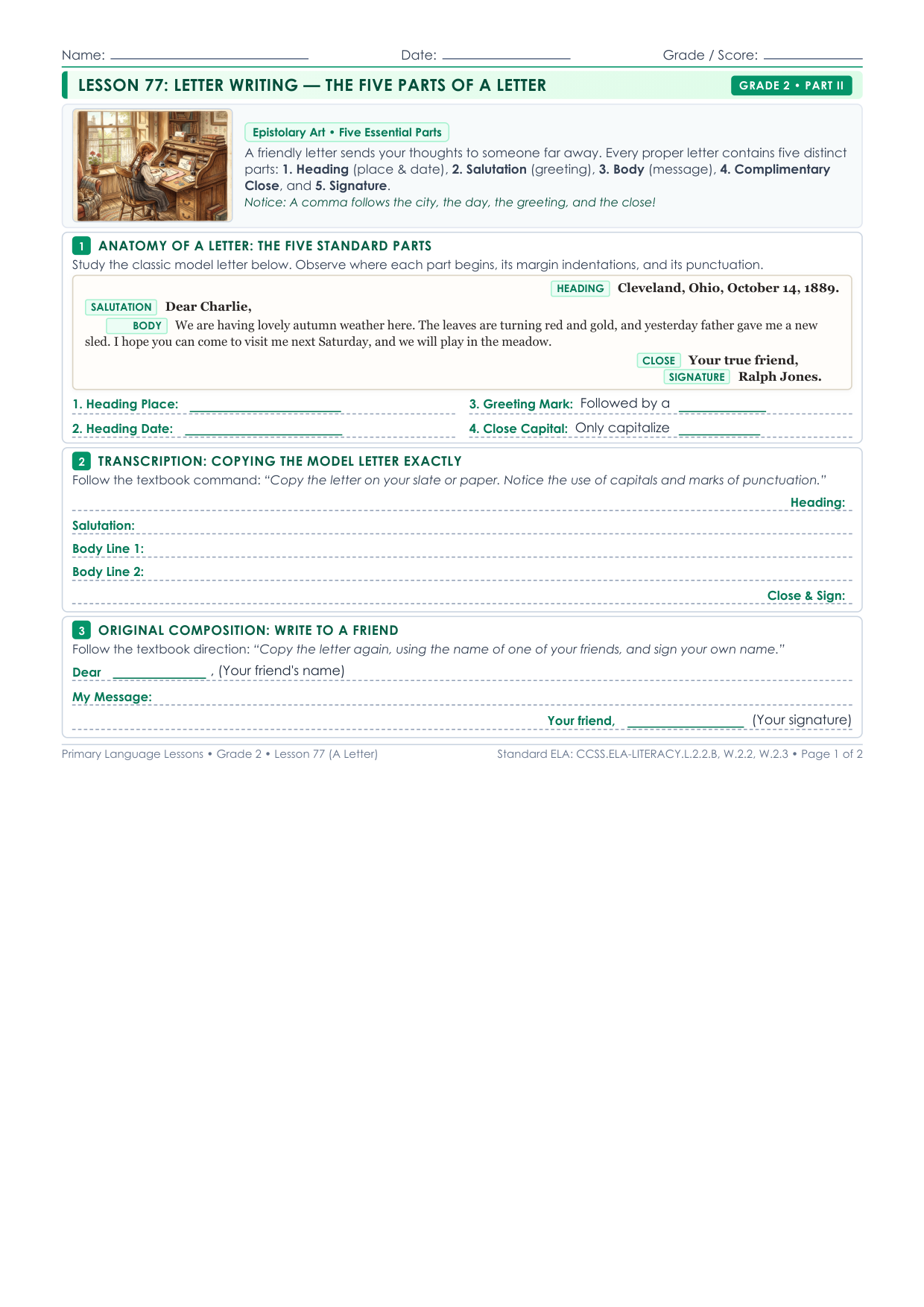
Grade 2 • Lesson 77: Letter Writing — The Five Parts of a Letter
Master the anatomy of a friendly letter: explore the five parts (heading, salutation, body, complimentary close, signature), transcribe a classic model letter with exact coordinates, and compose an original invitation.
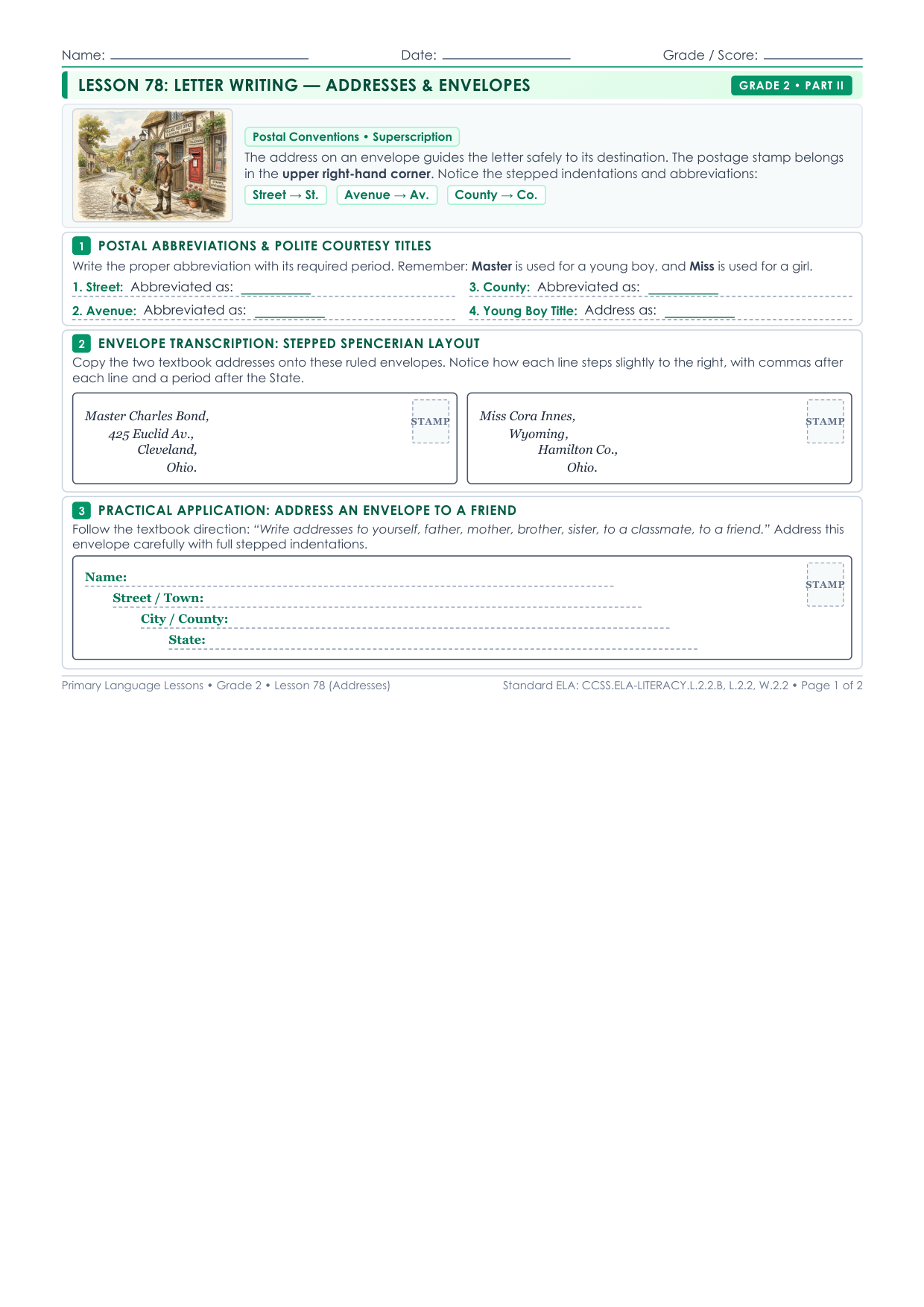
Grade 2 • Lesson 78: Letter Writing — Addresses & Envelopes
Learn the art of envelope superscription: master postal abbreviations (St., Av., Co.), courtesy titles (Master, Miss), diagonal stepped Spencerian indentations, stamp placement, and address your own envelope.
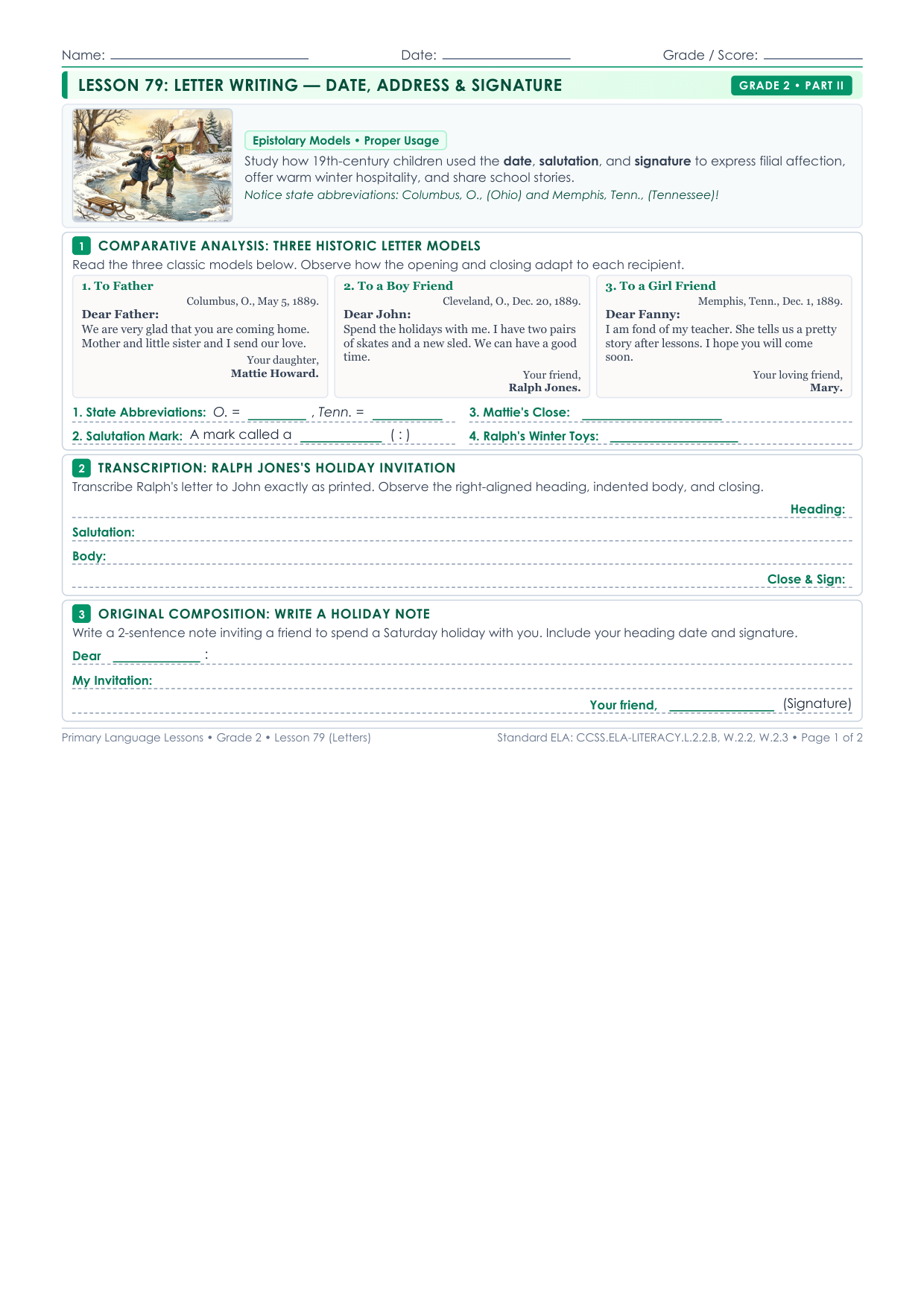
Grade 2 • Lesson 79: Letters — Date, Address, Signature
Analyze three historical epistolary models (Mattie Howard, Ralph Jones, and Mary): master heading mechanics, state abbreviations, salutations with colons, and nuanced closings for family versus friends.
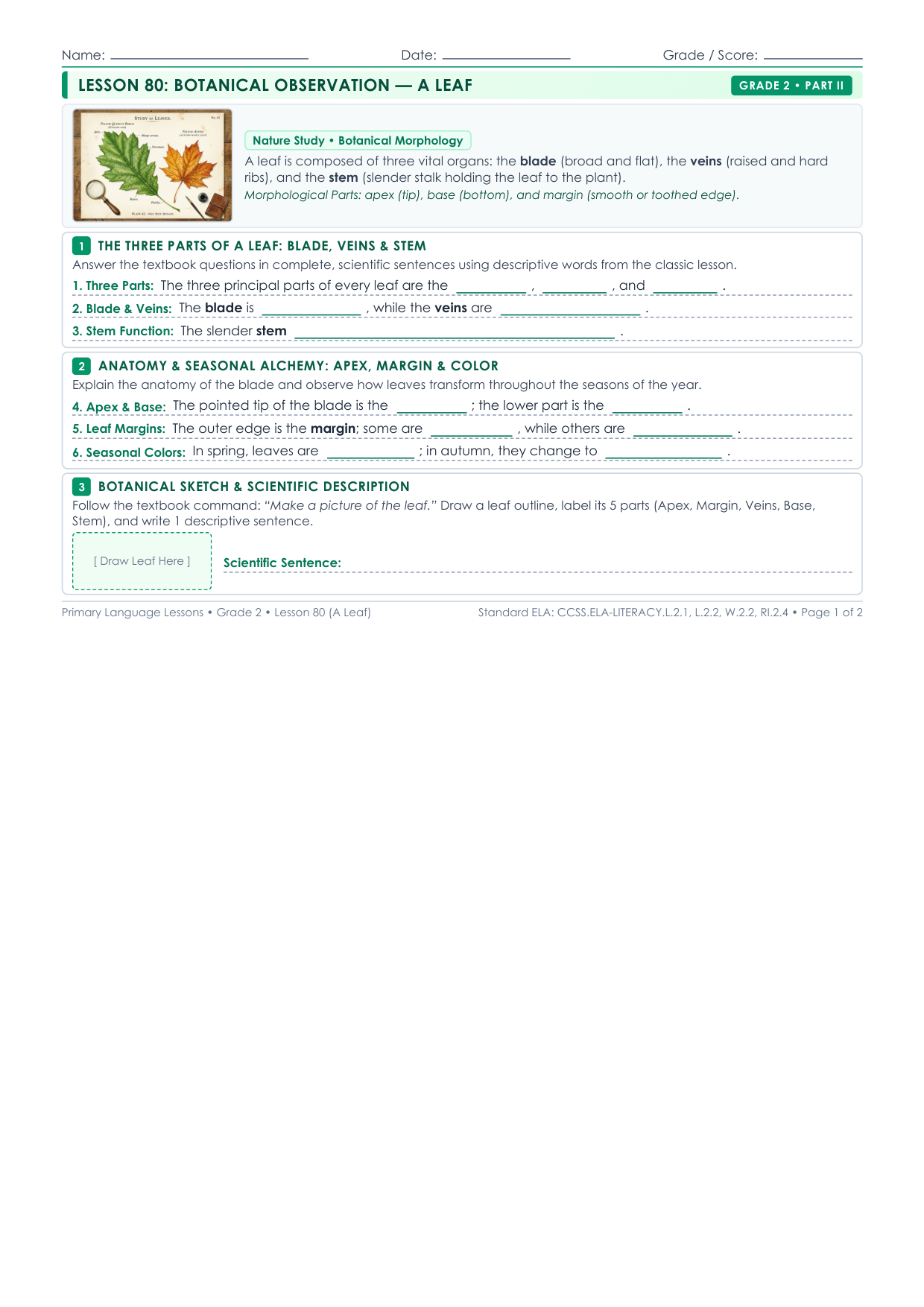
Grade 2 • Lesson 80: Botanical Study — A Leaf
Investigate real foliage through guided natural science questions: explore blade, veins, petiole, apex, base, and smooth vs. toothed margins, culminating in an illustrated leaf specimen study.
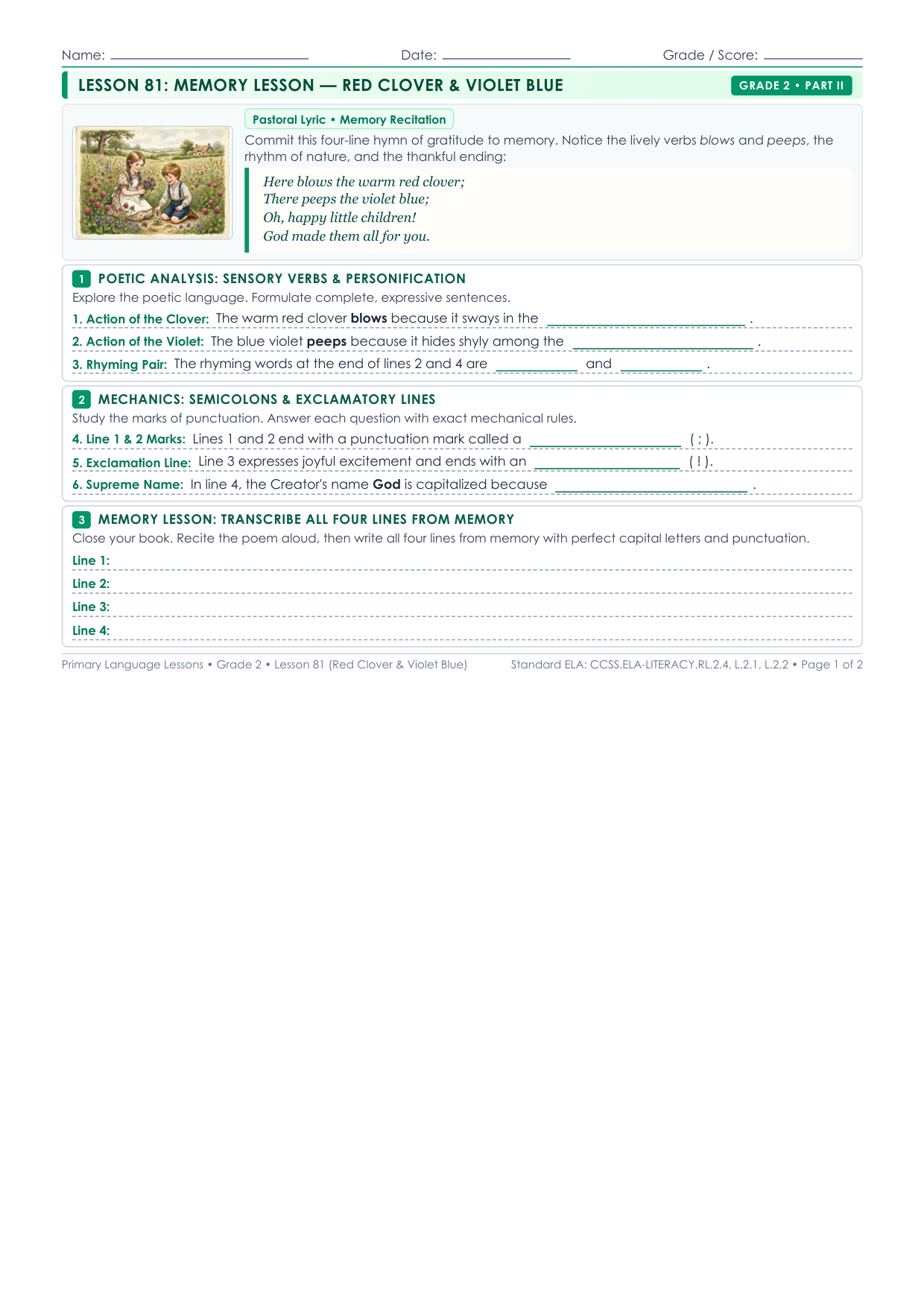
Grade 2 • Lesson 81: Memory Gem — Red Clover
Memorize and transcribe a beloved pastoral poem: analyze personified botanical imagery, punctuation syntax (semicolons, exclamation mark), rhyme scheme, and poetic meaning.
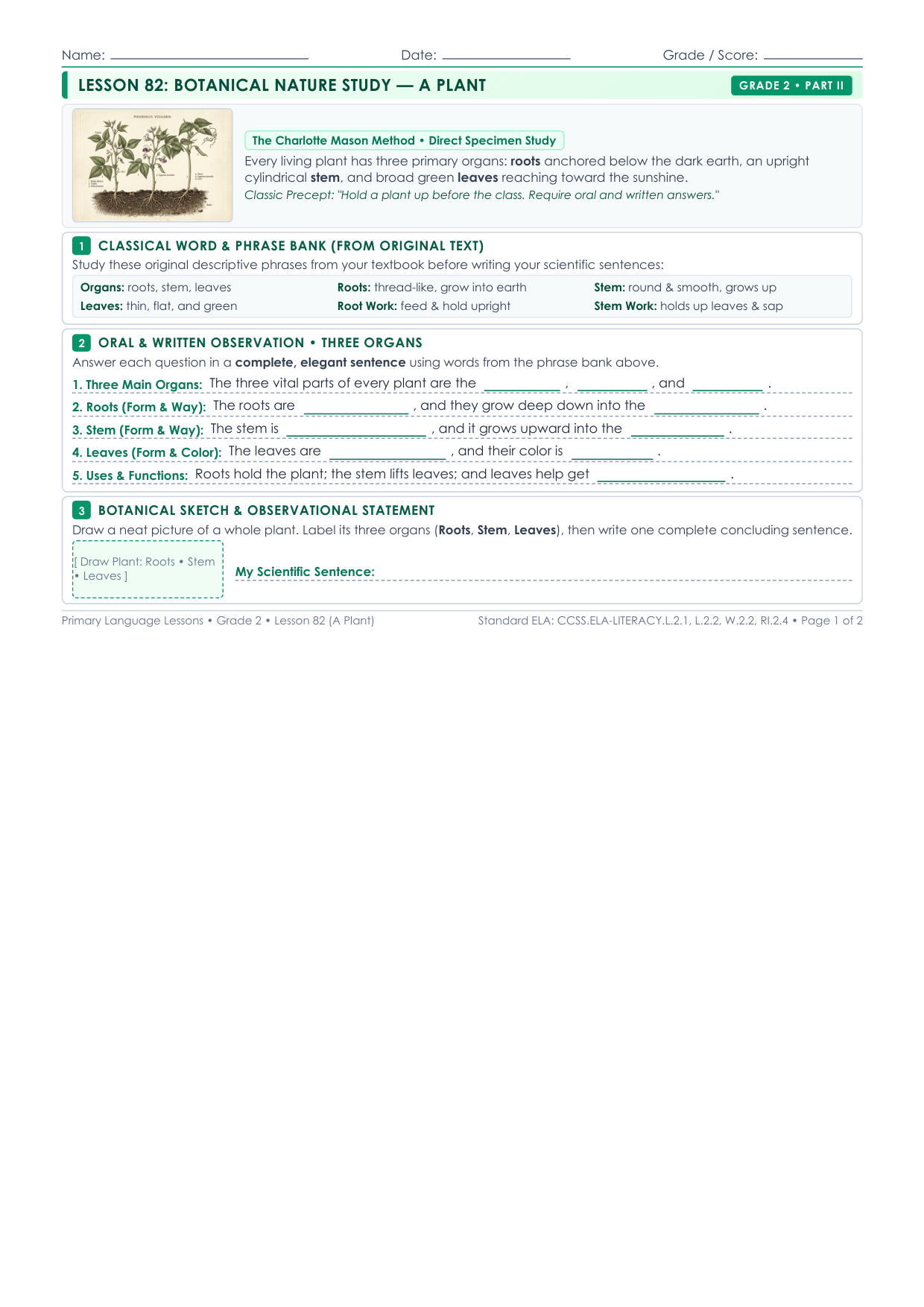
Grade 2 • Lesson 82: Botanical Nature Study — A Plant
Investigate a living plant organism through the Charlotte Mason object lesson method: explore roots, stem, and leaves; understand how structure serves life; and master classical descriptive scientific sentences.
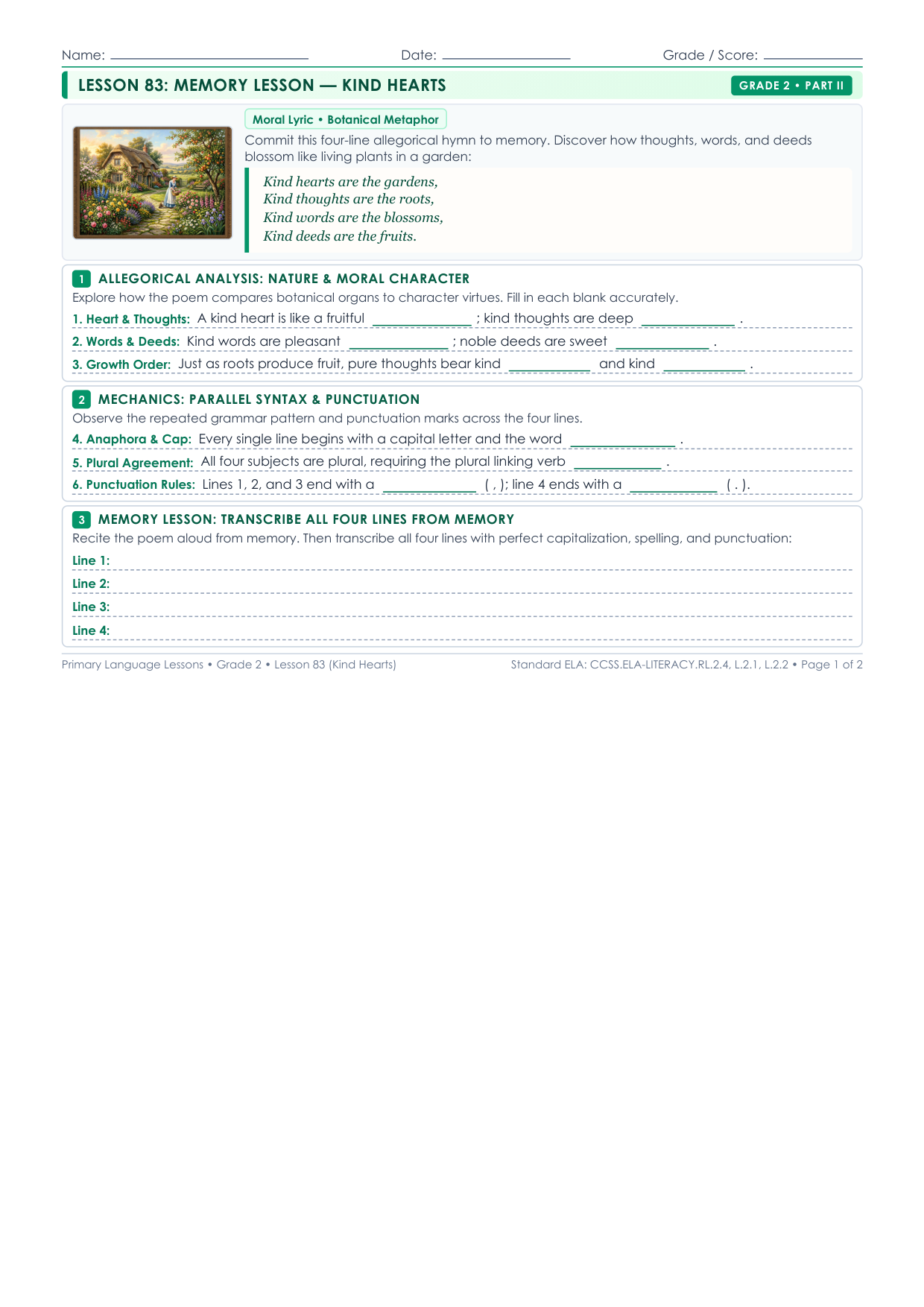
Grade 2 • Lesson 83: Memory Lesson — Kind Hearts
Recite and transcribe the beloved 4-line allegory: connect botanical organs (roots, blossoms, fruits) to character virtues (thoughts, words, deeds), and cultivate kindness through daily action.